

Class 12th
Get insights from 12k questions on Class 12th, answered by students, alumni, and experts. You may also ask and answer any question you like about Class 12th
Follow Ask QuestionQuestions
Discussions
Active Users
Followers
New answer posted
a year agoContributor-Level 10
This is a Short Answer Type Questions as classified in NCERT Exemplar
Explanation – the direction of (B ) will be perpendicular the plane containing B and B by right hand rule. A will lie in the plane of B and C and is perpendicular to vector A.
New answer posted
a year agoContributor-Level 10
This is a Short Answer Type Questions as classified in NCERT Exemplar
Explanation- if the football is kicked into the air vertically upwards. Acceleration of football will always vertically downwards and equal to acceleration due to gravity. But when it reaches the highest point its velocity is zero and acceleration is retarding.

New answer posted
a year agoContributor-Level 10
This is a Short Answer Type Questions as classified in NCERT Exemplar
Explanation- at point B it will gain the same speed u and after that speed increases and will be maximum just before reaching point c.

During journey from O to A speed decreases and will be maximum at point A and acceleration is always constant.
New answer posted
a year ago
Contributor-Level 10
This is a Short Answer Type Questions as classified in NCERT Exemplar
Explanation- vsin = vertical component

Vx= horizontal component of velocity =vcos = constant
Vy = vertical component of velocity =vsin
Velocity will always be tangential to the curve in the direction of motion and acceleration is always vertically downward and is equal to g.
New answer posted
a year agoContributor-Level 10
This is a Short Answer Type Questions as classified in NCERT Exemplar
Explanation- the cyclist covers OPRQO path.
As we know whenever an object performing circular motion, acceleration is called centripetal acceleration and is always directed towards the centre.
so there will be centripetal acceleration a= v2/r
So a= 100/1km= 100/1000=0.1m/s2 along RO.

New answer posted
a year ago
Contributor-Level 10
This is a Long Answer Type Questions as classified in NCERT Exemplar
Explanation – Tsand=
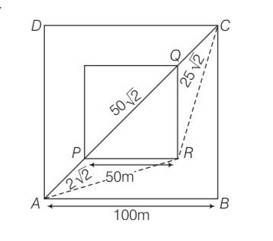
= 50
Time taken Toutside=
AR=
RC= AR=
Toutside= 2AR= 50
Tsand
New answer posted
a year ago
Contributor-Level 10
This is a Long Answer Type Questions as classified in NCERT Exemplar
Explanation – r=cos ?…….1
…….2
Multiplying eq1 by sin and 2 with cos and adding
Rsin
= ?( )=j
= rsin
n(rcos )=i
b)r
= -cos
c)r=cos
dr/dt=d/dt(cos )=w[-cos ]
d)L= MoLT0
e)a=1unit , r=
v= dr/dt=
v=
= w
a=
a=
=
New answer posted
a year agoContributor-Level 10
This is a Long Answer Type Questions as classified in NCERT Exemplar
Explanation- a) for x direction ux= u+vocos

uy=velocity in y direction= v0sin
now tan
b) let t be the time flight y =0 uy=vosin
y= uyt+1/2 ayt2
0= vosin +
So T =
c) horizontal range R, = (u+vocos T= (u+vocos )
d) for range to be maximum dR/d
4vocos2
So cos =
e) cos =
so
f) if u=0 0
New answer posted
a year ago
Contributor-Level 10
This is a Long Answer Type Questions as classified in NCERT Exemplar
Explanation – speed of river Vr= 3m/s
Speed of swimmer Vs= 4m/s
(a) when swimmer starts swimming due north then its resultant velocity
V=
tan so 'N

(b) to reach at point B resultant velocity will be
V=
tan

(c) time taken by swimmer t =d/v= d/4s
in case b time taken by swimmer to cross the river
t1=d/v=d/
so t
New answer posted
a year agoContributor-Level 10
This is a Long Answer Type Questions as classified in NCERT Exemplar
Explanation – Vr= a? +b?
Velocity vg= 5m/s
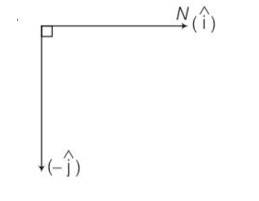
Velocity of rain w.r.t girl = Vr-Vg= a? +b? -5?
= (a-5)? +b?
a-5=0, a=5
case II
vg = 10m/s?
Vrg= Vr - Vg
= a? +b? -10? = (a-10)? +b?
Rain appear to be fall at 45 degree so = b/a-10 =1
So b =-5
Velocity of rain = a? +b?
Vr = 5? -5?
Speed of rain Vr=
Taking an Exam? Selecting a College?
Get authentic answers from experts, students and alumni that you won't find anywhere else
Sign Up on ShikshaOn Shiksha, get access to
- 67k Colleges
- 1.2k Exams
- 718k Reviews
- 1850k Answers