

Class 12th
Get insights from 12k questions on Class 12th, answered by students, alumni, and experts. You may also ask and answer any question you like about Class 12th
Follow Ask QuestionQuestions
Discussions
Active Users
Followers
New answer posted
a year agoContributor-Level 10
This is a Short Answer Type Questions as classified in NCERT Exemplar
Explanation- according to ohms law
I=

If voltage and resistance increase
V'= nVeff, R'= nReff
I'= =
New answer posted
a year agoContributor-Level 10
This is a Short Answer Type Questions as classified in NCERT Exemplar
Explanation- R= /A
Resistance of first conductor, RA= 2
Resistance of second conductor, RB=
Now ratio = 3:1
New answer posted
a year agoContributor-Level 10
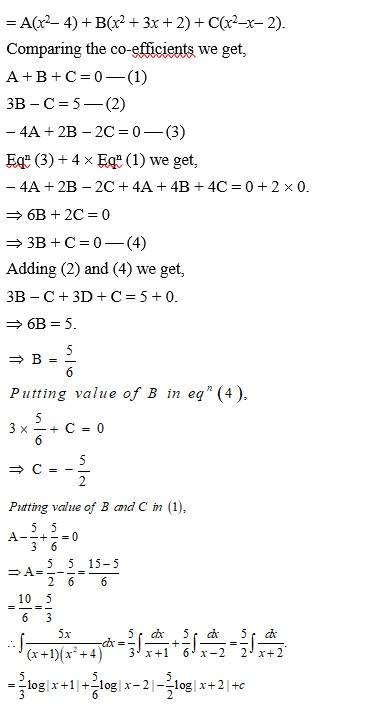
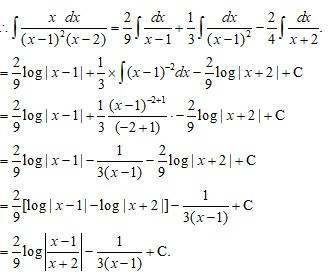
= A(x- 1)(x + 2) + B(x + 2) + C(x- 1)2
= A(x2 + 2x-x- 2) + B(x + 2) + C(x2 + 1 - 2x)
= A(x2 + x- 2) + B(x + 2) + C(x2- 2x + 1)
Comparing the co-efficient we get, A + C = 0 ¾ (1)
A + B - 2C = 1 ¾ (2)
- 2A + 2B + C = 0 ¾ (3)
EQn (3) - 2 ´ enQ. (2),
- 2A + 2B + C (2A + 2B - 4C) = 0 - 2 ´ 1.
=> - 4A + 5C = - 2 ¾ (4)
Eqn (4) + 4 ´ Eqn (1) we get,
- 4A + 5C + 4A + 4C = - 2 + 4 ´ 0
=> 9C = - 2
New answer posted
a year ago
Contributor-Level 10
This is a Short Answer Type Questions as classified in NCERT Exemplar
Explanation- according to ohms law
I=
The potential difference across terminal is
V=e-Ir= E- r1=0
E=
1=
R+r1+r2 = 2r1
R= r1-r2
New answer posted
a year agoContributor-Level 10
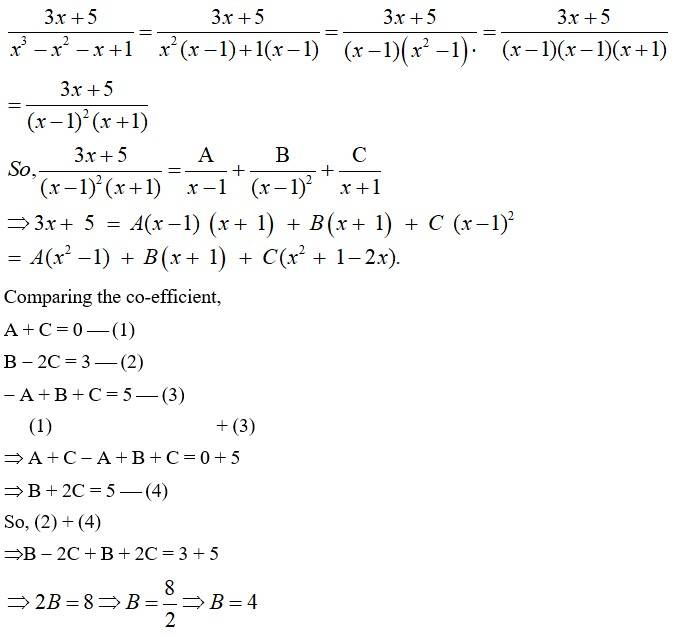
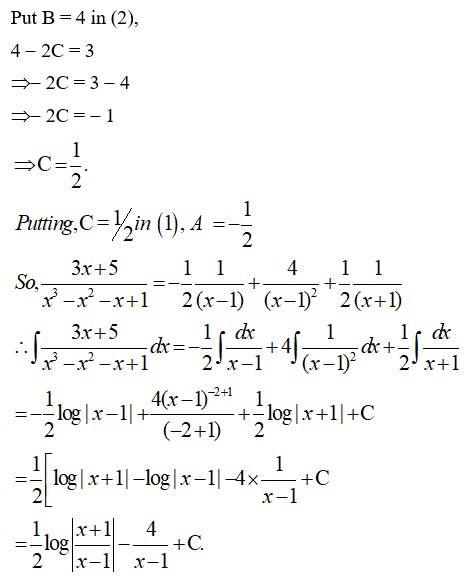
=> x = (Ax + B)(x- 1) + C(x2 + 1)
= Ax2- Ax + Bx- B + Cx2 + C.
Comparing the co-efficients we get,
A + C = 0 ---- (1)
- A + B = 1 ---- (2)
- B + C = 0 ---- (3)
Adding (1) and (2) we get,
A + C - A + B = 0 + 1
=> B + C = 1 --- (4)
Adding (4) + (3) we get,
- B + C + B + C = 0 + 1
=> 2C = 1
And C = B from (3)
So, from Eqn (1),
A = - C
New answer posted
a year agoContributor-Level 10
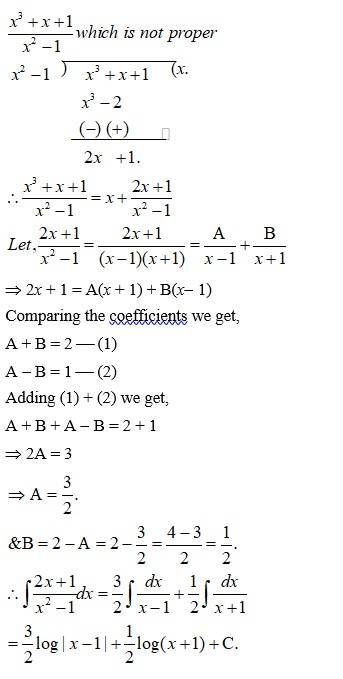
which is not a proper fraction
So, division is missing
=> 2 -x = A(1 - 2x) + B x.
So, - 2A + B = - 1
A = 2.
So, B = - 1 + 2A = - 1 + 2 ´ 2 = - 1 + 4 = 3
Taking an Exam? Selecting a College?
Get authentic answers from experts, students and alumni that you won't find anywhere else
Sign Up on ShikshaOn Shiksha, get access to
- 67k Colleges
- 1.2k Exams
- 718k Reviews
- 1850k Answers