Class 12th

Get insights from 12k questions on Class 12th, answered by students, alumni, and experts. You may also ask and answer any question you like about Class 12th

Follow Ask Question
12k

Questions

0

Discussions

58

Active Users

0

Followers

New answer posted

7 months ago

0 Follower 3 Views

V
Vishal Baghel

Contributor-Level 10

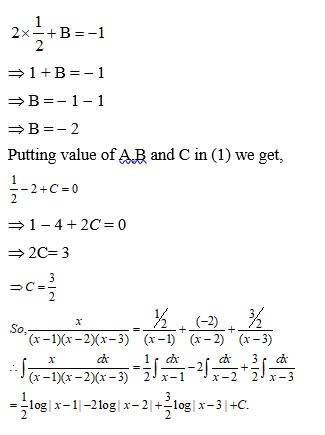
1x2x(12x) which is not a proper fraction

So, division is missing

So,1x2x(12x)=12+(x2+1)x(12x)=12+12(2x)x(12x)Let2xx(12x)=Ax+B(12x)

=> 2 -x = A(1 - 2x) + B x.

   So, - 2A + B = - 1

   A = 2.

   So, B = - 1 + 2A = - 1 + 2 ´ 2 = - 1 + 4 = 3

1 x 2 d x x ( 1 2 x ) = 1 2 d x + 1 2 ( 2 x ) x ( 1 2 x ) d x = x 2 + 1 2 { A x d x + B 1 2 x d x } = x 2 + 1 2 { { 2 x d x + 3 ( 1 2 x ) d x } = x 2 + l o g | x | + 3 2 l o g | 1 2 x | ( 2 ) + c = x 2 + l o g | x | 3 4 l o g | 1 2 x | + c

New answer posted

7 months ago

0 Follower 2 Views

A
alok kumar singh

Contributor-Level 10

This is a Short Answer Type Questions as classified in NCERT Exemplar

Explanation- when all resistance are in parallel

1 R p = 1 R 1 + . . + 1 R n by multiplying this equation by Rmin we have

R m i n R p = R m i n R 1 + . . + R m i n R n

But there exist a term in RHS RminRmin=1 and other terms are positive so we have


R m i n R p = R m i n R 1 + . . + R m i n R n >1

This shows that equivalent resistance is less than maximum resistance available.


But when all resistance are in series

Rs =R1+R2………Rn

here must be Rmax value in RHS

Rs= R1+……Rmax+….Rn

And Rs> Rmax

So equivalent resistance is less than Rmax

New answer posted

7 months ago

0 Follower 2 Views

V
Vishal Baghel

Contributor-Level 10

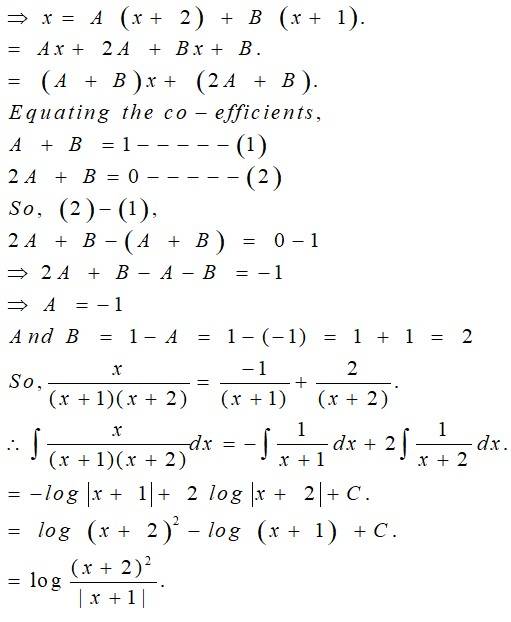
2xx2+3x+2=2x(x+1)(x+2)=A(x+1)+B(x+2)

2x = A(x + 2) + B(x + 1).

= (A + B) x + (2A + B).

Comparing the coefficients we get,

A + B = 2 ---(1)

2A + B = 0 ---- (2).

So, Eqn (2) - (1),

2A + B - (A + B) = 0 - 2

Þ A = - 2

And B = 2 - A = 2 - (-2) = 2 + 2 = 4

B = 4
S o , 2 x ( x + 1 ) ( x + 2 ) = 2 x + 1 + 4 x + 2 . 2 x d x ( x + 1 ) ( x + 2 ) = 2 d x x + 1 + 4 d x x + 2 = 2 l o g | x + 1 | + 4 l o g | x + 2 | + c = 4 l o g | x + 2 | 2 l o g | x + 1 | + c

New answer posted

7 months ago

0 Follower 1 View

V
Vishal Baghel

Contributor-Level 10

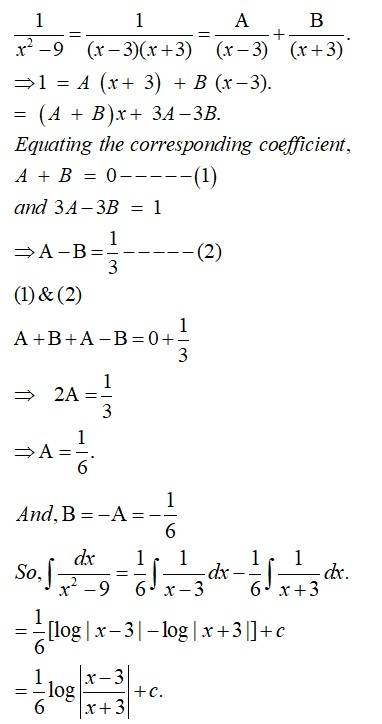
Kindly go through the solution

New answer posted

7 months ago

0 Follower 6 Views

A
alok kumar singh

Contributor-Level 10

This is a Short Answer Type Questions as classified in NCERT Exemplar

Explanation-

 total resistance = 2+8= 10 ohm

I= 6-42+8 = 0.2A

The direction of flow of current is always from high potential to low potential

If VB > VA

VB-4V-0.2 * 8 = VA

VB-VA= 3.6V

New answer posted

7 months ago

0 Follower 2 Views

V
Vishal Baghel

Contributor-Level 10

Kindly go through the solution

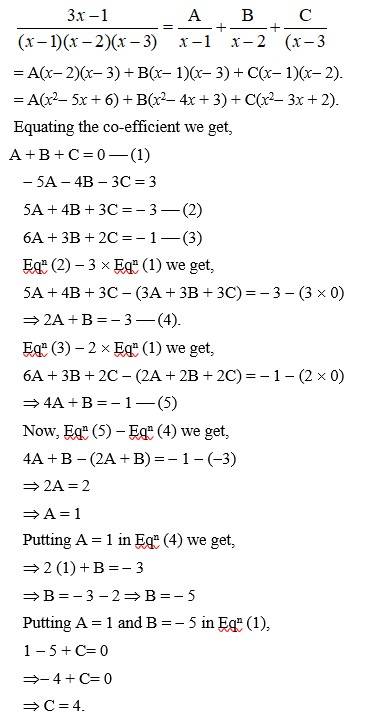
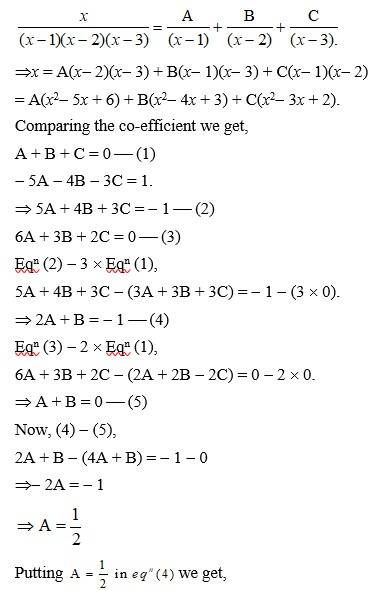
S o , 3 x 1 ( x 1 ) ( x 2 ) ( x 3 ) = 1 ( x 1 ) + ( 5 ) ( x 2 ) + 4 ( x 3 ) T h e n , 3 x 1 d x ( x 1 ) ( x 2 ) ( x 3 ) = d x x 1 5 d x x 2 + 4 d x x 3 . = l o g | x 1 | 5 l o g | x 2 | + 4 l o g | x 3 | + c

New answer posted

7 months ago

0 Follower 1 View

V
Vishal Baghel

Contributor-Level 10

Kindly go through the solution

New answer posted

7 months ago

0 Follower 2 Views

A
alok kumar singh

Contributor-Level 10

This is a Short Answer Type Questions as classified in NCERT Exemplar

Explanation – in series combination of resistors current I =e/R+r

10I= eR+rn

1+n1+1n  10 = ( 1+n1+n )n  n=10

New answer posted

7 months ago

0 Follower 2 Views

V
Vishal Baghel

Contributor-Level 10

Kindly go through the solution

New question posted

7 months ago

0 Follower 6 Views

Get authentic answers from experts, students and alumni that you won't find anywhere else

Sign Up on Shiksha

On Shiksha, get access to

  • 66k Colleges
  • 1.2k Exams
  • 684k Reviews
  • 1800k Answers

Share Your College Life Experience

×
×

This website uses Cookies and related technologies for the site to function correctly and securely, improve & personalise your browsing experience, analyse traffic, and support our marketing efforts and serve the Core Purpose. By continuing to browse the site, you agree to Privacy Policy and Cookie Policy.