 / Preparation Physics NCERT Exemplar Solutions Class 12th Chapter Three
Shiksha's experts have developed NCERT Exemplar Solutions Class 12 Chapter Three Current Electricity for Class 12 students who are preparing for their CBSE Board examination. Students who will prepare from this exemplar will have a deeper understanding of the theoretical concepts of the Current Electricity NCERT and will also develop problem-solving skills. The solutions given in the exemplar cover all types of questions, including short answer, long answer, and multiple choice, with detailed explanations.
Class 12 Chapter Three Current Electricity exemplar is an excellent resource for CBSE Board exam preparation and also for entrance exam preparation, such as JEE and NEET. Students will also get the Current Electricity Class 12 NCERT PDF here, which they can download and study offline from anywhere and at any time. The PDF has well-structured questions that cover all the important topics of the Current Electricity Class 12 NCERT.
Chapter Three Current Electricity is one of the most fundamental chapters of Class 12. It includes the study of electric charges in motion and explores various concepts like resistance, Ohm's law, electric current, resistivity, and the combination of resistors. It also covers the most advanced topics such as electromotive force (emf), internal resistance of cells, and Kirchhoff's laws.
Also read:
- Common Mistakes and Tips for NCERT Physics Exemplar Chapter Three
- Important Formulas Related to Physics Chapter Three NCERT Exemplar
- Current Electricity Questions and Answers
- Chapters List
- Current Electricity Short Answer Type Questions
- Current Electricity Multiple Choice Questions
- 24th June 2022 (Second Shift)
- JEE Mains Solutions 2022,28th june , Physics ,Second shift


Common Mistakes and Tips for NCERT Physics Exemplar Chapter Three
There are some common mistakes the students make while solving questions related to Current Electricity. The following are these common mistakes:
- Many students incorrectly use Ohm's law. They apply this law without considering whether the material is ohmic or non-ohmic.
- There is confusion between Terminal Voltage and electromotive force (EMF).
- In Kirchhoff's laws, the students make sign convention errors. They frequently misuse the positive/negative for voltage or current direction.
- They make incorrect identification of series and parallel arrangements of resistors, which results in wrong calculations of equivalent resistance.
- Students also sometimes don't convert all quantities to SI units. It results in wrong final answers.
- They use the wrong formula for electric power depending on what's given. The formula for electric power is
Following are some of the tips to solve the NCERT Exemplar Questions on Current Electricity and avoid these common mistakes:
- Before attempting the advanced problems of Chapter Three, try to understand the basic principles such as voltage, resistance, current, and resistivity.
- Practice drawing and simplifying circuits of the Current Electricity NCERT. Label all currents, resistances, and voltages to avoid any confusion.
- Use Kirchhoff’s rules systematically by applying the KVL and KCL step-by-step. Even if you later find the assumed direction is negative, always assign the current direction consistently.
- To find whether your answer has correct physical units, use dimensional analysis.
- Revise key formulas like resistance combinations, Ohm's Law, and power equations frequently, and keep a formula sheet handy.
- Practice from Chapter Three NCERT Exemplars to be ready for the JEE and NEET examinations. Many of the questions from this chapter are important from an entrance exam point of view. It provides exam-ready preparation.
- It is also recommended to practice 2-3 numerical problems daily and focus on the power calculations and resistive networks.
Related Links
| NCERT Class 11 Notes | Class 11 Physics Notes | NCERT Class 12 Physics Notes for CBSE |
| NCERT Class 12 Notes | NCERT Notes for Class 11 & 12 | NCERT Solutions Class 11 and 12 |
Important Formulas Related to Physics Chapter Three NCERT Exemplar
The following are the important formulas related to Class 12 Physics Chapter 3:
Ohm’s Law
Resistance of a Conductor
Current
Ohm’s Law in Terms of Resistivity
Electric Power
Work Done by Current
Resistors in Series
Resistors in Parallel
Kirchhoff’s Current Law
Kirchhoff’s Voltage Law
Terminal Voltage of a Cell
Resistivity and Temperature Relation
Current Electricity Questions and Answers
| 1. A room AC runs for 5 a day at a voltage of 220 V. The wiring of the room consists of Cu of 1 mm radius and a length of 10 m. Power consumption per day is 10 commercial units. What fraction of it goes in the joule heating in wires? What would happen if the wiring is made of aluminium of the same dimensions? 
|
| 2. In an experiment with a potentiometer, VB = 10 V. R is adjusted to be 50 Ω (figure). A student wanting to measure voltage E1of a battery (approx. 8 V) finds no null point possible. He then diminishes R to 10 Ω and is able to locate the null point on the-last (4th) segment of the potentiometer. Find the resistance of the potentiometer wire and potential drop per unit length across the wire in the second case. 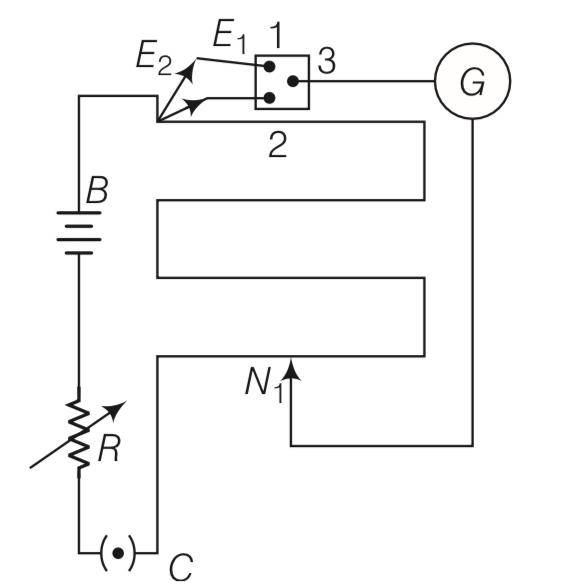
|
| Explanation – let R’ be the resistance of potentiometer wire. Effective resistance of potentiomter and variable resistor r=50ohm is 500+R’ Effective voltage across potentiometer = 10V The current through main circuit I= = Potential difference across wire of potentiometer IR’= Since with 50 ohm resistor , null point is not obtained it is possible when
10R’ 2R’<400 or R’<200 ohm Similarly with 10 ohm resistor , null point is obtained its is only possible when
2R’>40 R’>40
7.5R’<80+8R’ R’>160 160
Any R’ between 160 ohm and 200 ohm will achieve. Since the null point on the last 4th segment of the potentiometer , therefore potential drop across 400cm of wire >8V Potential gradient K K×4m>8V K>2V/m Similarly potential drop across 300 cm wire <8V k×3m<8V, K<2×2/3V/m 2×2/3V/m>k>2V/m |
| 3. (a) Consider circuit in Fig 3.10. How much energy is absorbed by electrons from the initial state of no current (ignore thermal motion) to the state of drift velocity? (b) Electrons give up energy at the rate of RI2 per second to the thermal energy. What time scale would one associate with energy in problem (a)? n = no of electron/volume = 1029/m3, length of circuit = 10 cm, cross-section = A = (1mm)2 |
| Explanation- according to ohm’s law V= IR I= 6/6 = 1A I= AneVd or Vd= i/neA 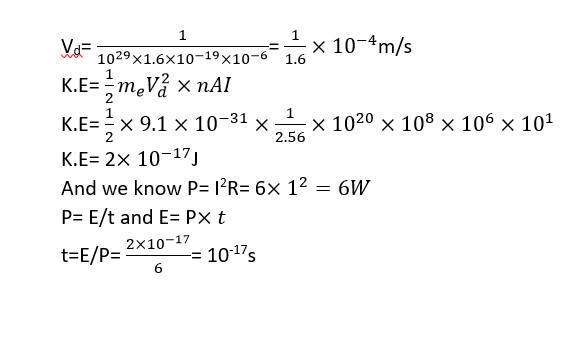
|
| 4. Two cells of voltage 10 V and 2 V, and internal resistances 10 Ω and 5 Ω respectively, are connected in parallel with the positive end of 10 V battery connected to negative pole of 2 V battery (figure). Find the effective voltage and effective resistance of the combination. 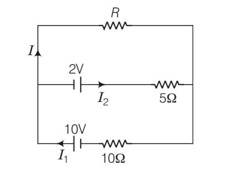
|
| Explanation- applying kirchhoff’s junction rule I1 = I+I2 Applying kirchhoff’s rule in outer loop containing 10V cell 10= IR+10I1……………..(1) Applying kirchhoff’s rule in outer loop containing 2V cell 2= 5I2-RI= 5(I1-I)-RI 4= 10I1-10I-RI…………(2) From 1 and 2 6=3RI+10I 2=I(R+10/3) V= I(R+Reff) After comparing V=2V, Reff= 10/3 ohm Since effective internal resistance Reff of two cells 10/3 ohm , being the parallel combination 5 ohm and 10 ohm . the equivalent circuit is 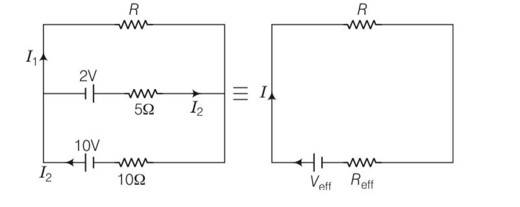
|

Commonly asked questions
The circuit in figure shows two cells connected in opposition to each other. Cell E1is of emf 6 V and internal resistance 2 Ω; the cell E2 is of emf 4 V and internal resistance 8 Ω. Find the potential difference between the points A and B.

This is a Short Answer Type Questions as classified in NCERT Exemplar
Explanation-

total resistance = 2+8= 10 ohm
I= = 0.2A
The direction of flow of current is always from high potential to low potential
If VB VA
VB-4V-0.2 8 = VA
VB-VA= 3.6V
In an experiment with a potentiometer, VB = 10 V. R is adjusted to be 50 Ω (figure). A student wanting to measure voltage E1of a battery (approx. 8 V) finds no null point possible. He then diminishes R to 10 Ω and is able to locate the null point on the-last (4th) segment of the potentiometer. Find the resistance of the potentiometer wire and potential drop per unit length across the wire in the second case.

This is a Long Answer Type Questions as classified in NCERT Exemplar
Explanation – let R' be the resistance of potentiometer wire.
Effective resistance of potentiomter and variable resistor r=50ohm is 500+R'
Effective voltage across potentiometer = 10V
The current through main circuit I= =
Potential difference across wire of potentiometer
IR'=
Since with 50 ohm resistor, null point is not obtained it is possible when
10R'
2R'<400 or R'<200 ohm
Similarly with 10 ohm resistor, null point is obtained its is only possible when
2R'>40
R'>40
7.5R'<80+8R'
R'>160
160
Any R' between 160 ohm and 200 ohm will achieve.
Since the null point on the last 4th segment of the potentiometer, therefore potential drop across 400cm of wire >8V
Potential gradient K
K*4m>8V
K>2V/m
Similarly potential drop across 300 cm wire <8V
k*3m<8V, K<2*2/3V/m
2*2/3V/m>k>2V/m
A room AC runs for 5 a day at a voltage of 220 V. The wiring of the room consists of Cu of 1 mm radius and a length of 10 m. Power consumption per day is 10 commercial units. What fraction of it goes in the joule heating in wires? What would happen if the wiring is made of aluminium of the same dimensions?
This is a Long Answer Type Questions as classified in NCERT Exemplar
Explanation – power consumption in a day i.e in 5 = 10 units
Power consumption per hour = 2 units
Power consumption = 2 units =2KW= 2000J/s
Also power =V I
2000W= 220V l or l= 9A approx.
R=
Power consumption in first current carrying wire
P= I2R
l2= 1.7 10-8 j/s = 4J/s approx.
Loss due to joule heating in first wire = 100=0.2%
Power loss in Al wire =1.6 4= 6.4J/s
Fractional loss due to joule heating in second wire = 100= 0.32%
(a) Consider circuit in Fig 3.10. How much energy is absorbed by electrons from the initial state of no current (ignore thermal motion) to the state of drift velocity?
(b) Electrons give up energy at the rate of RI2 per second to the thermal energy. What time scale would one associate with energy in problem (a)? n = no of electron/volume = 1029/m3, length of circuit = 10 cm, cross-section = A = (1mm)2
This is a Long Answer Type Questions as classified in NCERT Exemplar
Explanation- according to ohm's law V= IR
I= 6/6 = 1A
I= AneVd or Vd= i/neA

Two cells of voltage 10 V and 2 V, and internal resistances 10 Ω and 5 Ω respectively, are connected in parallel with the positive end of 10 V battery connected to negative pole of 2 V battery (figure). Find the effective voltage and effective resistance of the combination.

This is a Long Answer Type Questions as classified in NCERT Exemplar
Explanation- applying kirchhoff's junction rule I1 = I+I2
Applying kirchhoff's rule in outer loop containing 10V cell
10= IR+10I1……………. (1)
Applying kirchhoff's rule in outer loop containing 2V cell
2= 5I2-RI= 5 (I1-I)-RI
4= 10I1-10I-RI………… (2)
From 1 and 2
6=3RI+10I
2=I (R+10/3)
V= I (R+Reff)
After comparing V=2V, Reff= 10/3 ohm
Since effective internal resistance Reff of two cells 10/3 ohm, being the parallel combination 5 ohm and 10 ohm . the equivalent circuit is
Is the motion of a charge across junction momentum conserving? Why or why not?
This is a Short Answer Type Questions as classified in NCERT Exemplar
Explanation – In the circuit when an electron approaches a junction, in addition to the uniform E that faces it normally (which keep the drift velocity fixed), as drift velocity (vd) is directly proportional to Electric field (E). That's why there are accumulation of charges on the surface of wires at the junction.
These produce additional electric fields. These fields alter the direction of momentum. Thus, the motion of a charge across junction is not momentum conserving
The relaxation time T is nearly independent of applied field E whereas it changes significantly with temperature T. First fact is (in part) responsible for Ohm’s law whereas the second fact leads to variation of p with temperature. Elaborate why?
This is a Short Answer Type Questions as classified in NCERT Exemplar
Explanation- relaxation time =mean free path/rms velocity of electron
Also = = relaxation time is inversely proportional to velocities
What are the advantages of the null-point method in a Wheatstone bridge? What additional measurements would be required to calculate R unknown by any other method?
This is a Short Answer Type Questions as classified in NCERT Exemplar
Explanation- In a Wheatstone bridge the main advantage of null point method is that the resistance of galvanometer does not affect the balance point, there is no need to determine current in resistances and the internal resistance of a galvanometer. It is convenient and easy method for observer.
The R unknown can calculated applying Kirchhoff's rules to the circuit. We would need additional accurate measurement of all the currents in resistances and galvanometer and internal resistance of the galvanometer.
The necessary and sufficient condition for balanced Wheatstone bridge is P/Q = R/S where P and Q are ratio arms and R is known resistance and S is unknown resistance.
What is the advantage of using thick metallic strips to join wires in a potentiometer?
This is a Short Answer Type Questions as classified in NCERT Exemplar
Explanation- Metallic strips have negligible resistance and need not to be counted in the length l1, of the null point of potentiometer. That's why the thick metallic strips are used in potentiometer. It is for the convenience of experimenter as he measures only their lengths along the straight segments each of lengths 1 m.
For wiring in the home, one uses Cu wires or Al wires. What considerations are involved in this?
This is a Short Answer Type Questions as classified in NCERT Exemplar
Explanation- For the selection of metal for wiring in home the main criterion are: the availability, conductivity and the cost of the metal. The Cu wires or Al wires are used for wiring in the home. The main considerations are involved in this process are cost of metal and good conductivity of metal.
Why are alloys used for making standard resistance coils?
This is a Short Answer Type Questions as classified in NCERT Exemplar
Explanation- Alloys are used for making standard resistance coil because they have low temperature coefficient of resistance with less temperature sensitivity. The alloys also have high resistivity and hence high resistance, because for given length and cross-section area of conductor .
Power P is to be delivered to a device via transmission cables having resistance Rc. If V is the voltage across R and I the current through it, find the power wasted and how can it be reduced.
This is a Short Answer Type Questions as classified in NCERT Exemplar
Explanation – power consumed through wire is P=V2/R =I2R . for transmitting the power there are two types either current is large or voltage is less or vice versa. But when current in the circuit is higher then power loss is also higher . so we transmit the power through high voltage circuits.
AB is a potentiometer wire (figure). If the value of R is increased, in which direction will the balance point J shift?

This is a Short Answer Type Questions as classified in NCERT Exemplar
Explanation- If the value of R is increased, the current through the wire will decrease which in turn decreases the potential difference across AB, and hence potential gradient (k) across AB decreases.
Since, at neutral point, for given emf of cell, l increases as potential gradient (k) across AB has decreased because E' = kl
Thus, with the increase of l, which will result in increase in balance length. So, jockey J will shift towards B
While doing an experiment with potentiometer (figure) it was found that the deflection is one sided and (i) the deflection decreased while moving from one end A of the wire, to the end R; (ii) the deflection increased, while the jockey was moved towards the end D.

(i) Which terminal positive or negative of the cell E1 is connected at X in case (i) and how is E1 related to E?
(ii) Which terminal of the cell E1 is connected at X in case (ii)?
This is a Short Answer Type Questions as classified in NCERT Exemplar
Explanation- If the current in auxiliary circuit (lower circuit containing primary cell) decreases, and potential difference across A and jockey/increases. Then deflection in galvanometer is one sided and the deflection decreased, while moving from one end 'A ' of the wire to the end 'S'.
And clearly this is possible only when positive terminal of the cell E1 is connected at X and E1>E.
(ii) If the current in auxiliary circuit increases, and potential difference across A and jockey J increases. Then also deflection in galvanometer shows one sided deflection.
And this is possible only when negative terminal of the cell E1 is connected at X
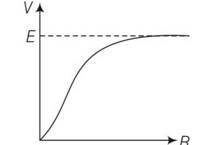
A cell of emf E and internal resistance r is connected across an external resistance R. Plot a graph showing the variation of potential difference across R, versus R.
This is a Short Answer Type Questions as classified in NCERT Exemplar
Explanation- according to the relation V=e-Ir and I=e/r+R
The graphical relation between voltage and resistance.
First a set of n equal resistors of R each are connected in series to a battery of emf E and internal resistance R. A current / is observed to flow. Then, the n resistors are connected in parallel to the same battery. It is observed that the current is increased 10 times. What is V?
This is a Short Answer Type Questions as classified in NCERT Exemplar
Explanation – in series combination of resistors current I =e/R+r
10I=
10 = ( )n n=10
Let there be n resistors R1 . . . 𝑅 𝑛 with 𝑅 max = max ( R1 . . . . 𝑅 ) and R min = min { R1 . . . R n }. Show that when they are connected in parallel the resultant resistance R p = R min 𝑅 𝑝 = 𝑅 min and when they are connected in series, the resultant resistance Rs > Rmax . Interpret the result physically.
This is a Short Answer Type Questions as classified in NCERT Exemplar
Explanation- when all resistance are in parallel
by multiplying this equation by Rmin we have
But there exist a term in RHS and other terms are positive so we have
>1
This shows that equivalent resistance is less than maximum resistance available.
But when all resistance are in series
Rs =R1+R2………Rn
here must be Rmax value in RHS
Rs= R1+……Rmax+…..Rn
And Rs> Rmax
So equivalent resistance is less than Rmax
Two cells of same emf E but internal resistance r1 and r2 are connected in series to an external resistor R (figure). What should be the value of R so that the potential difference across the terminals of the first cell becomes zero?

This is a Short Answer Type Questions as classified in NCERT Exemplar
Explanation- according to ohms law
I=
The potential difference across terminal is
V=e-Ir= E- r1=0
E=
1=
R+r1+r2 = 2r1
R= r1-r2
Two conductors are made of the same material and have the same length. Conductor A is a solid wire of diameter 1 mm. Conductor B is a hollow tube of outer diameter 2 mm and inner diameter 1 mm. Find the ratio of resistance RA to RB
This is a Short Answer Type Questions as classified in NCERT Exemplar
Explanation- R= /A
Resistance of first conductor, RA= 2
Resistance of second conductor, RB=
Now ratio = 3:1
Suppose there is a circuit consisting of only resistances and batteries. Suppose one is to double (or increase it to n-times) all voltages and all. resistances. Show that currents are unaltered. Do this for circuit of Examples 3, 7 in the NCERT Text Book for Class XII.
This is a Short Answer Type Questions as classified in NCERT Exemplar
Explanation- according to ohms law
I=

If voltage and resistance increase
V'= nVeff, R'= nReff
I'= =
Consider a current carrying wire (current 7) in the shape of a circle. Note that as the current progresses along the wire, the direction of j (current density) changes in an exact manner, while the current I remain unaffected. The agent that is essentially responsible for is
(a) Source of emf
(b) Electric field produced by charges accumulated on the surface of wire
(c) The charges just behind a given segment of wire which push them just the right way by repulsion
(d) The charges ahead.
This is a Multiple Choice Questions as classified in NCERT Exemplar
Answer- (b)
Explanation- as we know that J=E, and current density is directly proportional to electric field, so electric field produced by charges accumulated on the surface of wire.
Two batteries of emf e1 and e2 (e2>e1) and internal resistance r1 and r2 respectively are connected in parallel as shown in fig
(a) Two equivalent emf eeq of the cells is between e1 and e2 i.e. e1
(b) The equivalent emf eeq is samller than e1
(c) The eeq is given by eeq=e1+e2 always
(d) Eeq is independent of internal resistance r1 and r2
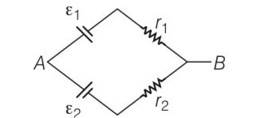
This is a Multiple Choice Questions as classified in NCERT Exemplar
Answer- (a)
Explanation- eeq=
A resistance R is to be measured using a meter bridge, a student chooses the standard resistance S to be 100 Ω He finds the null point at l1= 2.9 cm. He is told to attempt to improve the accuracy. Which of the following is a useful way?
(a) He should measure l1, more accurately
(b) He should change S to 1000 ? and repeat the experiment
(c) He should change S to 3 ? and repeat the experiment
(d) He should have given up hope of a more accurate measurement with a meter bridge.
This is a Multiple Choice Questions as classified in NCERT Exemplar
Answer – (c)
Explanation – R/S= (l1/100-l1)= 100 (2.9/100-2.9)= 100/97.1=2.98ohm
So he should change S to almost 3 ohm and repeat the experiment.
Two cells of emfs approximately 5 V and 10 V are to be accurately compared using a potentiometer of length 400 cm.4.
(a) The battery that runs the potentiometer should have voltage of 8 V.
(b) The battery of potentiometer can have a voltage of 15 V and R adjusted so that the potential drop across the wire slightly exceeds 10 V.
(c) The first portion of 50 cm of wire itself should have a potential drop of 10 V.
(d) Potentiometer is usually used for comparing resistances and not voltages.
This is a Multiple Choice Questions as classified in NCERT Exemplar
Answer- (b)
Explanation-The potential drop along the wires of potentiometer should be greater than emfs of cells.
In a potentiometer experiment, the emf of a cell can be measured if the potential drop along the potentiometer wire is more than the emf of the cell to be determined. Here, values of emfs of two cells are given as 5 V and 10 V, therefore, the potential drop along the potentiometer wire must be more than 10 V.
A metal rod of length 10 cm and a rectangular cross-section of 1 cm x 1/2 cm is connected to a battery across opposite faces. The resistance will be
(a) Maximum when the battery is connected across 1 cm x 1/2 cm faces
(b) Maximum when the battery is connected across 10 cm x 1 cm faces
(c) Maximum when the battery is connected across 10 cm x 1/2 cm faces
(d) Same irrespective of the three faces
This is a Multiple Choice Questions as classified in NCERT Exemplar
Answer- (a)
Explanation- R= for greater value of R, A should be less and its possible value when connected across 1cm 1/2cm faces.
Which of the following characteristics of electrons determines the current in a conductor?
(a) Drift velocity alone
(b) Thermal velocity alone
(c) Both drift velocity and thermal velocity
(d) Neither drift nor thermal velocity
This is a Multiple Choice Questions as classified in NCERT Exemplar
Answer- (a)
Explanation- I=AneVd , current is directly proportional to drift velocity.
Kirchhoff’s junction rule is a reflection of
(a) Conservation of current density vector.
(b) Conservation of charge.
(c) The fact that the momentum with which a charged particle approaches a junction is unchanged (as a vector) as the charged particle leaves the junction.
(d) The fact that there is no accumulation of charges at a junction.
This is a Multiple Choice Questions as classified in NCERT Exemplar
Answer – (b, d)
Explanation-Algebraic sum of the currents flowing towards any point in an electric network is zero. It also tell us about the conservation of charge.
Consider a simple circuit shown in figure stands for a variable resistance R’. R’ can vary from R0to infinity, r is internal resistance of the battery (r <
(b) Current through R’ is nearly a constant as R’ is varied.
(c) Current I depends sensitively on R’
(d) I ≥ V/r + R always;

This is a Multiple Choice Questions as classified in NCERT Exemplar
Answer – (a, d)
Explanation- potential drop across AB is independent to R' also when we decrease the value of R the current will also very large. According to the relation I=e/R+r
Temperature dependence of resistivity ρ(T) of semiconductors, insulators and metals is significantly based on the following factors:
(a) Number of charge carriers can change with temperature T.
(b) Time interval between two successive collisions can depend on T.
(c) Length of material can be a function of T.
(d) Mass of carriers is a function of T.
This is a Multiple Choice Questions as classified in NCERT Exemplar
Explanation- according to the relation = also T
The measurement of an unknown resistance R is to be carried out using Wheatstone bridge as given in the figure. Two students perform an experiment in two ways. The first student takes R2= 10 Ω and R1 = 5 Ω. The other student takes R2 = 1000 Ω, and R1 = 500 Ω. In the standard arm, both take R3 = 5 Ω.
Both find R = R2/R1, R3 = 100 Ω within errors.
(a) The errors of measurement of the two students are the same
(b) Errors of measurement do depend on the accuracy with which R2 and R1 can be measured
(c) If the student uses large values of R2 and R1, the currents through the arms will be feeble. This will make determination of null point accurately more difficult.
(d) Wheatstone bridge is a very accurate instrument and has no errors of measurementAnswer – (b,c)
Answer – (b, c)
Explanation – According to the relation that p/q=r/s if galvanometer shows no deflection. In the above equation the value of R4 depends upon R1 and R2 . if the value of R1 and R2 will be feeble the value of R4 would be affected.

In a meter bridge, the point D is a neutral point (figure).
(a) The meter bridge can have no other neutral. A point for this set of resistances.
(b) When the jockey contacts a point on meter wire left of D, current flows to B from the wire
(c) When the jockey contacts a point on the meter wire to the right of D, current flows from B to the wire through galvanometer
(d) When R is increased, the neutral point shifts to left

This is a Multiple Choice Questions as classified in NCERT Exemplar
Answer – (a, c)
Explanation- In case of meter bridge, the resistance wire AC is 100 cm long. Varying the position of tapping point B, bridge is balanced. If in balanced position of bridge AB = l, BC = (100 – l) so that Q/P= (100-l)/l. Also P/Q=R/S=>S= (100-l)/l R
When there is no deflection in galvanometer there is no current across the galvanometer, then points B and D are at same potential. That point at which galvanometer shows no deflection is called null point, then potential at B and neutral point D are same. When the jockey contacts a point on the meter wire to the right of D, the potential drop across AD is more than potential drop across AB, which brings the potential of point D less than that of B, hence current flows from B to D in the galvanometer wire.
Chapters List
Current Electricity Short Answer Type Questions
For reinforcing fundamental concepts like internal resistance, Ohm's law, and resistance in series/parallel, practicing such short-answer questions is ideal. They make students solve the numerals quickly and also make them clearer and precise while expressing concise explanations. Regular practice of the short-answer type questions helps students handle time-bound theoretical questions efficiently and gives them confidence in recalling key points.
For understanding the important topics of Class 11 NCERT Solutions Physics, and downloading the free PDFs, read here NCERT Solutions Physics Class 11th.
| 1. Is the motion of a charge across junction momentum conserving? Why or why not? |
| Explanation – In the circuit when an electron approaches a junction, in addition to the uniform E that faces it normally (which keep the drift velocity fixed), as drift velocity (vd) is directly proportional to Electric field (E). That’s why there are accumulation of charges on the surface of wires at the junction. |
| 2. The relaxation time T is nearly independent of applied field E whereas it changes significantly with temperature T. First fact is (in part) responsible for Ohm’s law whereas the second fact leads to variation of p with temperature. Elaborate why? |
| Explanation- relaxation time =mean free path/rms velocity of electron Also = = relaxation time is inversely proportional to velocities |
| 3. What are the advantages of the null-point method in a Wheatstone bridge? What additional measurements would be required to calculate R unknown by any other method? |
| Explanation- In a Wheatstone bridge the main advantage of null point method is that the resistance of galvanometer does not affect the balance point, there is no need to determine current in resistances and the internal resistance of a galvanometer. It is convenient and easy method for observer. The necessary and sufficient condition for balanced Wheatstone bridge is P/Q = R/S where P and Q are ratio arms and R is known resistance and S is unknown resistance. |
| 4. What is the advantage of using thick metallic strips to join wires in a potentiometer? |
| Explanation- Metallic strips have negligible resistance and need not to be counted in the length l1, of the null point of potentiometer. That’s why the thick metallic strips are used in potentiometer. It is for the convenience of experimenter as he measures only their lengths along the straight segments each of lengths 1 m. |
| 5. For wiring in the home, one uses Cu wires or Al wires. What considerations are involved in this? |
| Explanation- For the selection of metal for wiring in home the main criterion are: the availability, conductivity and the cost of the metal. The Cu wires or Al wires are used for wiring in the home. The main considerations are involved in this process are cost of metal and good conductivity of metal. |
| 6. Why are alloys used for making standard resistance coils? |
| Explanation- Alloys are used for making standard resistance coil because they have low temperature coefficient of resistance with less temperature sensitivity. The alloys also have high resistivity and hence high resistance, because for given length and cross-section area of conductor . |
| 7. Power P is to be delivered to a device via transmission cables having resistance Rc. If V is the voltage across R and I the current through it, find the power wasted and how can it be reduced. |
| Explanation – power consumed through wire is P=V2/R =I2R . for transmitting the power there are two types either current is large or voltage is less or vice versa. But when current in the circuit is higher then power loss is also higher . so we transmit the power through high voltage circuits. |
| 8. AB is a potentiometer wire (figure). If the value of R is increased, in which direction will the balance point J shift? 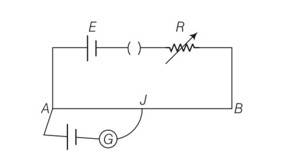
|
| Explanation- If the value of R is increased, the current through the wire will decrease which in turn decreases the potential difference across AB, and hence potential gradient (k) across AB decreases. |
| 9. While doing an experiment with potentiometer (figure) it was found that the deflection is one sided and (i) the deflection decreased while moving from one end A of the wire, to the end R; (ii) the deflection increased, while the jockey was moved towards the end D. 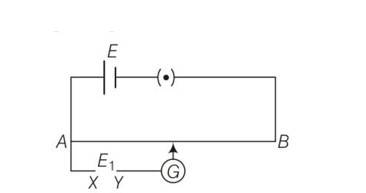
(i) Which terminal positive or negative of the cell E1 is connected at X in case (i) and how is E1 related to E? |
| Explanation- If the current in auxiliary circuit (lower circuit containing primary cell) decreases, and potential difference across A and jockey/increases. Then deflection in galvanometer is one sided and the deflection decreased, while moving from one end ‘A ’ of the wire to the end ‘S’. |
| 10. A cell of emf E and internal resistance r is connected across an external resistance R. Plot a graph showing the variation of potential difference across R, versus R. |
| Explanation- according to the relation V=e-Ir and I=e/r+R The graphical relation between voltage and resistance.
|
| 11. First a set of n equal resistors of R each are connected in series to a battery of emf E and internal resistance R. A current / is observed to flow. Then, the n resistors are connected in parallel to the same battery. It is observed that the current is increased 10 times. What is V? |
| Explanation – in series combination of resistors current I =e/R+r 10I= 10 = ( )n n=10 |
| 12. The circuit in figure shows two cells connected in opposition to each other. Cell E1is of emf 6 V and internal resistance 2 Ω; the cell E2 is of emf 4 V and internal resistance 8 Ω. Find the potential difference between the points A and B. 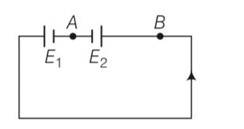
|
| Explanation- 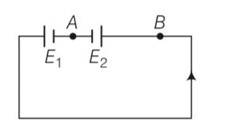
total resistance = 2+8= 10 ohm I= = 0.2A The direction of flow of current is always from high potential to low potential If VB VA VB-4V-0.2 8 = VA VB-VA= 3.6V |
| 13. Let there be n resistors R1 . . . 𝑅 𝑛 with 𝑅 max = max ( R1 . . . . 𝑅 ) and R min = min { R1 . . . R n }. Show that when they are connected in parallel the resultant resistance R p = R min 𝑅 𝑝 = 𝑅 min and when they are connected in series, the resultant resistance Rs > Rmax . Interpret the result physically. |
| Explanation- when all resistance are in parallel by multiplying this equation by Rmin we have
But there exist a term in RHS and other terms are positive so we have
>1 This shows that equivalent resistance is less than maximum resistance available.
But when all resistance are in series Rs =R1+R2………Rn here must be Rmax value in RHS Rs= R1+……Rmax+…..Rn And Rs> Rmax So equivalent resistance is less than Rmax |
| 14. Two cells of same emf E but internal resistance r1 and r2 are connected in series to an external resistor R (figure). What should be the value of R so that the potential difference across the terminals of the first cell becomes zero? 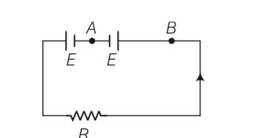
|
| Explanation- according to ohms law I= The potential difference across terminal is V=e-Ir= E- r1=0 E= 1= R+r1+r2 = 2r1 R= r1-r2 |
| 15. Two conductors are made of the same material and have the same length. Conductor A is a solid wire of diameter 1 mm. Conductor B is a hollow tube of outer diameter 2 mm and inner diameter 1 mm. Find the ratio of resistance RA to RB |
| Explanation- R= /A Resistance of first conductor , RA= 2 Resistance of second conductor , RB= Now ratio = 3:1 |
| 16. Suppose there is a circuit consisting of only resistances and batteries. Suppose one is to double (or increase it to n-times) all voltages and all. resistances. Show that currents are unaltered. Do this for circuit of Examples 3, 7 in the NCERT Text Book for Class XII. |
| Explanation- according to ohms law I= 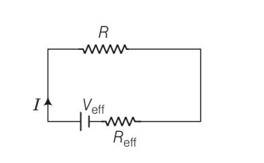
If voltage and resistance increase V’= nVeff , R’= nReff I’= = I |
Current Electricity Multiple Choice Questions
| 1. Consider a current carrying wire (current 7) in the shape of a circle. Note that as the current progresses along the wire, the direction of j (current density) changes in an exact manner, while the current I remain unaffected. The agent that is essentially responsible for is |
| Answer- (b) Explanation- as we know that J=E , and current density is directly proportional to electric field , so electric field produced by charges accumulated on the surface of wire. |
| 2. Two batteries of emf e1 and e2 (e2>e1) and internal resistance r1 and r2 respectively are connected in parallel as shown in fig (a) Two equivalent emf eeq of the cells is between e1 and e2 i.e. e1
(b) The equivalent emf eeq is samller than e1 (c) The eeq is given by eeq=e1+e2 always (d) Eeq is independent of internal resistance r1 and r2
|
| Answer- (a) Explanation- eeq= |
| 3. A resistance R is to be measured using a meter bridge, a student chooses the standard resistance S to be 100 Ω He finds the null point at l1= 2.9 cm. He is told to attempt to improve the accuracy. Which of the following is a useful way? |
| Answer –(c) Explanation – R/S=(l1/100-l1)= 100(2.9/100-2.9)= 100/97.1=2.98ohm So he should change S to almost 3 ohm and repeat the experiment. |
| 4. Two cells of emfs approximately 5 V and 10 V are to be accurately compared using a potentiometer of length 400 cm.4. (a) The battery that runs the potentiometer should have voltage of 8 V. (b) The battery of potentiometer can have a voltage of 15 V and R adjusted so that the potential drop across the wire slightly exceeds 10 V. (c) The first portion of 50 cm of wire itself should have a potential drop of 10 V. |
| Answer- (b) Explanation-The potential drop along the wires of potentiometer should be greater than emfs of cells. |
| 5. A metal rod of length 10 cm and a rectangular cross-section of 1 cm x 1/2 cm is connected to a battery across opposite faces. The resistance will be |
| Answer-(a) Explanation- R= for greater value of R , A should be less and its possible value when connected across 1cm 1/2cm faces. |
| 6. Which of the following characteristics of electrons determines the current in a conductor? |
| Answer-(a) Explanation- I=AneVd , current is directly proportional to drift velocity. |
| 7. Kirchhoff’s junction rule is a reflection of |
| Answer – (b,d) Explanation-Algebraic sum of the currents flowing towards any point in an electric network is zero. It also tell us about the conservation of charge. |
| 8. Consider a simple circuit shown in figure stands for a variable resistance R’. R’ can vary from R0to infinity, r is internal resistance of the battery (r <
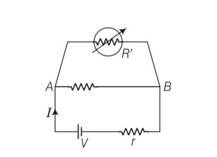
|
| Answer – (a,d) Explanation- potential drop across AB is independent to R’ also when we decrease the value of R the current will also very large. According to the relation I=e/R+r |
| 9. Temperature dependence of resistivity ρ(T) of semiconductors, insulators and metals is significantly based on the following factors: |
| Explanation- according to the relation = also T |
| 10. The measurement of an unknown resistance R is to be carried out using Wheatstone bridge as given in the figure. Two students perform an experiment in two ways. The first student takes R2= 10 Ω and R1 = 5 Ω. The other student takes R2 = 1000 Ω, and R1 = 500 Ω. In the standard arm, both take R3 = 5 Ω. |
| Answer – (b,c) Explanation – According to the relation that p/q=r/s if galvanometer shows no deflection. In the above equation the value of R4 depends upon R1 and R2 . if the value of R1 and R2 will be feeble the value of R4 would be affected. 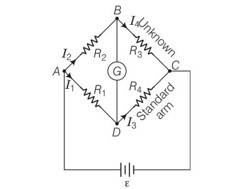
|
| 11. In a meter bridge, the point D is a neutral point (figure). 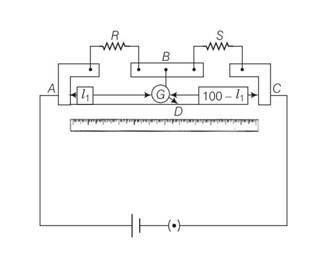
|
| Answer –(a,c) Explanation- In case of meter bridge, the resistance wire AC is 100 cm long. Varying the position of tapping point B, bridge is balanced. If in balanced position of bridge AB = l, BC = (100 – l) so that Q/P= (100-l)/l. Also P/Q=R/S=>S=(100-l)/l R |
24th June 2022 (Second Shift)
24th June 2022 (Second Shift)
Commonly asked questions
Identify the pair of physical quantities that have same dimensions
Velocity gradient =
Decay constant
The distance between Sun and Earth is R. The duration of year if the distance between Sun and Earth becomes 3R will be
A stone of mass m, tied to a string is being whirled in a vertical circle with a uniform speed. The tension in the string is
Is minimum at the highest position of the circular path.
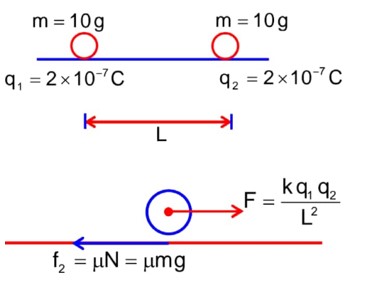
Two identical charged particles each having a mass 10g and charge 2.0 × 10⁻⁷ C are placed on a horizontal table with a separation of L between them such that they stay in limited equilibrium. If the coefficient of friction between each particle and the table is 0.25, find the value of L. [Use g = 10ms-2]
L = 12 cm
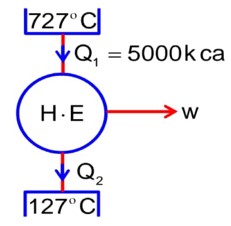
A carnot engine takes 5000 kcal of heat from a reservoir at and gives heat to a sink at The work done by the engine is
T1 = 727 + 273 = 1000k
T2 = 127° + 273 = 400 k
Q1 = 5 × 10³ k cal
w = 12.6 × 10⁶ J
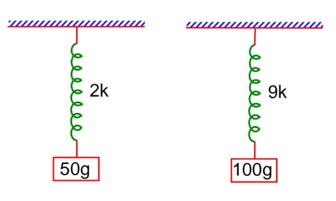
Two massless springs with spring constants 2k and 9k, carry 50g and 100g masses at their free ends. These two masses oscillate vertically such that their maximum velocities are equal. Then the ratio of their respective amplitudes will
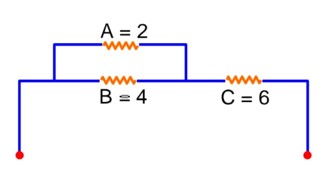
What will be the most suitable combination of three resistors A = , B = , C = so that is equivalent resistance of combination
Given
The soft-iron is a suitable material for making an electromagnet. This is because soft iron has
High permeability and low retentivity
A proton, a deuteron and an α - particle with same kinetic energy enter into a uniform magnetic field at right angle to magnetic field. The ratio of the radii of their respective circular paths is
mp = m
qp = q
md = 2m
qd = q
ma = 4m
qa = 2q
Statement – I : The reactance of an ac circuit is zero. It is possible that the circuit contains a capacitor and an inductor.
Statement – II : In ac circuit, the average power delivered by the source never becomes zero.
In the light of the above statements, choose the correct answer from the options given below
Z = if only L & C are present then R = 0 then p = 0
Potential energy as a function of r is given by , where r is the interatomic distance, A and B are positive constant. The equilibrium distance between the two atoms will be
An object of mass 5kg is thrown vertically upwards from the ground. The air resistance produces a constant retarding force of 10 N throughout the motion. The ratio of time of ascent to the time of descent will be equal to : [Use g = 10ms-2].
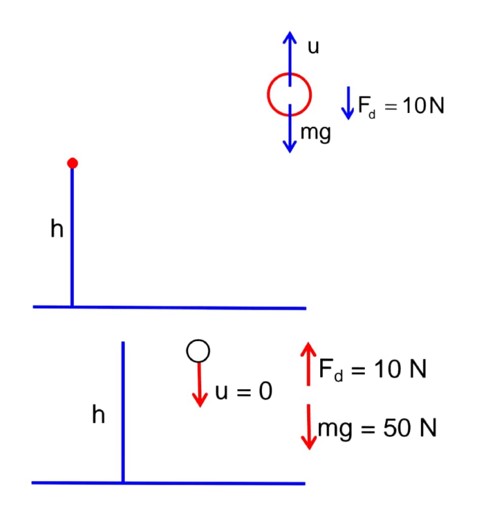
v = u + at
0 = u – 6t
(time of Ascent)
=
for time of descent
a = 4 m /sec2
A fly wheel is accelerated uniformly from rest and rotates through 5 rad in the first second. The angle rotated by the fly wheel in the next second, will be
= 10 rad/sec2
(ln 2 seconds) =
Angle rotated by wheel in 2nd second
=
= 20 – 5
= 15 rad
A 100g of iron nail is hit by a 1.5 kg hammer striking at a velocity of 60ms-1. What will be the rise in the temperature of the nail if one fourth of energy of the hammer goes into heating the nail?
Heating energy energy of the hammer
= 675 J
If the charge on a capacitor is increased by 2C, the energy stored in it increases by 44%. The original charge on the capacitor is (in C)
Uf = 1.44 Ui
Qf = Q + 2
0.2 Q = 2
Q = 10 C
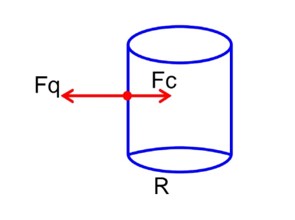
A long cylindrical volume contains a uniformly distributed charge of density . The radius of cylindrical volume is R. A charge particle (q) revolves around the cylinder in a circular path. The kinetic energy of the particle is
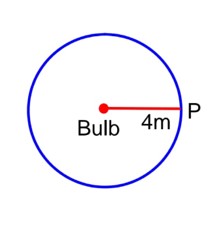
An electric bulb is rated as 200W. What will be the peak magnetic field at 4m distance produced by the radiations coming from this bulb? Consider this bulb as a point source with 3.5% efficiency.
IR = IB (due to magnetic field)
(due to Radiation)
The light of two different frequencies whose photons have energies 3.8 eV and 1.4 eV respectively, illuminate a metallic surface whose work function is 0.6 eV successively. The ratio of maximum speed of emitted electrons for the two frequencies respectively will be
K. E1 = 3.2 eV (i)
1.4 = 0.6 + K.E2
KE2 = 0.8 eV (ii)
Two light beams of intensities in the ratio of 9 : 4 are allowed to interfere. The ratio of the intensity of maxima and minima will be
In Bohr’s atomic model of hydrogen, let K, P and E are the kinetic energy, potential energy and total energy of the electron respectively. Choose the correct option when the electron undergoes transitions to a higher level
Based on theory
A body is projected from the ground at an angle of with horizontal. Its velocity after 2s is 20 ms-1. The maximum height reached by the body during its motion is ______m. (use g = 10ms-2)
after 2 sec, v = 20 m/sec
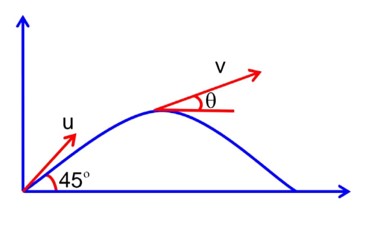
u = 40 sin 45°
An antenna is placed in a dielectric medium of dielectric constant 6.25. If the maximum size of that antenna is 5.0 mm, it can radiate a signal of minimum frequency of ________ GHz.
(Given µr = 1 for dielectric medium)
So,
A potentiometer wire of length 10m and resistance 20 is connected in series with a 25 V battery and an external resistance . A cell of emf E in secondary circuit is balanced by 250cm long potentiometer wire. The value of E (in volt) is The value of x is ______.
AB = 10 m
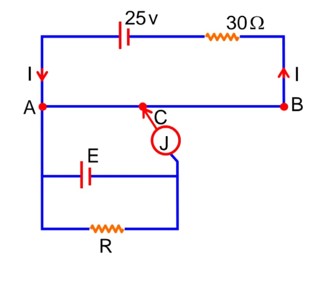
= 2.5 m
Two travelling waves of equal amplitudes and frequencies move in opposite directions along a string. They interfere to produce a stationary wave whose equation is given by y =
The amplitude of the particle at x = cm will be _______cm.
Then Amplitude will be 5 cm.
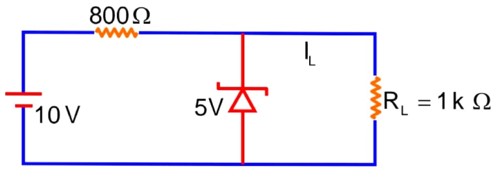
In the given circuit, the value of current IL will be _________mA. (When RL = 1 k )
A sample contains 10-2kg each of two substances A and B with half lives 4s and 8s respectively. The ration of their atomic weights is 1 : 2. The ratio of the amounts of A and B after16s is . The value of x is ______.
- (1)
for B,
for B,
- (2)
A ray of light is incident at an angle of incidence on the glass slab of refractive index After refraction, the light ray emerges out from other parallel faces and lateral shift between incident ray and emergent ray is cm. The thickness of the glass slab is _______cm.
cm (Lateral shift)
By Snell’s law
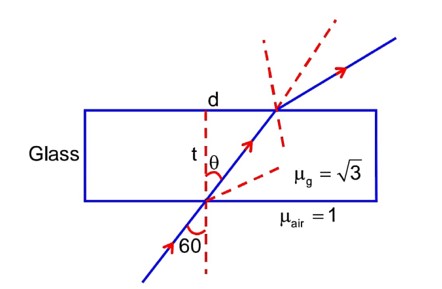
= 30°
t = 12 cm
A circular coil of 1000 turns each with area 1m2 is rotated about its vertical diameter at the rate of one revolution per second in a uniform horizontal magnetic field of 0.07 T. The maximum voltage generation will be ________V.
given N = 1000 turns
A = 1m2
=
= 20 × 22
= 440 volts
A monoatomic gas performs a work of where Q is the heat supplied to it. The molar heat capacity of the gas will be ________ R during this transformation. Where R is the gas constant.
In an experiment to verigy Newton’s law of cooling, a graph is plotted between, the temperature difference of the water and surrounding and time as shown in figure. The initial temperature of water is taken as The value of t2 as mentioned in the graph will be _______.
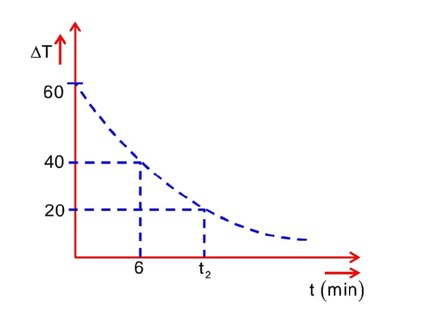
- (1)
Now
t = 10.257
t2 = 6 + 10.257 = 16.257 minutes
16.25 and or 16
JEE Mains Solutions 2022,28th june , Physics ,Second shift
Commonly asked questions
Velocity and acceleration (a) in two system of units 1 and 2 are related as respectively. Here m and n are constants. The relations for distance and time in two system respectively are:
Let, L1 & L2 one distance for system (1) & (2) respectively
T1 & T2 are time for system (1) & (2) respectively
Given : v2 =
And a2 =
from (1)
A ball is spun with angular acceleration a = 6t2 – 2t where t is in second and a is in rads-1. At t = 0, the ball has angular velocity of 10 rads-1 and angular position of 4 rad. The most appropriate expression for the angular position of the ball is:
a = 6t2 – 2t, of t 20, w = 10 rad/sec
, q = 4 rad
=
A block of mass 2kg moving on a horizontal surface with speed of 4 ms-1 enters a rough surface ranging from x = 0.5m to x = 1.5m. The retarding force in this range of rough surface is related to distance by F = -kx where k = 12Nm-1. The speed of the block as it just crosses the rough surface will be:
by, WET
vf = 2m/sec
A long ladder weighing 10kg leans on a frictionless wall. Its feet rest on the floor 3m away from the wall as shown in the figure. If Ff and Fw are the reaction forces of the floor and the wall, then ratio of Fw / Ff will be:
(Use g = 10 m/s2)
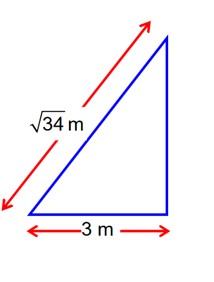
mg = 10 × 10
= 100 of
NA = reaction force offered by the wall
reaction force offered by the floor.
By NLM 1
Translational fB = NA
NB = mg = 100N
Ac2 + Bc2 = AB2
Ac2 = 34 – 9
Ac = 5m
Rotational equilibrium
mg
NA = 50 cot
Now cot =
NA =
Therefore, NA = - (i)
- (2)
Water falls from a 40m height dam at the rate of 9 × 10⁴ kg per hour. Fifty percentage of gravitational potential energy can be converted into electrical energy. Using this hydro electric energy number of 100 W lamps, that can be lit, is:
(Take g = 10 ms-2)
Given : water flow rate = = 9 × 10⁴ kg/hr
=
Potential energy available on water per unit time
50% of it converts into electrical energy = 50% of
Let be the number of bulbs n = 100 =
n = 50
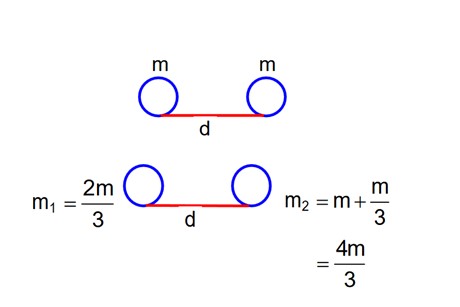
Two objects of equal masses placed at certain from each other attracts each other with a force of F. If one-third mass of one object is transferred to the other, then the new force will be:
F = - (i)
Now,
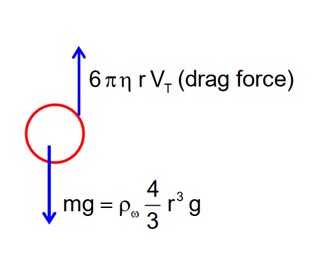
A water drop of radius falls in a situation where the effect of buoyant force is negligible. Co-efficient of viscosity of air is 1.8 × 10⁻⁵ Nsm-2 and its density is negligible as compared to that of water 106 gm-3. Terminal velocity of the water drop is:
(Take acceleration due to gravity = 10 ms-2)
NLM 1
vT = 123.4 × 10⁻⁶m/sec
A sample of an ideal gas is taken through the cyclic process ABCA as shown in figure. It absorbs, 40 J of heat during the part AB, no heat during BC and rejects 60 J of heat during CA. A work of 50 J is done on the during the part BC. The internal energy of the gas at A is 1560 J. The work done by the gas during the part CA is:
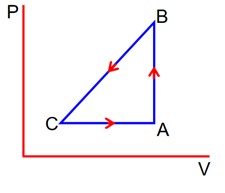
Given
QAB = +40J
QBC = 0J
QCA = -60J
WCA =?
WBC = -50J (on the gas)
UA = 1560J
1st Law on path A to B
WAB +
Þ 0 +
Þ UB = UA + 40
= 1560 + 40
UB = 1600 J
1st Low on path B to C
QBC =
Þ 0 = Uc – UD – 50
UC = UB + 50
= 1600 + 50
= 1650 J
UA – UC =
= -90 J
1st Low for path C to A
QCA =
Þ -60 = -90 + wCA
WCA = +30J
What will be the effect on the root mean square velocity of oxygen molecules if the temperagture is doubled and oxygen molecule dissociates into atomic oxygen?
Vrms =
Vrms’ =
Vrms’ = 2Vrms
Two point charges A and B of magnitude + 8 × 10⁻⁶ and -8 × 10⁻⁶C respectively are placed at a distance d apart. The electric field at the middle point O between the charges is 6.4 × 10⁴ NC-1. The distance ‘d’ between the point charges A and B is:
E1 (done to q1) =
E2 (done to q2) =
Enet = E1 + E2
Given Enet = 6.4 × 10⁴
d2 = 9 × 10⁻⁶ + 6
d = 3m
Resistance of the wire is measured as at 10°C and 30°C respectively. Temperature co-efficient of resistance of the material of the wire is:
RT = R0
at t = 10°C, RT = 2
2 = R0 (1 + [10 – T0])- (1)
at T = 30°C, RT = 3
3 = (2)
from (1)
(3)
from (2) 3 = R0 (1 + 30) - (4)
3 + 30 = 2T 60α =
The space inside a straight current carrying solenoid is filled with a magnetic material having magnetic susceptibility equal to 1.2 × 10⁻⁵. What is fractional increase in the magnetic field inside solenoid with respect to air medium inside the solenoid?
fractional change =
=
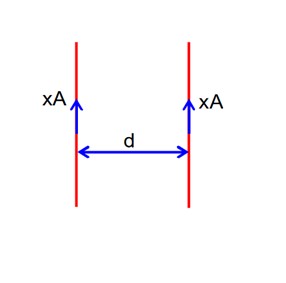
Two parallel, long wires are kept 0.20 m apart in vacuum, each carrying current of x A in the same direction. If the force of attraction per meter of each wire is 2 × 10⁻⁶N, then the value of x is approximately:
x2 = 2x = = 1.4x = 1.4
A coil is placed in a time varying magnetic field. If the number of turns in the coil were to be halved and the radius of wire doubled, the electrical power dissipated due to the current induced in the coil would be:
(Assume the coil to be short circuited.)
An EM wave propagating in x-direction has wavelength of 8 mm. The electric field vibrating y-direction has maximum magnitude of 60 Vm-1. Choose the correct equations for electric and magnetic fields if the EM wave is propagating in vacuum:
Given,
Now
B0 =
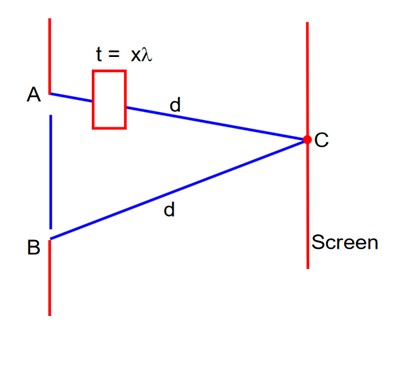
In young’s double slit experiment performed using a monochromatic light of wavelength when a glass plate of thickness is introduced in the path of the one of the interfering beams, the intensity at the position where the central maximum occurred previously remains unchanged. The value of x will be:
Þ AC = d + t
BC = d
path different = AC – BC =
for contal maxima
Þ
0.5x = x
n = 0, 1,2- -
n = 0 Not possible
Now, n = 1
0.5x = 1
x = 2
Let K1 and K2 be the maximum kinetic energies of photo-electrons emitted when two monochromatic beams of wavelength respectively are incident on a metallic surface. If then:
E Energy with which photons are incident on a metallic surface.
E E1 < E2
We know E1 =
k1 =
& E2 =
k2 = (i)
from (1) & (2)
k2 >
Following statements related to radioactivity are given below:
(A) Radioactivity is a random and spontaneous process and is dependent on physical and chemical conditions.
(B) The number of un-decayed nuclei in the radioactive sample decays exponentially with time.
(C) Slope of the graph of loge (no. of undecayed nuclei) Vs, time represents the reciprocal of mean life time
(D) Product of decay constant and half-life time is not constant.
We know, N =
Where, N Number of un-decayed Nuclei
No Initial No. Of Nuclei
N
Taking log both side log N = log N0 + loge
log N = log No
Slope =
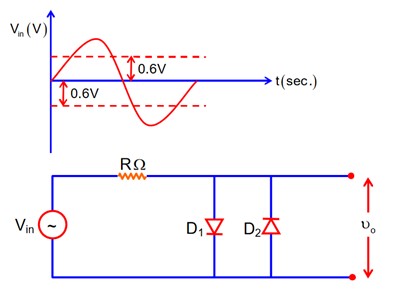
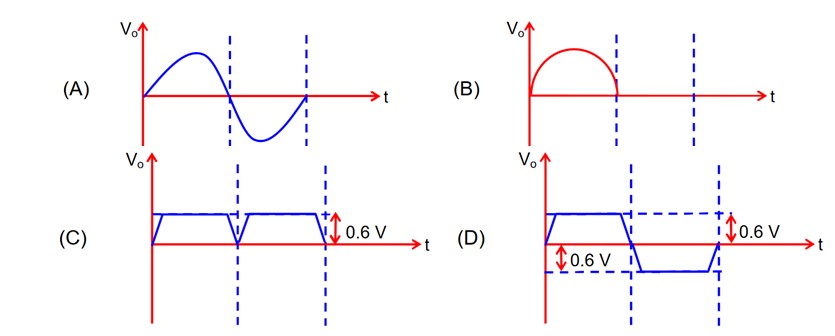
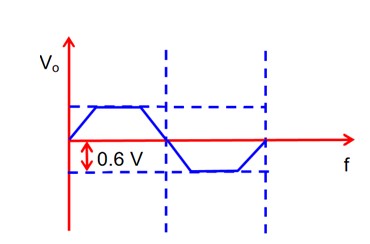
In the given circuit the input voltage Vin is shown in figure. The cut-in voltage of p-n junction diode (D1 or D2) is 0.6 V. Which of the following output voltage (V0) waveform across the diode is correct?
Amplitude modulated wave is represented by VAM = Total bandwidth of the amplitude modulated wave is:
Main wave frequency (carrier frequency)
Bandwidth = 2 fm
=
A student in the laboratory measures thickness of a wire using screw gauge. The readings are 1.22mm, 1.23mm, 1.19mm and 1.20mm. The percentage error is The value of x is________.
Given x1 = 1.22mm
x2 = 1.23mm
x3 = 1.19mm
& x4 = 1.20mm
x = 150
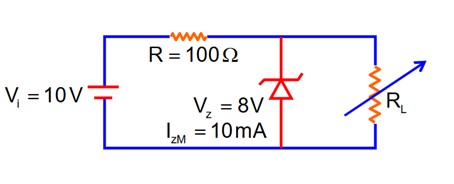
A zener of breakdown voltage VZ = 8V and maximum zener current, IZM = 10mA is subjected to an input voltage Vi = 10V with series resistance R = 100 In the given circuit RL represents the variable load resistance. The ratio maximum and minimum value of RL is__________.
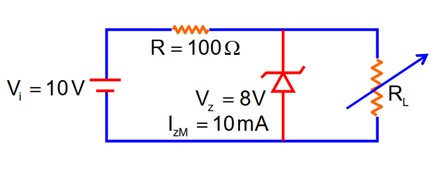
Across zener diode & RL
8 = ILRL
8 =
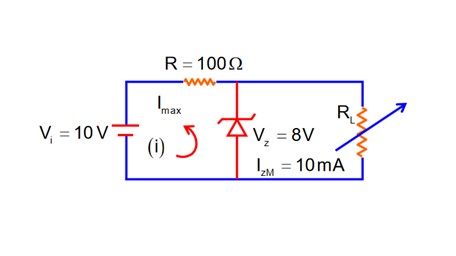
At max current in loop (1)
10 = imax R + 8
imax =
= 20 mA
RL (max) =
At minimum curre3nt through zener
imax RL (minimum) = 8
RL (minimum) =
In a Young’s double slit experiment, an angular width of the fringe is 0.53° on a screen place at 2m away for particular wavelength of 450 nm. The angular width of the fringe, when whole system is immersed in a medium of refractive index 7/5, is The value of a is__________.
we know, =
[with change in medium frequency refnain constaint]
2 =
2
= 4
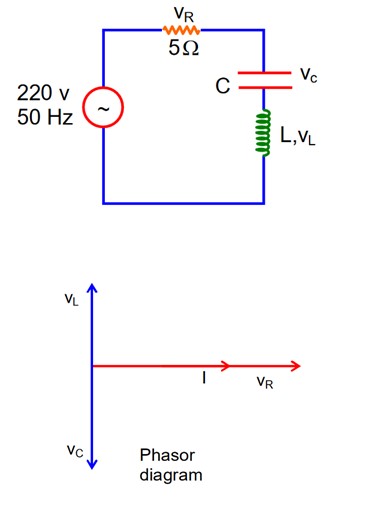
In the given circuit, the magnitude of VL and VC are twice that of VR. Given that f = 50 Hz. the inductance of the coil is The value of K is_________.
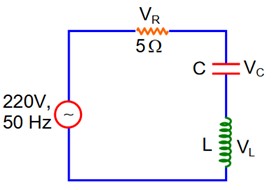
Given
VL = VC = 2VR, f = 50Hz
since, VL = VC.
then
VR = VNet = 220V
I =
= I xL = 440
xL = 10
WL = 10
2πfL = 10
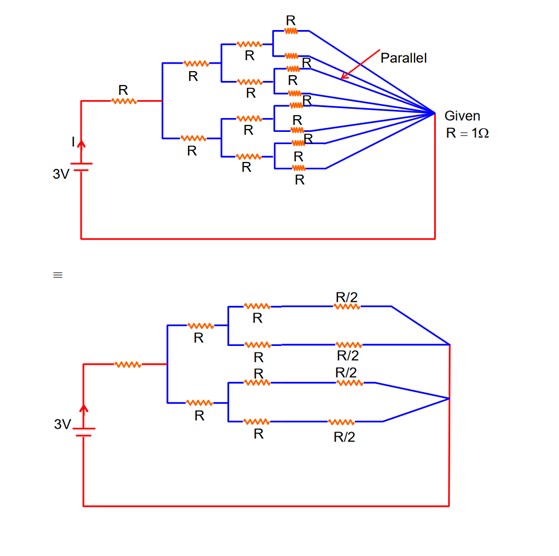
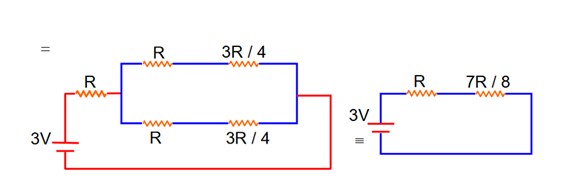
All resistances in figure are each. The value of current ‘I’ is The value of a is___________.
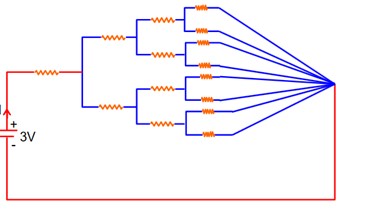
I =
a = 8
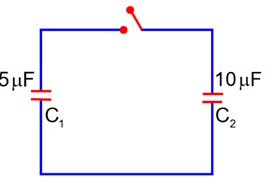
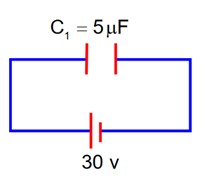
A capacitor C1 of capacitance is charged to a potential of 30V using a battery. The battery is then removed and the charged capacitor is connected to an uncharged capacitor C2 of capacitance as shown in figure. When the switch is closed charge flows between the capacitors. At equilibrium, the charge on the capacitor C2 is__________
Q = C1v
= 5 × 30
Q = 150
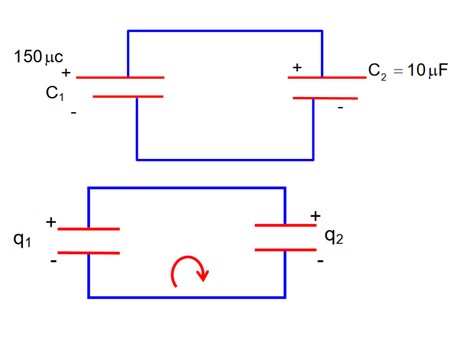
Now it is connected to an unchanged capacitor C2
Let change on C1 ® q1
& 4 C2 ® q2
Apply kvL
Þ q2 = 2q1 – (1)
& conservation of change
q1 + q2 = 150 – (2)
Þ from (1) & (2)
3q1 = 150
q1 = 50
A running fork of frequency 340 Hz resonates in the fundamental mode with a air column of length 125cm in a cylindrical tube closed at one end. When water is slowly poured in it, the minimum height of water required for observing resonance once again is __________cm.
(Velocity of sound in air is 340 ms-1)
First resonating length =
Second resonating length =
Third resonating length =
Height of water required = 125 – 75 = 50cm
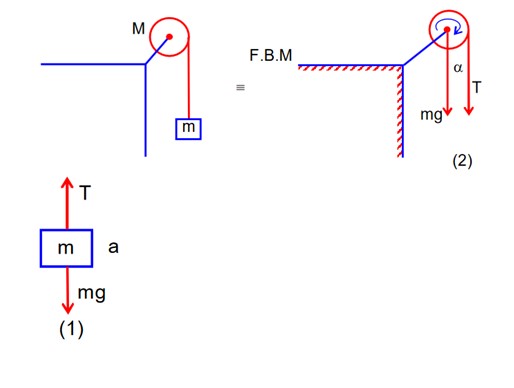
A uniform disc with mass M = 4 kg and radius R = 10 cm is mounted on a fixed horizontal axle as shown in figure. A block with mass m = 2kg hangs from a massless cord that is wrapped around the rim of the disc. During the fall of the block, the cord does not slip and there is no friction at the axle. The tension in the cord is_________ N.
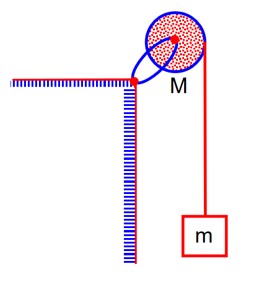
NLM2 for (1)
mg – T = ma
Þ 2 × 10 – T = 2a
Þ T + 2a = 20 - (1)
Rotation equestion for (2)
T × R = Icma
Þ T R =
T =
T = 2a - (2)
from (1) & (2)
2T = 20
T = 10N
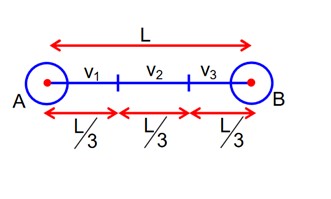
A car cover AB distance with first one-third at velocity second one-third at and last one-third at If then the average velocity of the car is__________ ms-1.
=
= 3 × b
= 18 m/sec
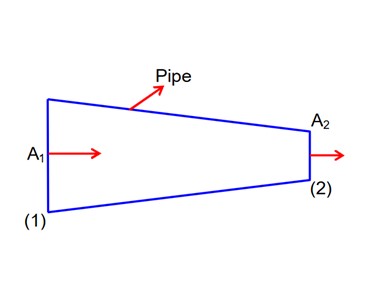
A liquid of density 750 kgm-3 flows smoothly through a horizontal pipe that tapers in cross-sectional area from A1 = 1.2 × 10⁻²m2 to A2 = The pressure difference between the wide and narrow sections of the pipe is 4500 Pa. The rate of flow of liquid is_________ × 10-3m3s-1.
Given A2 =
Bernoulli’s b/w (1) & (2)
z1 = z2]
[Q = A1V1 = A2V2]
= 2.4 × 10⁻² m3 /sec
= 24 × 10-3 m3 /sec
= 24
Physics NCERT Exemplar Solutions Class 12th Chapter Three Exam
Student Forum
 Anything you would want to ask experts?