First Law of Thermodynamics
Get insights from 7 questions on First Law of Thermodynamics, answered by students, alumni, and experts. You may also ask and answer any question you like about First Law of Thermodynamics
- 7
Questions
- 0
Discussions
- 0
Active Users
- 0
Followers
Have a question about First Law of Thermodynamics? Ask our experts
Keep it short & simple. Type complete word. Avoid abusive language.
An ideal gas undergoes the process as shown in the figure, the heat supplied and work done in the process is and respectively. The ratio is
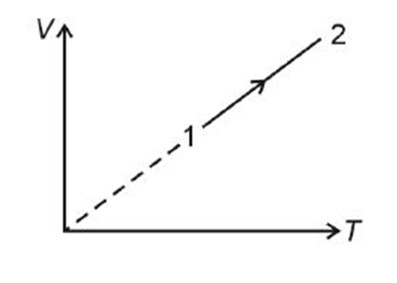
An ideal gas undergoes the process as shown in the figure, the heat supplied and work done in the process is and respectively. The ratio is
From first law of thermodynamics
 Upvote

An ideal gas undergoes the process as shown in the figure, the heat supplied and work done in the process is and respectively. The ratio is
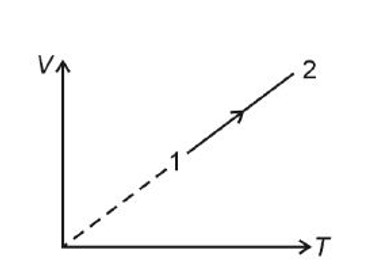
An ideal gas undergoes the process as shown in the figure, the heat supplied and work done in the process is and respectively. The ratio is
From first law of thermodynamics
Upvote 1 mole of rigid diatomic gas performs a work of <!-- [if gte mso 9]><xml>
[R = universal gas constant]
1 mole of rigid diatomic gas performs a work of <!-- [if gte mso 9]><xml>
[R = universal gas constant]
A sample of an ideal gas is taken through the cyclic process ABCA as shown in figure. It absorbs, 40 J of heat during the part AB, no heat during BC and rejects 60 J of heat during CA. A work of 50 J is done on the during the part BC. The internal energy of the gas at A is 1560 J. The work done by the gas during the part CA is:
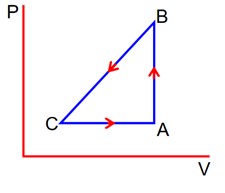
A sample of an ideal gas is taken through the cyclic process ABCA as shown in figure. It absorbs, 40 J of heat during the part AB, no heat during BC and rejects 60 J of heat during CA. A work of 50 J is done on the during the part BC. The internal energy of the gas at A is 1560 J. The work done by the gas during the part CA is: