Magnetism and Matter
Get insights from 91 questions on Magnetism and Matter, answered by students, alumni, and experts. You may also ask and answer any question you like about Magnetism and Matter
- 91
Questions
- 0
Discussions
- 0
Active Users
- 0
Followers
Have a question about Magnetism and Matter? Ask our experts
Keep it short & simple. Type complete word. Avoid abusive language.
Statement I : The ferromagnetic property depends on temperature. At high temperature, ferromagnet becomes paramagnet.
Statement II : At high temperature, the domain wall are of a ferromagnetic substance increases.
In the light of the above statements, choose the most appropriate answer from the options given below:
I : at high temperature, ferromagnet becomes paramagnet.
II : at high temperature, domains of ferromagnet will break
At an angle of 30° to the magnetic meridian, the apparent dip is 45°. Find the true dip:
Let the true dip is and apparent dip is , so
A long solenoid with 1000 turns/m has a core material with relative permeability 500 and volume 103 cm3. If the core material is replaced by another material having relative permeability of 750 with same volume maintaining same current of 0.75A in the solenoid, the fractional change in the magnetic moment of the core would be approximately <!-- [if gte mso 9]><xml>
</xml><![endif]--> Find the value of x.
A long solenoid with 1000 turns/m has a core material with relative permeability 500 and volume 103 cm3. If the core material is replaced by another material having relative permeability of 750 with same volume maintaining same current of 0.75A in the solenoid, the fractional change in the magnetic moment of the core would be approximately <!-- [if gte mso 9]><xml>
Gauss law for magnetism states that total magnetic flux through a closed surface S will be zero. It is one of the four maxwell's equations that is useful in understanding the prinicples of electromagnetism. When understood in depth, the law implies that magnetic field lines form closed loops since t
A ring magnet is a type of strong and permanent magnet which is made from the alloy of iron, boron and neodymium. These are the part of rare-earth magnet family which is the reason behind their the strongest magnetic properties amongst all other permanent magents.
A U-shaped magnet is another type of bar magnet. This is known as a horseshoe magnet since its shapes resembles the object called horseshoe. The two ends of this U-shaped magnet are its magnetic poles. Configration of these magnetic poles creates a concentrated magnetic field. This concentrated magn
The two points in a bar magnet are its North pole and South pole. A bar magnet has magnetic field lines around it. These points give these field lines a travelling direction. For example, the magnetic field lines emerge form the North pole of the bar magnet and then they curve toward South pole. Thi
The susceptibility of a paramagnetic material is 99. The permeability of the material in Wb/A-m, is:
[Permeability of free space <!-- [if gte mso 9]><xml>
</xml><![endif]-->
The susceptibility of a paramagnetic material is 99. The permeability of the material in Wb/A-m, is:
[Permeability of free space <!-- [if gte mso 9]><xml>
Given, x = 99
(Permeability of the material)
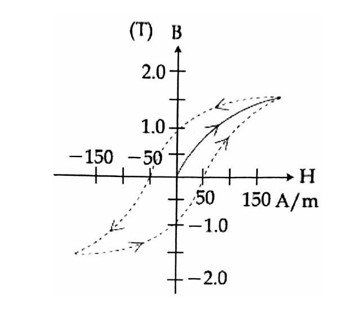
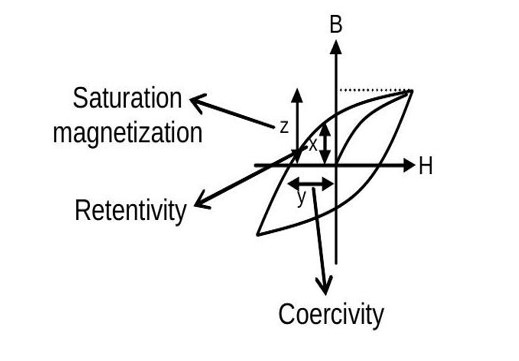
The figure gives experimentally measured vs variation in a ferromagnetic material. The retentivity, co-ercivity and saturation, respectively, of the material are
retentivity
coercivity
saturation magnetization