

Maths Applications of Derivatives
Get insights from 50 questions on Maths Applications of Derivatives, answered by students, alumni, and experts. You may also ask and answer any question you like about Maths Applications of Derivatives
Follow Ask QuestionQuestions
Discussions
Active Users
Followers
New answer posted
a year agoContributor-Level 10
Since p (x) has relative extreme at x=1 and 2
so p' (x)=0 at x=1 and 2
⇒ p' (x)=A (x-1) (x-2)
⇒ p (x)=∫A (x²-3x+2)dx
p (x)=A (x³/3 - 3x²/2 + 2x)+C
P (1)=8
From (1)
8=A (1/3-3/2+2)+C
⇒ 8=5A/6+C ⇒ 48=5A+6C
P (2)=4
⇒ 4=A (8/3-6+4)+C
⇒ 4=-2A/3+C ⇒ 12=-2A+3C
From 3 and 4, C=-12
So P (0)=C=-12
New answer posted
a year agoContributor-Level 9
f' (x) = 12sin³xcosx+30sin²xcosx+12sinxcosx = 3sin2x (2sin²x+5sinx+2) = 3sin2x (2sinx+1) (sinx+2).
In [-π/6, π/2], sinx+2>0. 2sinx+1>0 except at x=-π/6. sin2x>0 for x∈ (0, π/2), <0 for x (-/6,0).
So f' (x)<0 on (-/6,0) (decreasing) and f' (x)>0 on (0, π/2) (increasing).
New answer posted
a year agoContributor-Level 9
f(3)=f(4) ⇒ α=12
f'(x) = (x²-12)/(x(x²+12))
∴ f'(c)=0 ⇒ c=√12
∴ f''(c) = 1/12
New answer posted
a year agoContributor-Level 10
0.50
y = x²-3x+2, x+y=a, x-y=b
x?=2 x?=1
y? = 4-6+2 = 0 y?=0
(2,0)
(1,0)
b=2
a=1
∴ a/b = 1/2 = 0.5
New answer posted
a year agoContributor-Level 10
f(x) = (3x²+ax-2-a)e?
f'(x) = (3x²+ax-2-a)e? + e?(6x+a)
= e?(3x²+(a+6)x-2)
∴ x=1 is a critical point
∴ f'(1)=0
∴ 3+a+6-2=0
a = -7
∴ f'(x) = e?(3x²-x-2)
= e?(3x+2)(x-1)
∴ maxima at x = -2/3
∴ minima at x = 1
New answer posted
a year agoWhich of the following point lies on the tangent to the curve x⁴eʸ + 2√(y+1) = 3 at the point (1,0)?
Contributor-Level 10
e? y'x? + 4x³e? + 2y' / (2√ (y+1) = 0 at (1,0)
y' + 4 + y' = 0 ⇒ y' = -2
equation of tangent at (1,0) is 2x + y - 2 = 0
So option (C) is correct.
New answer posted
a year ago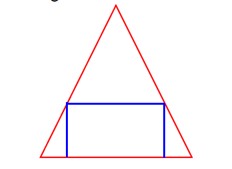
Contributor-Level 10
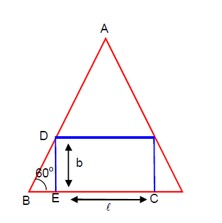
Let rectangle have dimensions l, w.
Triangle above rectangle is similar to large triangle.
(H-w)/H = l/a.
l = a (H-w)/H = a (1-w/H).
Area A = lw = aw (1-w/H).
A' (w) = a (1-2w/H) = 0 ⇒ w = H/2 = √6/2.
l = a/2 = √2.
Max Area A = √2 * √6/2 = √3.
Square of area = 3.
Taking an Exam? Selecting a College?
Get authentic answers from experts, students and alumni that you won't find anywhere else
Sign Up on ShikshaOn Shiksha, get access to
- 67k Colleges
- 1.2k Exams
- 716k Reviews
- 1850k Answers