Maths Integrals

Get insights from 376 questions on Maths Integrals, answered by students, alumni, and experts. You may also ask and answer any question you like about Maths Integrals

  • 376

    Questions

  • 0

    Discussions

  • 0

    Active Users

  • 0

    Followers

Have a question about Maths Integrals? Ask our experts

Ask Your Question

Keep it short & simple. Type complete word. Avoid abusive language.

New answer posted•a year ago

265. ∫0π4·2tan3x dx=1−log2

13 Views|Posted a year ago
Asked by Vishal Baghel
S
a year ago

Let I ∫0π4·2tan3x dx

=2∫0π4tan2xtanx dx

=2∫0π4(sec2x−1)tanx dx {?sec2x=tan2x+1}

=2∫0π4sec2xtanx dx−2∫0π4tan x dx

=2I1+2[log](cosx)0π4

=2I1+2[log(cosπ4)−log(cos0)]

=2I1+2(log1/√2
−log1)

=2I1+2(log·2−12−0)

I=2I1+2×(−12)log2=2I1−log2.____(1).

Where I1=∫0π4sec2xtanx dx

Let tan x = t =>sec2xdx = dt

When, x = 0, t = tan 0. = 0

x=π4,t=tanπ4=1

1=∫01t dt=[t22]01=12−0=12

So, Equation (1) becomes,

=2×12−log2

=1 - log 2.

...Read more

Thumbs Up IconUpvote Thumbs Down Icon
New answer posted•a year ago

264. ∫0π2sin3x dx.=23

6 Views|Posted a year ago
Asked by Vishal Baghel
S
a year ago

LHS = I=∫0π2sin3x dx. {sin3A=3sinA−4sin3 A

=∫0π214 (3sinx−sin3x)dx.sin3A=14(3sinA−sin3A)

=14[3∫0π2sin x dx−∫0πqsin 3x dx]

=14{3[−cosx]0π2−[−cos3x3]0π2}

=34(−cosπ2+cos0)−112(−cos3π2+cos3×0)

=34(−0+1)−112(−0+1)

=34  −112=9−112=812=23

Thumbs Up IconUpvote Thumbs Down Icon
New answer posted•a year ago

263. ∫−11x17·cos4x dx =0

5 Views|Posted a year ago
Asked by Vishal Baghel
S
a year ago

=∫−11x17·cos4x dx

Here f (x) = x17 cos4x

f ( -x) = ( -x)17 cos4 ( -x)

= -x17 cos4x

= f (x)

i e, odd fxn

As ∫aaf (x)dx=0 for odd fxn

therefore, I = 0.

Thumbs Up IconUpvote Thumbs Down Icon
New answer posted•a year ago

262. ∫01xexdx=1     

3 Views|Posted a year ago
Asked by Vishal Baghel
S
a year ago

LHS= ∫01xexdx=x∫01exdx−∫01dxdx∫exdx dx

= [xex]01−∫01exdx

= [1e1−0×e0]− [ex]01

= (e1−0)− (e1−e0)

= e-e + e0

= e0 = 1=RHS

Thumbs Up IconUpvote Thumbs Down Icon
New answer posted•a year ago

261. ∫13dxx2(x+1). =23+log23

4 Views|Posted a year ago
Asked by Vishal Baghel
S
a year ago

Let I=∫13dxx2(x+1).

The integrand is of the form.

1 = Ax (x + 1) + B (x + 1) + Cx2

= A (x2 + x) + B (x + 1) + Cx2

Comparing the coefficients,

A + C = 0 ____ (1)

A + B = 0 ______ (2)

B = 1 ________ (3)

Putting Equation (3) in (2),

A + 1 = 0

A = -1.

and putting value of A in Equation (1),

-1 + C = 0

C = 1

1x2(x+1)=−1x+1x2+1x+1

∴I=∫13dxx2(x+1)=∫13−dxx+∫13dxx2+∫13dxx+1

=− [log|x|]13+[x−2+1−2+1]13+[log?x+1]13

=[−log3+log1]−[1x]13+[log|3+1|−log|1+1|]

=−log3+0−[13−1]+log4−log2

=−log3−(1−3)3+log22−log2

=−log3−(−2)3+2log2−log2

=log2−log3+23

=23+log23

Hence proved.

Thumbs Up IconUpvote Thumbs Down Icon
New answer posted•a year ago

260. ∫14[|x−1|+|x+2|+|x−3|]dx

7 Views|Posted a year ago
Asked by Vishal Baghel
S
a year ago

Let I = ∫14[|x−1|+|x+2|+|x−3|]dx

I = ∫14|x−1|dx+∫14|x+2|dx+∫14|x−3|dx

I = I1 + I2 + I3______(1)

So, I1 = ∫4 |x – 1| dx . {(x−1)x−1>0⇒x>1(x−1)x−1<0⇒x<1

= ∫14(x−1)dx

= [x22−x]14=(422−122)−(4−1)

= 152−3=15−62=92.

I2 = ∫14|x−2|dx {x−2x−2>0,x>2−(x−2)x−2<0,x<2.

= ∫12−(x−2)dx+∫24(x−2)dx

= −[x22−2x]12+[x22−2x]24

= −[(222−12)−(2×2−2×1)]+[(422−222)−(2×4−2×2)]

= −[4−12−(4−2)]+[(8−2)−(8−4)]

= −32+2+6−4

= −3+4+12−82=52

 I3 = ∫14|x−3|dx {(x−3)x−3>0,x>3−(x−3)x−3<0,x<3

= ∫13−(x−3)dx+∫34(x−3)dx

= −[x22−3x]13+[x22−3x]34

= −[(322−122)−(3·3−3·1)]+[(422−322)−(3×4−3×3)]

= −[82−6]+[72−3]

= −4+6+72−3=−8+12+7−62=52

Hence Equation (1) becomes

I = 92+52+52

I = 192

...Read more

Thumbs Up IconUpvote Thumbs Down Icon
New answer posted•a year ago

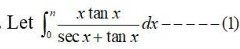
259 ∫0nxtanxsecx+tanxdx

8 Views|Posted a year ago
Asked by Vishal Baghel
S
a year ago

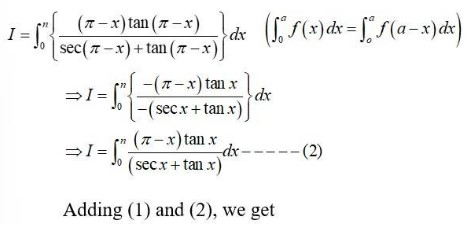
2I=∫0nπtanxsecx+tanxdx⇒2I=π∫0nsinxcosx1cosx+sinxcosxdx⇒2I=π∫0πsinx+1−11+sinxdx⇒2I=π∫0π1.dx−π∫0π11+sinxdx⇒2I=π∫0π1.dx−π∫0π(1−sinx)(1+sinx)(1−sinx)dx

⇒2I=π[x]0π−π∫0π1−sinxcos2xdx⇒2I=π2−π∫0π(sec2x−tanxsecx)dx⇒2I=π2−π[tanx−secx]0π

⇒2I=π2−π[tanπ−secπ−tan0+sec0]⇒2I=π2−π[0−(−1)−0+1]⇒2I=π2−2π⇒2I=π(π−2)I=π2(π−2)

Thumbs Up IconUpvote Thumbs Down Icon
New answer posted•a year ago

258. ∫0π/2sin2xtan−1(sinx)dx

4 Views|Posted a year ago
Asked by Vishal Baghel
S
a year ago

Let I = ∫0π/2sin2xtan−1(sinx)dx

= ∫0π22sinxcosxtan−1(sinx)dx

Putting sin x = t =>cos xdx = dt.

whenx = 0, t = sin 0 = 0.

x=π/2 t=sinπ/2=1

? I = ∫012·ttan−1(t)dt

= 2[tan−t∫01tdt−∫01ddttan−t∫t dt dt]

= 2{[tan−1t×t22]01−∫0111+t2×t22dt}

= 2{[tan−1(1)×12−tan−1(0)×02]−12∫01(1+t2)−11+t2dt}

= 2[π8−0]−22{∫011+t21+t2dt−∫01dt1+t2}

= π4−∫01dt+[tan−1t]01

= −π4−[t]01+[tan−1(1)−tan−1(0)]

= π4−1+π4=2×π4−1=π2−1

...Read more

Thumbs Up IconUpvote Thumbs Down Icon
New answer posted•a year ago

257. ∫0π4sinx+cosx9+16sin2xdx

4 Views|Posted a year ago
Asked by Vishal Baghel
S
a year ago

Let I = ∫0π4sinx+cosx9+16sin2xdx

Let sin x – cos x = t. =>(cosx + sin x) dx = dt.

and (sin x – cos x)2 = t2

sin2x + cos2x – 2 sin x cos x = t2

1 – sin2x = t2.

sin2t = 1 - t2.

When x = 0, t = sin 0 – cos 0 = –1

? I = ∫−10 dt9+16(1−t2)=∫−10dt9+16−16t2

= ∫−10dt25−16t2

= ∫−10  dt16  (2516−t2)

= 116∫−10dt(54)2−t2

= 116[12×(54)log|54+t54−t|]−10{∫dxa2−x2=12alog|a+xa−x|}

= 116×42×5[log|5+4t5−4t|]−10

= 140[log5+4×05−4×0−log5+4(−1)5−4(−1)]

= 140[log55−log19]

= −140[log1−log9(−1)]

= 140[0−(−1)log9]

= 140log9

= 140log32=240log3

= 120log3

...Read more

Thumbs Up IconUpvote Thumbs Down Icon
New answer posted•a year ago

256. Kindly Consider the following

6 Views|Posted a year ago
Asked by Vishal Baghel
S
a year ago

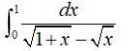
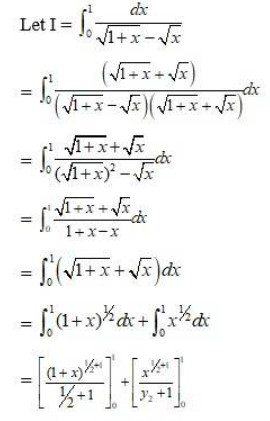
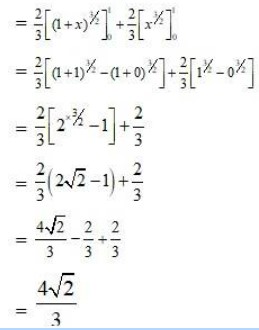
Kindly go through the solution

Thumbs Up IconUpvote Thumbs Down Icon