
Ncert Solutions Maths class 11th
Get insights from 1.6k questions on Ncert Solutions Maths class 11th, answered by students, alumni, and experts. You may also ask and answer any question you like about Ncert Solutions Maths class 11th
- 1.6k
Questions
- 0
Discussions
- 0
Active Users
- 83
Followers
Have a question about Ncert Solutions Maths class 11th? Ask our experts
Keep it short & simple. Type complete word. Avoid abusive language.
If the normal at an end of a latus rectum of an ellipse passes through an extremity of the minor axis, then the eccentricity e of the ellipse satisfies:
If the normal at an end of a latus rectum of an ellipse passes through an extremity of the minor axis, then the eccentricity e of the ellipse satisfies:
Equation of normal to the ellipse x²/a² + y²/b² = 1 at (x? , y? ) is a²x/x? - b²y/y? = a² - b².
At the point (ae, b²/a):
a²x/ (ae) - b²y/ (b²/a) = a² - b²
It passes through (0, -b).
a² (0)/ (ae) - b² (-b)/ (b²/a) = a² - b²
ab = a² - b²
Since b² = a² (1-e²), a²-b² = a²e².
ab = a²e²
a²b² = a? e?
a² (a² (1-e²)
 Upvote

The common difference of the A.P. b?, b?, ., b? is 2 more than the common difference of A.P. a?, a?, ., a?. If a? = –159, a? = –399 and b? = a?, then b? is equal to:
<!-- [if !supportLineBreakNewLine]-->
<!--[endif]-->
The common difference of the A.P. b?, b?, ., b? is 2 more than the common difference of A.P. a?, a?, ., a?. If a? = –159, a? = –399 and b? = a?, then b? is equal to:
<!-- [if !supportLineBreakNewLine]-->
<!--[endif]-->
Let the first A.P. be a? , a? + d, a? + 2d.
a? = a? + 39d = -159
a? = a? + 99d = -399
Subtracting the equations, 60d = -240 ⇒ d = -4.
Substituting d back, a? + 39 (-4) = -159 ⇒ a? - 156 = -159 ⇒ a? = -3.
Now, for the second A.P. with first term b? and common difference D = d+2 = -2.
b? = a?
⇒ b? + 99D =
Upvote Let L denote the line in the xy-plane with x and y intercepts as 3 and 1 respectively. Then the image of the point (–1, –4) in this line is:
Let L denote the line in the xy-plane with x and y intercepts as 3 and 1 respectively. Then the image of the point (–1, –4) in this line is:
Equation of line is x/3 + y/1 = 1
⇒ x + 3y - 3 = 0
The image (x? , y? ) of point (-1, -4) is given by:
(x? - (-1)/1 = (y? - (-4)/3 = -2 (1 (-1) + 3 (-4) - 3) / (1² + 3²)
(x? + 1)/1 = (y? + 4)/3 = -2 (-1 - 12 - 3)/10 = -2 (-16)/10 = 16/5
x? + 1 = 16/5 ⇒ x? = 11/5
(y? + 4)/3 = 16/5 ⇒ y? + 4 = 48/5 ⇒ y? =
Upvote For all twice differentiable functions f: R → R, with f(0) = f(1) = f'(0) = 0,
For all twice differentiable functions f: R → R, with f(0) = f(1) = f'(0) = 0,
Applying Rolle's theorem in for function f (x), there exists c such that f' (c) = 0, c ∈ (0,1).
Again applying Rolle's theorem in [0, c] for function f' (x), there exists c? such that f' (c? ) = 0, c? ∈ (0, c).
Option A is correct.
Upvote If α and β are the roots of the equation 2x(2x + 1) = 1, then β is equal to:
<!-- [if !supportLineBreakNewLine]-->
<!--[endif]-->
If α and β are the roots of the equation 2x(2x + 1) = 1, then β is equal to:
<!-- [if !supportLineBreakNewLine]-->
<!--[endif]-->
Given equation is 2x (2x + 1) = 1 ⇒ 4x² + 2x - 1 = 0. Roots of the equation are α and β.
∴ α + β = -2/4 = -1/2 ⇒ β = -1/2 - α
and
4α² + 2α - 1 = 0 ⇒ α² = (1-2α)/4 = 1/4 - α/2
Now
α = 1/2 - 2α²
Substituting into the expression for β:
β = -1/2 - (1/2 - 2α²) = -1 + 2α²
Upvote The angle of elevation of the summit of a mountain from a point on the ground is 45°. After climbing up one km towards the summit at an inclination of 30° from the ground, the angle of elevation of the summit is found to be 60°. Then the height (in km ) of the summit from the ground is:
The angle of elevation of the summit of a mountain from a point on the ground is 45°. After climbing up one km towards the summit at an inclination of 30° from the ground, the angle of elevation of the summit is found to be 60°. Then the height (in km ) of the summit from the ground is:
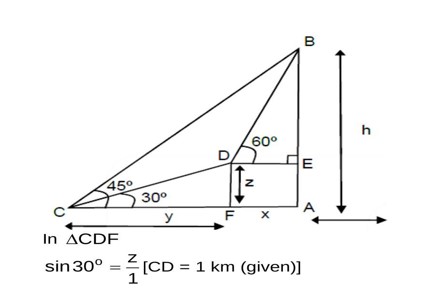
In ΔCDF
sin 30° = z/1 [CD = 1 km (given)]
z = 1/2
cos 30° = y/1 ⇒ y = √3/2
Now in ΔABC
tan 45° = h/ (x+y)
⇒ h = x+y
⇒ x = h - √3/2
Now
In ΔBDE,
tan 60° = (h-z)/x
√3x = h - z
√3 (h - √3/2) = h - 1/2
√3h - 3/2 = h - 1/2
h (√3 - 1) = 1
h = 1/ (√3-1) km
Upvote Let PQ be a diameter of the circle x² + y² = 9. If α and β are the lengths of the perpendiculars from P and Q on the straight line, x + y = 2 respectively, then the maximum value of αβ is.
Let PQ be a diameter of the circle x² + y² = 9. If α and β are the lengths of the perpendiculars from P and Q on the straight line, x + y = 2 respectively, then the maximum value of αβ is.
Let P (2cosθ, 2sinθ)
∴ Q (-2cosθ, -2sinθ)
Given line x+y-2=0
∴ α = |2cosθ + 2sinθ – 2| / √2
β = |-2cosθ - 2sinθ – 2| / √2
∴ αβ = √2 (cosθ + sinθ – 1) · √2 (cosθ + sinθ + 1)
= 2|cos²θ + sin²θ + 2sinθcosθ – 1| = 2|sin2θ|
Max |sin2θ| = 1
∴ maximum αβ = 2.
Upvote A test consists of 6 multiple choice questions, each having 4 alternative answers of which only one is correct. The number of ways, in which a candidate answers all six questions such that exactly four of the answers are correct, is
<!-- [if !supportLineBreakNewLine]-->
<!--[endif]-->
A test consists of 6 multiple choice questions, each having 4 alternative answers of which only one is correct. The number of ways, in which a candidate answers all six questions such that exactly four of the answers are correct, is
<!-- [if !supportLineBreakNewLine]-->
<!--[endif]-->
Ways of selecting correct questions =? C? = 15
Ways of doing them correct = 1
Ways of doing remaining 2 questions incorrect = 3² = 9
∴ No. Of ways = 15 × 1 × 9 = 135
Upvote Let a₁, a₂, . aₙ be a given A.P. whose common difference is an integer and Sₙ = a₁ + a₂ + … + aₙ. If a₁ = 1, aₙ = 300 and 15 ≤ n ≤ 50, then the ordered pair (Sₙ−₄, aₙ−₄) is equal to:
Let a₁, a₂, . aₙ be a given A.P. whose common difference is an integer and Sₙ = a₁ + a₂ + … + aₙ. If a₁ = 1, aₙ = 300 and 15 ≤ n ≤ 50, then the ordered pair (Sₙ−₄, aₙ−₄) is equal to:
Given,
300 = 1 + (N – 1)d
⇒ (N − 1)d = 299
∴ (N, d) = (24,13) is the only possible pair
∴ a? = 1 + 19 (13) = 248 and, S? = (1+248)/2 × 20
= 2490
Upvote