
Ncert Solutions Maths class 11th
Get insights from 1.6k questions on Ncert Solutions Maths class 11th, answered by students, alumni, and experts. You may also ask and answer any question you like about Ncert Solutions Maths class 11th
- 1.6k
Questions
- 0
Discussions
- 0
Active Users
- 83
Followers
Have a question about Ncert Solutions Maths class 11th? Ask our experts
Keep it short & simple. Type complete word. Avoid abusive language.
Which of the following is correct for a reaction to be spontaneous?
Which of the following is correct for a reaction to be spontaneous?
The locus of the point of intersection of the lines = 0 is a conic, whose eccentricity is…………………
The locus of the point of intersection of the lines = 0 is a conic, whose eccentricity is…………………
Let A1, A2, A3,………. be squares such that for each the length of the side of An equals the length of diagonal of An+1. If the length of A1 is 12cm then smallest value of an for which area of An is less than one, is………………….
Let A1, A2, A3,………. be squares such that for each the length of the side of An equals the length of diagonal of An+1. If the length of A1 is 12cm then smallest value of an for which area of An is less than one, is………………….
Let an be the side of square An
a1 = 12
an = 12
 Upvote

The image of the point (3, 5) in the line x – y + 1 = 0, lies on:
The image of the point (3, 5) in the line x – y + 1 = 0, lies on:
Kindly consider the following figure
Upvote The integer ‘k’ for which the inequality x2 – 2(3k – 1) x + 8k2 – 7 > 0 is valid for every x in R, is:
The integer ‘k’ for which the inequality x2 – 2(3k – 1) x + 8k2 – 7 > 0 is valid for every x in R, is:
a = 1 > 0 and D < 0
4 (3k – 1)2 – 4 (8k2 – 7) < 0
K = 3
Upvote All possible values of θ for which sin 2θ + tan 2θ > 0 lie in:
All possible values of θ for which sin 2θ + tan 2θ > 0 lie in:
sin 2 + tan 2 > 0
Let tan = x
Upvote A man is walking on a straight line. The arithmetic mean of the reciprocals of the intercepts of the line on the coordinate axes is Three stones A, B and C are placed at the point (1, 1), (2, 2) and (4, 4) respectively. Then which of these stones is / are on the path of the man?
A man is walking on a straight line. The arithmetic mean of the reciprocals of the intercepts of the line on the coordinate axes is Three stones A, B and C are placed at the point (1, 1), (2, 2) and (4, 4) respectively. Then which of these stones is / are on the path of the man?
According to question,
Equation of required line is
Obviously B (2, 2) satisfying condition (i)
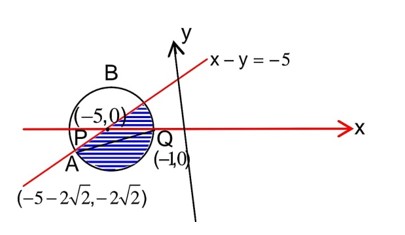
Upvote Let z be those complex numbers which satisfy
<!-- [if gte mso 9]><xml>
If the maximum value of <!-- [if gte mso 9]><xml>
Let z be those complex numbers which satisfy
<!-- [if gte mso 9]><xml>
If the maximum value of <!-- [if gte mso 9]><xml>
->Represent a circle
->Represent a line X – y
So max |z + 1|2 = AQ2
Hence a + b = 48
Upvote The total number of 4-digit numbers whose greatest common divisor with 18 is 3, is…….
The total number of 4-digit numbers whose greatest common divisor with 18 is 3, is…….
18 = 32 * 2
For G.C.D to be 3. no. of four digits should be only multiple of 3, but not multiple of 9 & also should not be even.
As we know no. of the form &nb
Upvote If the arithmetic mean and geometric mean of the pth and qth terms of the sequence -16,8,-4,2,…. satisfy the equation 4x2 – 9x + 5 = 0, then p + q is equation to……….
If the arithmetic mean and geometric mean of the pth and qth terms of the sequence -16,8,-4,2,…. satisfy the equation 4x2 – 9x + 5 = 0, then p + q is equation to……….
Given sequence is -16, 8, -4, 2, .
are in G.P. with first term a = -16 & common ratio r =
Now
So A.M. = -8
Given equation is 4x2 – 9x + 5 = 0 gives
From roots we get possible value of b = 1 so
&nb
Upvote