
Ncert Solutions Maths class 11th
Get insights from 1.6k questions on Ncert Solutions Maths class 11th, answered by students, alumni, and experts. You may also ask and answer any question you like about Ncert Solutions Maths class 11th
- 1.6k
Questions
- 0
Discussions
- 0
Active Users
- 83
Followers
Have a question about Ncert Solutions Maths class 11th? Ask our experts
Keep it short & simple. Type complete word. Avoid abusive language.
6. Let (r + 1)th be the general term of (
So, Tr-1 = 12Cr (x2)12–r (–yx)r
= (–1)r12Crx24–2ryrxr
= (–1)r12Cr
= (-1)r12Cr
 Upvote

5. Let (r + 1)th term be the general term of (x2–y)6.
So, Tr-1 = 6Cr (x2)6-r (-y)r
= (–1)r .6Cr . .
Upvote 4. Let a5b7 occurs in (r + 1)th term of [removed]a – 2b)12.
Now, Tr+1 = 12Cra12-r (–2b)r
= (–1)r12Cra12–r . 2r. br
Comparing indices of a and b in Tr-1 with a5 and b7 we get, r = 7
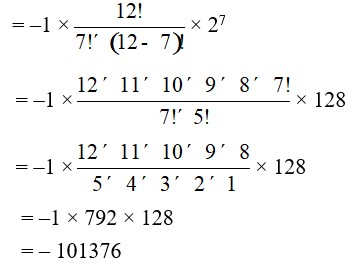
So, co-efficient of a5b7 is (–1)712C7 27
 Upvote
<p><strong>4. a<sup>5</sup>b<sup>7</sup>in (a – 2b)<sup>12</sup>.</strong></p>
<p><strong>2. a<sup>5</sup>b<sup>7</sup>in (a – 2b)<sup>12</sup>.</strong></p>
2. 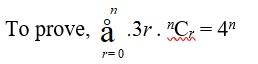
By binomial theorem,
(a + b)n = nC0 (a)n (b)0 + nC1 (a)n–1 (b)1 + …………. + nCr (a)n–r (b)r + …………… + nCn (a)n–n (b)n
Where, b0 = 1 = an–n
So, (a + b)n = nCr (a)n–r (b)r
Putting a = 1 and b = 3 such that a + b = 4, we can rewrite the above equation as
(1 + 3)n = nCr (1)n–r.3r
=>4n = .nCr
Hence proved.
Upvote 1. Show that 9n+1– 8n – 9 is divisible by 64, whenever n is a positive integer.
1. Show that 9n+1– 8n – 9 is divisible by 64, whenever n is a positive integer.
1. For a number x to be divisible by y, we can write x as a factor of y i.e., x = ky where k is some natural number. Thus in order for 9n+1 – 8n – 9 to be divisible by 64 we need to show that 9n+1 – 8n – 9 = 64k where k is some natural number.
We have, by binomial theorem
(1 + a)m = mC0 + mC1 (a
Upvote 24. Let P (n) be the statement “ 2n+7< (n+3)2”
ofn=1
P (1): 2
9<16 which is true. This P (1) is true.
Suppose P (k) is true.
P (k)= 2k+7< (k+3)2 . (1)
Lets prove that P (k +1) is also true.
“ 2 (k + 1) + 7 < (k + 4)2=k2+ 8k + 16”
P (k +1) = 2 (k +1) +7 = (2k +7) +2
< (k +3)2+ 2 (
Upvote 23. Let
Put n= 1,
is a multiple of 27.
Which is true.
Assume that P(k) is true for some natural no. k.
P(k)= be a multiple of 27
i.e,
(1)
We want to prove that P(k+1) is also true.
Now,
(Using 1)
is true when P(k) is true.
Hence, by P.M.I. P(n) is true for every po
Upvote