
Ncert Solutions Maths class 11th
Get insights from 1.6k questions on Ncert Solutions Maths class 11th, answered by students, alumni, and experts. You may also ask and answer any question you like about Ncert Solutions Maths class 11th
- 1.6k
Questions
- 0
Discussions
- 0
Active Users
- 83
Followers
Have a question about Ncert Solutions Maths class 11th? Ask our experts
Keep it short & simple. Type complete word. Avoid abusive language.
Which of the following sentences are statements? Give reasons for your answer.
(i) There are 35 days in a month.
(ii) Mathematics is difficult.
(iii) The sum of 5 and 7 is greater than 10.
(iv) The square of a number is an even number.
(v) The sides of a quadrilateral have equal length.
(vi) Answer this question.
(vii) The product of (–1) and 8 is 8.
(viii) The sum of all interior angles of a triangle is 180°.
(ix) Today is a windy day.
(x) All real numbers are complex numbers.
This is a Mathematical Reasoning Solutions Type Questions as classified in NCERT Exemplar
(i) This sentence is false because there are less than 35 days in a month. Hence it is a statement.
(ii) This sentence differs to individual, as some may find it difficult and some may find it easy.
 Upvote

15. Find the expansion of (3x2– 2ax + 3a2)3 using binomial theorem.
15. Find the expansion of (3x2– 2ax + 3a2)3 using binomial theorem.
15.
=
We know that by binomial theorem,
=
=
Then,
= (3x2)3 + + +
= 27x6 + + +
= 27x6 + + + [ ]
= 27x6 + [ ] + [ ] + [ ]
= 27x6 +
= 27x6– 54ax5
Upvote 14. If a and b are distinct integers, prove that a – b is a factor of an– bn, whenever n is a positive integer.
[Hint: write an= (a – b + b)n and expand]
14. If a and b are distinct integers, prove that a – b is a factor of an– bn, whenever n is a positive integer.
[Hint: write an= (a – b + b)n and expand]
14. For (a – b) to be a factor of an – b nwe need to show (an – bn) = (a – b)k as k is a natural number.
We have, for positive n
an = =
=>an = nC0(a – b)n + nC1(a – b)n -1b + nC2(a – b)n – 2b2 + ………… +nCn-1 + nCnbn
=>an= + nC1 + nC2 + …………….…+ nCn-1 + [Since, nC0 = 1 and
Upvote 13. Find a if the coefficients of x2and x3in the expansion of (3 + ax)9are equal.
13. Find a if the coefficients of x2and x3in the expansion of (3 + ax)9are equal.
13. The general term of the expansion is
Tr+1 = 9Cr
= 9Cr
At r = 2,
T2+1 = 9C2
= 37a2x2
= / 37a2x2
= 36 ×37a2x2
At r = 3,
T3+1 = 9C3
= 36a3x3
= 9'8'7'6!/3'2'1'6! 36a3x3
= 84 ×36a3x3
Given that,
Co-efficient of = co-efficient of
=> 36 × = 84 ×
Upvote 12. Find a, b and n in the expansion of (a + b)n if the first three terms of the expansion are 729, 7290 and 30375, respectively.
12. Find a, b and n in the expansion of (a + b)n if the first three terms of the expansion are 729, 7290 and 30375, respectively.
1.The general term of the expansion (a + b)n is given by
Tr +1 = nCran–rbr
So, T1 = nC0an = an
T2 = nC1an-1b = an-1 b = an-1b = nan-1b
T3 = nC2an-2b2 = an-2b2 = an-2b2 = an-2b2
Given,
T1 = 729
=>an = 729 ------------------ (1)
T2 = 7290
=>nan–1b = 7290 ------------- (2)
T3 = 30375
=> an–2b2 = 30375
Upvote 11. Find a positive value of m for which the coefficient of x2in the expansion (1 + x)m is 6.
11. Find a positive value of m for which the coefficient of x2in the expansion (1 + x)m is 6.
11. The general term of the expansion is given by,
Tr+1 = mCr
= mCrxr
At r = 2,
T2+1 = mC2x2
Given that, co-efficient of x2 = 6
=>mC2 = 6
=> = 6
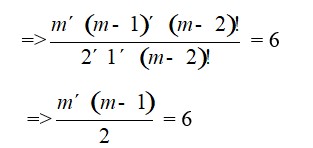
=>m2 – m = 12
=>m2 – m – 12 = 0
=>m2 + 3m – 4m – 12 = 0
=>m (m + 3) – 4 (m+ 3) = 0
=> (m – 4) (m + 3) = 0
=>m = 4 and m = –3
Since, we need a po
Upvote 10. Prove that the coefficient of xn in the expansion of (1 + x)2n is twice the coefficientof xn in the expansion of (1 + x)2n-1.
10. Prove that the coefficient of xn in the expansion of (1 + x)2n is twice the coefficientof xn in the expansion of (1 + x)2n-1.
10. General term of the expansion (1 + x)2n is
Tr+1 = 2nCr (1)2n-r(x)r
So, co-efficient of xn (i.e. r = n) is 2nCn
Similarly general term of the expansion (1 + x)2n–1 is
Tr+1 = 2n-1Cr (1)2n–1–rxr
And co-efficient of xn i.e. when r = n is 2n-1Cn
Therefore,
= 
= ÷
= ×
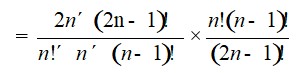
=
=
Upvote 9. The coefficients of the (r – 1)th, rthand (r + 1)thterms in the expansion of (x + 1)n are in the ratio 1 : 3 : 5. Find n and r.
9. The coefficients of the (r – 1)th, rthand (r + 1)thterms in the expansion of (x + 1)n are in the ratio 1 : 3 : 5. Find n and r.
9. The general term of the expansion (x +1)n is
Tr+1 = nCrxn–r1r
i.e. co-efficient of term = nCr
So, co-efficient of term =nC(r–1) – 1 = nCr – 2
Similarly, co-efficient of rth term = nCr – 1
Given that, nCr – 2 :nCr – 1 : nCr = 1 : 3 : 5
We have,

=
=> × =
Upvote 8. In the expansion of (1 + a)m+n,prove that coefficients of an and an are equal.
8. In the expansion of (1 + a)m+n,prove that coefficients of an and an are equal.
8. The general term of the expansion (1 + a)m+n is
Tr+1 = m+nCrar [since, 1m+n-r = 1]
At r = m we have,
Tm+1 = m+nCmam
= (a)m
= am - (1)
Similarly at r = n we have,
Tn+1 = m+nCnan
= (a)n
= an - (2)
Hence from (1) & (2),
Co-efficient of am = Co-efficient of an =
Upvote 7. General term of the expansion is given by
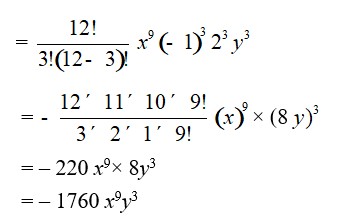
Tr+1 = 12Cr
For 4th term, r + 1 = 4 i.e., r = 3
Therefore, T4 = T3+1 = 12C3
 Upvote