
Overview
Get insights from 152 questions on Overview, answered by students, alumni, and experts. You may also ask and answer any question you like about Overview
- 152
Questions
- 0
Discussions
- 0
Active Users
- 0
Followers
Have a question about Overview? Ask our experts
Keep it short & simple. Type complete word. Avoid abusive language.
A resistor develops 500J of thermal energy in 20 s when a current of 1.5A is passed through it. If the current is increased from 1.5 A to 3 A, what will be the energy developed in 20 s.
<!-- [if !supportLineBreakNewLine]-->
<!--[endif]-->
A resistor develops 500J of thermal energy in 20 s when a current of 1.5A is passed through it. If the current is increased from 1.5 A to 3 A, what will be the energy developed in 20 s.
<!-- [if !supportLineBreakNewLine]-->
<!--[endif]-->
Heat generated in the resistance
H = i²RT
H? = 500 = (1.5)²R (20) ⇒ R = 500/45 = 11.11 Ω
H? = (3)²R (20) = 9 × (500/45) × 20 = 2000 J.
 Upvote

The resistance of a conductor at 15°C is 16Ω and at 100°C is 20Ω. What will be the temperature coefficient of resistance of the conductor?
The resistance of a conductor at 15°C is 16Ω and at 100°C is 20Ω. What will be the temperature coefficient of resistance of the conductor?
R = R? [1 + α? T]
⇒ 16 = R? [1 + α (15 - T? )]
20 = R? [1 + α (100 - T? )]
Assuming T? = 0°C:
16 = R? (1 + 15α)
20 = R? (1 + 100α)
Dividing the equations:
16/20 = (1+15α)/ (1+100α)
16 + 1600α = 20 + 300α
1300α = 4
α = 4/1300 ≈ 0.003 °C? ¹
Upvote Consider an electrical circuit containing a two way switch 'S'. Initially S is open and then T? is connected to T?. As the current in R = 6Ω attains a maximum value of steady state level, T? is disconnected from T? and immediately connected to T?. Potential drop across r = 3Ω resistor immediately after T? is connected to T? is _______ V. (Round off to the Nearest Integer)
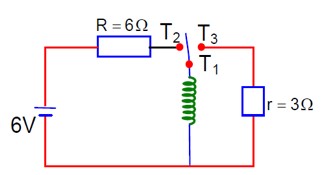
Consider an electrical circuit containing a two way switch 'S'. Initially S is open and then T? is connected to T?. As the current in R = 6Ω attains a maximum value of steady state level, T? is disconnected from T? and immediately connected to T?. Potential drop across r = 3Ω resistor immediately after T? is connected to T? is _______ V. (Round off to the Nearest Integer)
When T? & T? are connected, at steady state current, I becomes
I = 6V/6Ω = 1A
Now when T? & T? are connected, the current through the inductor, just after connecting, remains same. So
V? Ω = 1A × 3Ω = 3volt.
Upvote An electric bulb rated as 200 W at 100 V is used in a circuit having 200 V supply. The resistance R that must be put in series with the bulb so that the bulb delivers the same power is _______ Ω.
An electric bulb rated as 200 W at 100 V is used in a circuit having 200 V supply. The resistance R that must be put in series with the bulb so that the bulb delivers the same power is _______ Ω.
Given: Power in R_B = 200 W, R_B = 50 Ω, V_source = 200 V
I² R_B = 200
I² (50) = 200
I² = 4 ⇒ I = 2A
Also, I = V_source / (R + R_B)
2 = 200 / (R + 50)
2 (R + 50) = 200
R + 50 = 100
R = 50Ω
Upvote In the given figure, a battery of emf E is connected across a conductor PQ of length 'l' and different area of cross- sections by having radii r? and r? (r? < r?). Choose the correct option as one moves from P to Q:
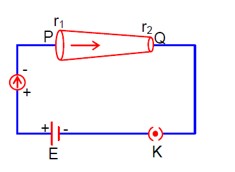
In the given figure, a battery of emf E is connected across a conductor PQ of length 'l' and different area of cross- sections by having radii r? and r? (r? < r?). Choose the correct option as one moves from P to Q:
i = constant
v ∝ E & E ∝ 1/r² So, E increases with decrease in the radius.
also v ∝ E
So, drift speed increases.
Upvote A 16Ω wire is bend to form a square loop. A 9V supply having internal resistance of 1Ω is connected across one of its sides. The potential drop across the diagonals of the square loop is __________ x 10?¹ V.
A 16Ω wire is bend to form a square loop. A 9V supply having internal resistance of 1Ω is connected across one of its sides. The potential drop across the diagonals of the square loop is __________ x 10?¹ V.
Each side of the square has a resistance of 16/4 = 4Ω.
The side AC has the 9V, 1Ω source.
The other three sides (AB, BD, DC) form a path with resistance 4+4+4 = 12Ω.
This is in parallel with the side AC (4Ω).
Total resistance of the loop part: (12×4)/ (12+4) = 48/16 = 3Ω.
Total resistance of the circuit
Upvote The given potentiometer has its wire of resistance 10Ω. When the sliding contact is in the middle of the potentiometer wire, the potential drop across 2Ω resistor is :
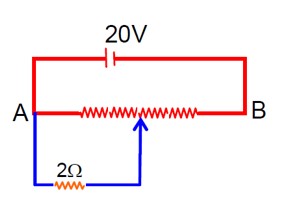
The given potentiometer has its wire of resistance 10Ω. When the sliding contact is in the middle of the potentiometer wire, the potential drop across 2Ω resistor is :
Applying nodal analysis at point X with potential xV:
(x-20)/5 + (x-0)/2 + (x-20)/5 = 0
2 (x-20) + 5x + 2 (x-20) = 0
9x - 80 = 0 => x = 80/9 V
Potential drop across 2Ω resistor = x = 80/9 V.
(Note: There seems to be a discrepancy in the provided solution and standard circuit analysis. The provided solu
Upvote In the given potentiometer circuit arrangement, the balancing length AC is measured to be 250 cm. When the galvanometer connection is shifted from point (1) to point (2) in the given diagram, the balancing length becomes 400 cm. The ratio of the emf of two cells, ε₁/ε₂,, is:
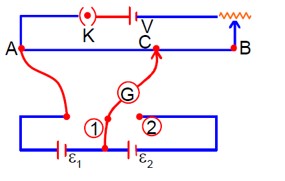
In the given potentiometer circuit arrangement, the balancing length AC is measured to be 250 cm. When the galvanometer connection is shifted from point (1) to point (2) in the given diagram, the balancing length becomes 400 cm. The ratio of the emf of two cells, ε₁/ε₂,, is:
ε? = 250 × Potential Gradient
ε? + ε? = 400 × Potential Gradient
(ε? )/ (ε? + ε? ) = 250/400 = 5/8
By solving above
ε? /ε? = 5/3
Upvote 
