
Overview
Get insights from 152 questions on Overview, answered by students, alumni, and experts. You may also ask and answer any question you like about Overview
- 152
Questions
- 0
Discussions
- 0
Active Users
- 0
Followers
Have a question about Overview? Ask our experts
Keep it short & simple. Type complete word. Avoid abusive language.
If the galvanometer does not show any deflection in the circuit shown, the value of is given by:
`
If the galvanometer does not show any deflection in the circuit shown, the value of is given by:
`
The magnitude and direction of the current in the following circuit is
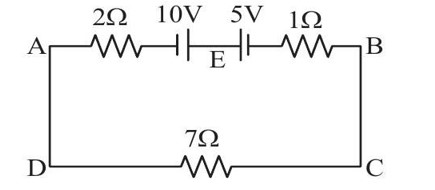
The magnitude and direction of the current in the following circuit is
First band  Red
2nd band Red
3rd band =Orange (Multiplier)
4th band = Gold (Tolerance)
 Upvote

Two wires of same length and thickness having specific resistance 6 Ω cm and 3 Ω cm respectively are connected in parallel. The effective resistivity is ρ Ω cm. The value of ρ, to the nearest integer, is.
Two wires of same length and thickness having specific resistance 6 Ω cm and 3 Ω cm respectively are connected in parallel. The effective resistivity is ρ Ω cm. The value of ρ, to the nearest integer, is.
R_eq = (R? )/ (R? +R? ) ⇒ p (l)/ (2A) = [ (p? l/A) (p? l/A)] / [ (p? l/A) + (p? l/A)]
⇒ ρ/2 = (p? )/ (p? +p? ) ⇒ ρ = (2p? p? )/ (p? +p? ) = (2 × 6 × 3)/9 = 4 Ωcm
Upvote Consider a 72 cm long wire AB as shown in the figure. The galvanometer jockey is placed at P on AB at a distance x cm from A. The galvanometer shows zero deflection.
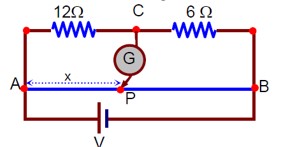
The value of x, to nearest integer, is.
Consider a 72 cm long wire AB as shown in the figure. The galvanometer jockey is placed at P on AB at a distance x cm from A. The galvanometer shows zero deflection.
The value of x, to nearest integer, is.
12/x = 6/ (72-x) ⇒ x = 144 - 2x ⇒ x = 144/3 = 48cm
Upvote Sea-water at a frequency f = 9 × 10² Hz, has permittivity ε = 80ε₀ and resistivity ρ = 0.25Ωm. Imagine a parallel plate capacitor is immersed in seawater and is driven by an alternating voltage source V(t) = V₀sin(2πft). Then the conduction current density become 10ˣ times the displacement current density after time t = 1/800 s. The value of x is ______. [Given: 1/(4πε₀) = 9 × 10⁹ Nm²C⁻²]
Sea-water at a frequency f = 9 × 10² Hz, has permittivity ε = 80ε₀ and resistivity ρ = 0.25Ωm. Imagine a parallel plate capacitor is immersed in seawater and is driven by an alternating voltage source V(t) = V₀sin(2πft). Then the conduction current density become 10ˣ times the displacement current density after time t = 1/800 s. The value of x is ______. [Given: 1/(4πε₀) = 9 × 10⁹ Nm²C⁻²]
Conduction current density, J? = E/ρ = (V/d) / ρ = (V? sin (2πft) / (pd)
Displacement current density, J? = ε (dE/dt) = (ε/d) (dV/dt) = (2πfε/d) * V? cos (2πft)
The ratio of their magnitudes is:
J? / J? = tan (2πft) / (2πfε? ρ) = tan (2π * 900) / (2π * 9 * 10? * 80ε? * 0.25) = 10?
Upvote The equivalent resistance of series combination of two resistors is 's'. When they are connected in parallel, the equivalent resistance is 'p'. If s = np, then the minimum value for n is . (Round off to the Nearest Integer)
The equivalent resistance of series combination of two resistors is 's'. When they are connected in parallel, the equivalent resistance is 'p'. If s = np, then the minimum value for n is . (Round off to the Nearest Integer)
For series combination: s = R? + R?
For parallel combination: p = (R? ) / (R? + R? )
Given the condition s = np:
R? + R? = n * (R? ) / (R? + R? )
(R? + R? )² = nR? R?
R? ² + 2R? R? + R? ² = nR? R?
R? ² - 2R? R? + R? ² + 4R? R? = nR? R?
(R? - R? )² = (n - 4)R?
(R? - R? )² / (R? ) = n - 4
n = 4 + (R? -
Upvote A current of 10 A exists in a wire of cross-sectional area of 5mm² with a drift velocity of 2×10⁻³ ms⁻¹. The number of free electrons in each cubic meter of the wire is ……………
A current of 10 A exists in a wire of cross-sectional area of 5mm² with a drift velocity of 2×10⁻³ ms⁻¹. The number of free electrons in each cubic meter of the wire is ……………
Given:
- i = 10
- e = 1.6 x 10? ¹? C
- A = 5 x 10?
- V = 2 x 10? ³
The formula for current is I = neAV.
Rearranging for n (number of free electrons per unit volume):
n = I / (eAV)
n = 10 / (1.6 × 10? ¹? × 5 × 10? × 2 × 10? ³)
n = 625 × 10²?
Upvote A galvanometer of resistance G is converted into a voltmeter of range 0 - 1V by connecting a resistance R? in series with it. The additional resistance that should be connected in series with R? to increase the range of the voltmeter to 0 – 2V will b
A galvanometer of resistance G is converted into a voltmeter of range 0 - 1V by connecting a resistance R? in series with it. The additional resistance that should be connected in series with R? to increase the range of the voltmeter to 0 – 2V will b

Four resistance 40Ω, 60Ω, 90Ω, and 110Ω make the arms of a quadrilateral ABCD. Across AC is a battery of emf 40 V and internal resistance negligible. The potential difference across BD in V is
<!-- [if !supportLineBreakNewLine]-->
<!--[endif]-->
Four resistance 40Ω, 60Ω, 90Ω, and 110Ω make the arms of a quadrilateral ABCD. Across AC is a battery of emf 40 V and internal resistance negligible. The potential difference across BD in V is
<!-- [if !supportLineBreakNewLine]-->
<!--[endif]-->
i? = 40/100 = 2/5
i? = 40/200 = 1/5
V? – V? = 40i? = 40 × 2/5
V? – V? = 16
V? – Vd = 90i? = 90/5 = 18
V? – Vd = 18 – 16 = 2 volt
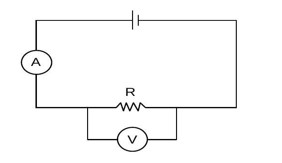
Upvote A circuit to verify Ohm's law uses ammeter and voltmeter in series or parallel connected correctly to the resistor. In the circuit:
<!-- [if !supportLineBreakNewLine]-->
<!--[endif]-->
A circuit to verify Ohm's law uses ammeter and voltmeter in series or parallel connected correctly to the resistor. In the circuit:
<!-- [if !supportLineBreakNewLine]-->
<!--[endif]-->
In Ohm's law experiment, ammeter is used in series because in series same current will flow through it. But voltmeter is used in parallel to resistor to measure the potential difference across it.
Upvote