
Overview
Get insights from 152 questions on Overview, answered by students, alumni, and experts. You may also ask and answer any question you like about Overview
- 152
Questions
- 0
Discussions
- 0
Active Users
- 0
Followers
Have a question about Overview? Ask our experts
Keep it short & simple. Type complete word. Avoid abusive language.
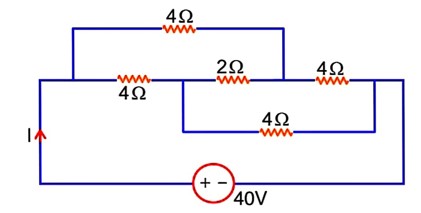
In an electric circuit, a cell of certain emf provides a potential difference of 1.25 V across a load resistance of <!-- [if gte mso 9]><xml>
In an electric circuit, a cell of certain emf provides a potential difference of 1.25 V across a load resistance of <!-- [if gte mso 9]><xml>
A Copper (Cu) rod of length 25cm and cross – sectional area 3 mm2 is joined with a similar aluminium (Al) rod as shown in figure. Find the resistance of the combination between the ends A and B.
(Take Resistivity of Copper = 1.7 × 10⁻⁸ <!-- [if gte mso 9]><xml>
Resistivity of Aluminium = 2.6 × 10⁻⁸ <!-- [if gte mso 9]><xml>
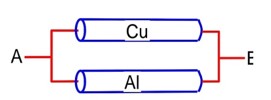
A Copper (Cu) rod of length 25cm and cross – sectional area 3 mm2 is joined with a similar aluminium (Al) rod as shown in figure. Find the resistance of the combination between the ends A and B.
(Take Resistivity of Copper = 1.7 × 10⁻⁸ <!-- [if gte mso 9]><xml>
Resistivity of Aluminium = 2.6 × 10⁻⁸ <!-- [if gte mso 9]><xml>
A resistor dissipates 192 J of energy in 1s when a current of 4A is passed4 through it. Now, when the current is doubled, the amount of thermal energy dissipated in 5s in________J.
A resistor dissipates 192 J of energy in 1s when a current of 4A is passed4 through it. Now, when the current is doubled, the amount of thermal energy dissipated in 5s in________J.
Using Heat equation : H = i2Rt
=>192 = (4)2 R (1)
H = (8)2 R (5)
=>H = 3840 J
 Upvote

The equivalent resistance of the given circuit between the terminals A and B is:
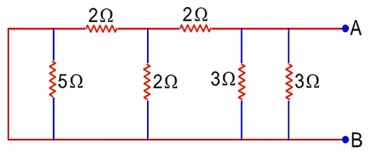
The equivalent resistance of the given circuit between the terminals A and B is:
Since
Upvote A square shaped wire with resistance of each side <!-- [if gte mso 9]><xml>
A square shaped wire with resistance of each side <!-- [if gte mso 9]><xml>

First, a set of n equal resistors of 10 <!-- [if gte mso 9]><xml>
First, a set of n equal resistors of 10 <!-- [if gte mso 9]><xml>
In series Req = nR = 10n
In parallel
n = 20
Upvote Two cells of same emf but different internal resistance r1 and r2 are connected in series with a resistance R. The value of resistance R, for which the potential difference across second cell is zero, if:
Two cells of same emf but different internal resistance r1 and r2 are connected in series with a resistance R. The value of resistance R, for which the potential difference across second cell is zero, if:
Given
E1 = E2 = E - (i)
Potential drop across second cell is
According to question VA – VB = 0
E2 lr2 = 0
Upvote Five identical cells each of internal resistance <!-- [if gte mso 9]><xml>
Five identical cells each of internal resistance <!-- [if gte mso 9]><xml>
What equal length of an iron wire and a copper-nickel alloy wire, each of 2mm diameter connected parallel to give an equivalent resistance of 3 <!-- [if gte mso 9]><xml>
(Given resistivities of iron and copper-nickel alloy wire are <!-- [if gte mso 9]><xml>
What equal length of an iron wire and a copper-nickel alloy wire, each of 2mm diameter connected parallel to give an equivalent resistance of 3 <!-- [if gte mso 9]><xml>
(Given resistivities of iron and copper-nickel alloy wire are <!-- [if gte mso 9]><xml>