Physics Current Electricity
Get insights from 213 questions on Physics Current Electricity, answered by students, alumni, and experts. You may also ask and answer any question you like about Physics Current Electricity
- 213
Questions
- 0
Discussions
- 0
Active Users
- 2
Followers
Have a question about Physics Current Electricity? Ask our experts
Keep it short & simple. Type complete word. Avoid abusive language.
A current of 10 A exists in a wire of cross-sectional area of 5mm² with a drift velocity of 2×10⁻³ ms⁻¹. The number of free electrons in each cubic meter of the wire is ……………
A current of 10 A exists in a wire of cross-sectional area of 5mm² with a drift velocity of 2×10⁻³ ms⁻¹. The number of free electrons in each cubic meter of the wire is ……………
Given:
- i = 10
- e = 1.6 x 10? ¹? C
- A = 5 x 10?
- V = 2 x 10? ³
The formula for current is I = neAV.
Rearranging for n (number of free electrons per unit volume):
n = I / (eAV)
n = 10 / (1.6 × 10? ¹? × 5 × 10? × 2 × 10? ³)
n = 625 × 10²?
 Upvote

A galvanometer of resistance G is converted into a voltmeter of range 0 - 1V by connecting a resistance R? in series with it. The additional resistance that should be connected in series with R? to increase the range of the voltmeter to 0 – 2V will b
A galvanometer of resistance G is converted into a voltmeter of range 0 - 1V by connecting a resistance R? in series with it. The additional resistance that should be connected in series with R? to increase the range of the voltmeter to 0 – 2V will b

Four resistance 40Ω, 60Ω, 90Ω, and 110Ω make the arms of a quadrilateral ABCD. Across AC is a battery of emf 40 V and internal resistance negligible. The potential difference across BD in V is
<!-- [if !supportLineBreakNewLine]-->
<!--[endif]-->
Four resistance 40Ω, 60Ω, 90Ω, and 110Ω make the arms of a quadrilateral ABCD. Across AC is a battery of emf 40 V and internal resistance negligible. The potential difference across BD in V is
<!-- [if !supportLineBreakNewLine]-->
<!--[endif]-->
i? = 40/100 = 2/5
i? = 40/200 = 1/5
V? – V? = 40i? = 40 × 2/5
V? – V? = 16
V? – Vd = 90i? = 90/5 = 18
V? – Vd = 18 – 16 = 2 volt
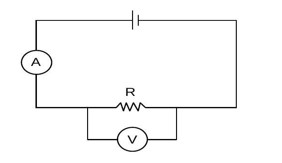
Upvote A circuit to verify Ohm's law uses ammeter and voltmeter in series or parallel connected correctly to the resistor. In the circuit:
<!-- [if !supportLineBreakNewLine]-->
<!--[endif]-->
A circuit to verify Ohm's law uses ammeter and voltmeter in series or parallel connected correctly to the resistor. In the circuit:
<!-- [if !supportLineBreakNewLine]-->
<!--[endif]-->
In Ohm's law experiment, ammeter is used in series because in series same current will flow through it. But voltmeter is used in parallel to resistor to measure the potential difference across it.
Upvote The value of current i1 flowing from A to C in the circuit diagram is:
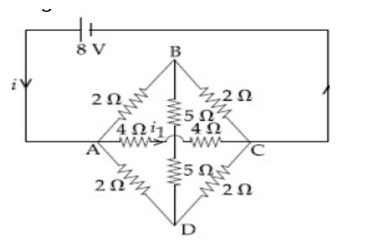
The value of current i1 flowing from A to C in the circuit diagram is:
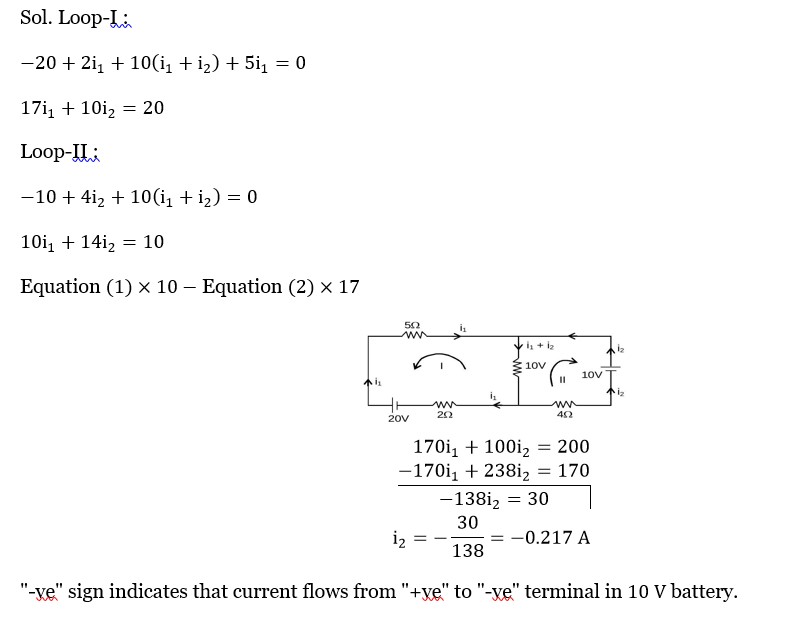
In the figure shown, the current in the 10 V battery is close to:
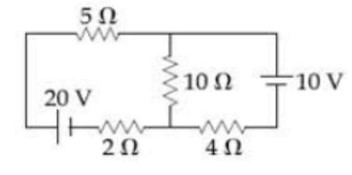
In the figure shown, the current in the 10 V battery is close to:
A battery of 3.0 V is connected to a resistor dissipating 0.5 W of power. If the terminal voltage of the battery is 2.5 V, the power dissipated within the internal resistance is:
<!-- [if !supportLineBreakNewLine]-->
<!--[endif]-->
A battery of 3.0 V is connected to a resistor dissipating 0.5 W of power. If the terminal voltage of the battery is 2.5 V, the power dissipated within the internal resistance is:
<!-- [if !supportLineBreakNewLine]-->
<!--[endif]-->
↑? (1) ε = 3
(2) ε – Ir = 2.5 V
⇒ Ir = 0.5
Now, IR = 2.5
⇒ R/r = 5.
⇒ PR/Pr = I²R/I²r = R/r = 5
⇒ Pr = 0.5/5 = 0.1
Upvote