
Physics Laws of Motion
Get insights from 189 questions on Physics Laws of Motion, answered by students, alumni, and experts. You may also ask and answer any question you like about Physics Laws of Motion
- 189
Questions
- 0
Discussions
- 0
Active Users
- 4
Followers
Have a question about Physics Laws of Motion? Ask our experts
Keep it short & simple. Type complete word. Avoid abusive language.
A block of mass 40kg slides over a surface, when a mass of 4kg is suspended through an inextensible massless string passing over frictionless pulley as shown below.
The coefficient of kinetic friction between the surface and block is 0.02. The acceleration of block is. (given g = 10 ms-2.)
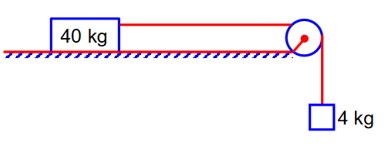
A block of mass 40kg slides over a surface, when a mass of 4kg is suspended through an inextensible massless string passing over frictionless pulley as shown below.
The coefficient of kinetic friction between the surface and block is 0.02. The acceleration of block is. (given g = 10 ms-2.)
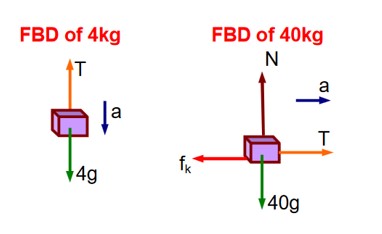
According to Newton’s laws of motion, we can write
4a = 4g – T . (1), and
40a = T - fk = T -  (40g) ……………… (2)
Adding equations (1) and (2), we can write
44a = 40 – 0.02 × (400) = 32
 Upvote

A 20 kg block B is suspended from a cord attached to a 40 kg cart A. Find the ratio of the acceleration of block in cases (i) and (ii) shown in the figure immediately after the system is released from rest. (Neglect friction)
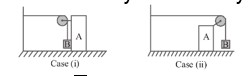
A 20 kg block B is suspended from a cord attached to a 40 kg cart A. Find the ratio of the acceleration of block in cases (i) and (ii) shown in the figure immediately after the system is released from rest. (Neglect friction)
Case I:
and
Also
After simplifying, we get
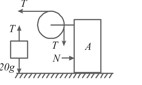
Acceleration of block
Case II:
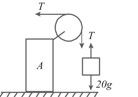
and
After simplifying above equation, we get
Ratio
Upvote The new white belt of a long horizontal conveyor is moving with a constant speed v = 3.0m/s. A small block of carbon is placed on the belt with zero initial velocity relative to the ground. The block will slip a bit before moving with the belt, leaving a black mark on the belt (figure). How long is that mark (in m) if the coefficient of kinetic friction between the carbon block and the belt is 0.20 and the coefficient of static friction is 0.30?

The new white belt of a long horizontal conveyor is moving with a constant speed v = 3.0m/s. A small block of carbon is placed on the belt with zero initial velocity relative to the ground. The block will slip a bit before moving with the belt, leaving a black mark on the belt (figure). How long is that mark (in m) if the coefficient of kinetic friction between the carbon block and the belt is 0.20 and the coefficient of static friction is 0.30?
A small elastic ball of mass m is placed at the apex of a inclined plane as shown in the figure below. The ball is allowed to slip without friction down the plane (along the dotted line), hit the ground (as shown) and bounce along it. If the height of the inclined plane is h and the coefficient of restitution between the ball and the ground is 0.5, then the distance AB, as marked on the figure, will be N × h, where N is
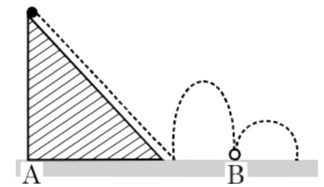
A small elastic ball of mass m is placed at the apex of a inclined plane as shown in the figure below. The ball is allowed to slip without friction down the plane (along the dotted line), hit the ground (as shown) and bounce along it. If the height of the inclined plane is h and the coefficient of restitution between the ball and the ground is 0.5, then the distance AB, as marked on the figure, will be N × h, where N is
Block of mass M slides down on frictionless incline as shown. The minimum friction coefficient so that block of mass m does not slide with respect to lower block is close to , the nearest integer to I is Take <!--[endif]--><!--[endif]-->
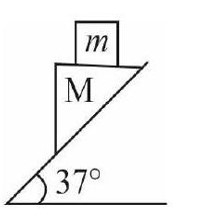
Block of mass M slides down on frictionless incline as shown. The minimum friction coefficient so that block of mass m does not slide with respect to lower block is close to , the nearest integer to I is Take <!--[endif]--><!--[endif]-->
Acceleration of the combined system along the incline is given by
With respect to block M :
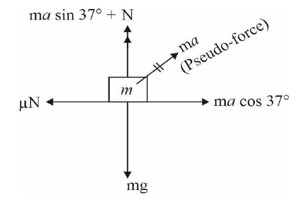
Upvote A particle of mass 3 kg moving with speed of 3 m/s is acted upon by an impulse. As a result, the particle starts moving in a direction 90° to the original direction with a speed of 4 m/s. Find the impulse acted upon on the particle in SI units.
A particle of mass 3 kg moving with speed of 3 m/s is acted upon by an impulse. As a result, the particle starts moving in a direction 90° to the original direction with a speed of 4 m/s. Find the impulse acted upon on the particle in SI units.
I? = P? – P? = 3 × 4? – 3 × 3î = 12? – 9î |I? | = √12² + 9² = 15kgm/s
Upvote An inverted cone is rotating about its vertical axis. A particle is kept on the inner surface of cone and it is at rest relative to the cone at a height of 0.4 m above its vertex. The coefficient of friction between the surface of cone and the particle is 0.6 and the apex angle of cone is 90°. The maximum angular velocity of revolution of the cone can be: (take g = 10/s2)
<!-- [if !supportLineBreakNewLine]-->
<!--[endif]-->
An inverted cone is rotating about its vertical axis. A particle is kept on the inner surface of cone and it is at rest relative to the cone at a height of 0.4 m above its vertex. The coefficient of friction between the surface of cone and the particle is 0.6 and the apex angle of cone is 90°. The maximum angular velocity of revolution of the cone can be: (take g = 10/s2)
<!-- [if !supportLineBreakNewLine]-->
<!--[endif]-->
N = (mg/√2) + (mω²h/√2)
(mω²h/√2) = (mg/√2) + f?
(mω²h/√2) = (mg/√2) + μ (mg/√2) + (mω²h/√2)
ω = √ (g/h) (1+μ)/ (1-μ) = 10rad/s
Upvote Two blocks of mass 10kg and 2ktg respectively are connected by an ideal string passing over a fixed smooth pulley as shown in figure. A monkey of 8kg started climbing the string with constant acceleration 2ms-2 with respect to string at t = 0. Initially the monkey is 2.4m from the pulley. Find the time taken by the monkey to reach the pulley.
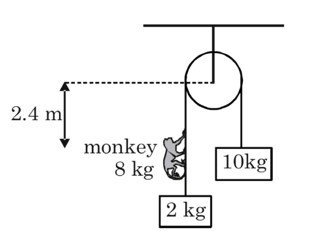
Two blocks of mass 10kg and 2ktg respectively are connected by an ideal string passing over a fixed smooth pulley as shown in figure. A monkey of 8kg started climbing the string with constant acceleration 2ms-2 with respect to string at t = 0. Initially the monkey is 2.4m from the pulley. Find the time taken by the monkey to reach the pulley.
Let the acceleration of string = a
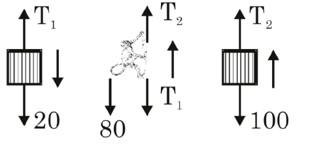
For 2 kg 20 – T1 = 2a ………… (i)
For monkey T2 – 80 – T1 = 8 (2 – a) …. (ii)
For 10 kg T2 – 100 = 10a ……. (iii)
Acceleration of monkey w.r. to ground
= 2 – 0.8 = 1.2 m/s2
Upvote A car goes on a circular horizontal road of radius 100 m. What should be the minimum coefficient of friction between the tyres and the road so that it completes the circle with velocity 10 m/s without slipping? (Take g = 10 m/s2)
<!-- [if !supportLineBreakNewLine]-->
<!--[endif]-->
A car goes on a circular horizontal road of radius 100 m. What should be the minimum coefficient of friction between the tyres and the road so that it completes the circle with velocity 10 m/s without slipping? (Take g = 10 m/s2)
<!-- [if !supportLineBreakNewLine]-->
<!--[endif]-->
Centripetal acceleration is provided by friction force. Maximum friction force should be equal to or greater that mv² / R.
µmg = mv²/R ; µ = 100/ (100*10) ; µ = 1/10 ; µ = 0.1
Upvote A rod of mass m and length L is hinged at its top end. If the rod is in equilibrium making an angle of 30° with the vertical when a horizontal force F is applied as shown in figure, then the value of F is:
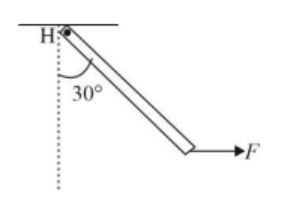
A rod of mass m and length L is hinged at its top end. If the rod is in equilibrium making an angle of 30° with the vertical when a horizontal force F is applied as shown in figure, then the value of F is:
Taking torque at top pt, mg sin30°×L / 2 = F cos30°×L ⇒ F = mg / 2√3
Upvote