
Physics Moving Charges and Magnetism
Get insights from 108 questions on Physics Moving Charges and Magnetism, answered by students, alumni, and experts. You may also ask and answer any question you like about Physics Moving Charges and Magnetism
- 108
Questions
- 0
Discussions
- 0
Active Users
- 0
Followers
Have a question about Physics Moving Charges and Magnetism? Ask our experts
Keep it short & simple. Type complete word. Avoid abusive language.
The net magnetic flux through any closed surface is:
The net magnetic flux through any closed surface is:
For resonance frequency
 Upvote

Given below are two statements:
Statement I: Biot-Savart's law gives us the expression for the magnetic field strength of an infinitesimal current element (Idl) of a current carrying conductor only
Statement II: Biot-Savart's law is analogous to Coulomb's inverse square law of charge q, with the former being related to the field produced by a scalar source, Idl while the latter being produced by a vector source, q.
In light of above statements choose the most appropriate answer from the options given below:
The expression for magnetic field depends on current carrying element , which is a vector quantity, therefore, statement-I is correct and statement-II is wrong.
Upvote A proton and an α-particle, having kinetic energy Kp and Kα respectively, enter into a magnetic field at right angles. The ratio of the radii of trajectory of proton to that of α-particle is 2 : 1. The ratio of Kp : Kα is
<!-- [if !supportLineBreakNewLine]-->
<!--[endif]-->
A proton and an α-particle, having kinetic energy Kp and Kα respectively, enter into a magnetic field at right angles. The ratio of the radii of trajectory of proton to that of α-particle is 2 : 1. The ratio of Kp : Kα is
<!-- [if !supportLineBreakNewLine]-->
<!--[endif]-->
R = mv / (qB) = √ (2mK) / (qB) ⇒ K = (R²q²B²) / (2m)
⇒ K? /Kα = (R? ²q? ²B² / 2m? ) × (2mα / (Rα²qα²B²) = (mα/m? ) × (R? /Rα)² × (q? /qα)²
⇒ K? /Kα = (4) × (2)² × (1/2)² = 4:1
Upvote A loop of flexible wire of irregular shape carrying current is placed in an external magnetic field. Identify the effect of the field on the wire.
A loop of flexible wire of irregular shape carrying current is placed in an external magnetic field. Identify the effect of the field on the wire.
In external magnetic field, a magnetic force acts on every small part of the loop in direction perpendicular to the wire. Thus, loop assumes a shape (circular) in which it covers maximum area
Upvote A hairpin like shape as shown in figure is made by bending a long current carrying wire. What is the magnitude of a magnetic field at point P which lies on the centre of the semicircle?
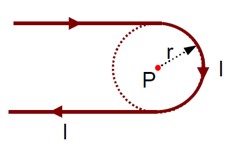
A hairpin like shape as shown in figure is made by bending a long current carrying wire. What is the magnitude of a magnetic field at point P which lies on the centre of the semicircle?
The magnetic field B is calculated as:
B = 2 * (μ? I / 4πr) + (μ? I / 4πr) = (μ? I / 4πr) * (2 + π)
Upvote A solenoid of 1000 turns per meter has a core with relative permeability 500. Insulated windings of the solenoid carry an electric current of 5 A. The magnetic flux density produced by the solenoid is: (permeability of free space = 4π×10-7H/m)
<!-- [if !supportLineBreakNewLine]-->
<!--[endif]-->
A solenoid of 1000 turns per meter has a core with relative permeability 500. Insulated windings of the solenoid carry an electric current of 5 A. The magnetic flux density produced by the solenoid is: (permeability of free space = 4π×10-7H/m)
<!-- [if !supportLineBreakNewLine]-->
<!--[endif]-->
B = μni
B = (500 × 4π × 10? ) × 1000 × 5
B = π Tesla
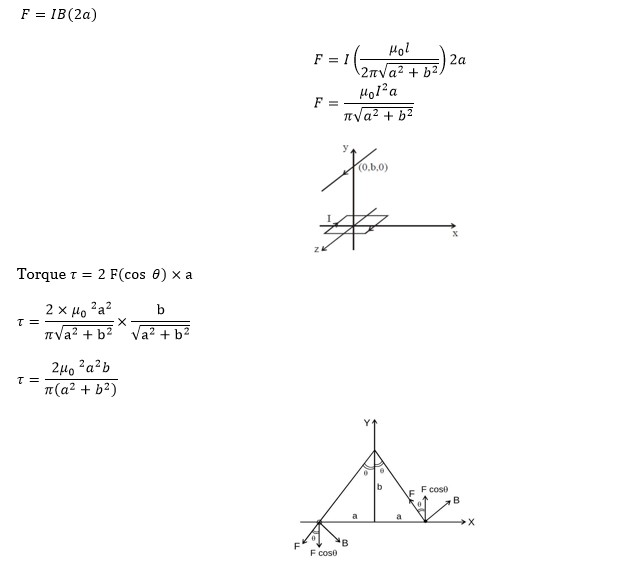
Upvote A square loop of side 2a and carrying current I is kept in xz plane with its centre at origin. A long wire carrying the same current I is placed parallel to z-axis and passing through point (0, b, 0), (b >> a). The magnitude of torque on the loop about z-axis will be
<!-- [if !supportLineBreakNewLine]-->
<!--[endif]-->
A square loop of side 2a and carrying current I is kept in xz plane with its centre at origin. A long wire carrying the same current I is placed parallel to z-axis and passing through point (0, b, 0), (b >> a). The magnitude of torque on the loop about z-axis will be
<!-- [if !supportLineBreakNewLine]-->
<!--[endif]-->
A wire A, bent in the shape of an arc of a circle, carrying a current of 2 A and having radius 2 cm and another wire B, also bent in the shape of arc of a circle, carrying a current of 3 A and having radius of 4 cm, are placed as shown in the figure. The ratio of the magnetic fields due to the wires A and B at the common centre O is:
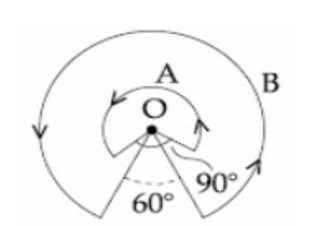
A wire A, bent in the shape of an arc of a circle, carrying a current of 2 A and having radius 2 cm and another wire B, also bent in the shape of arc of a circle, carrying a current of 3 A and having radius of 4 cm, are placed as shown in the figure. The ratio of the magnetic fields due to the wires A and B at the common centre O is:
BA = μ?Iθ / 4πR
⇒ BA/BB = IAθARB / IBθBRA
⇒ (2(3π/2)(4)) / (3(π/3)(2))
⇒ 6/5
Upvote