
Physics Moving Charges and Magnetism
Get insights from 108 questions on Physics Moving Charges and Magnetism, answered by students, alumni, and experts. You may also ask and answer any question you like about Physics Moving Charges and Magnetism
- 108
Questions
- 0
Discussions
- 0
Active Users
- 0
Followers
Have a question about Physics Moving Charges and Magnetism? Ask our experts
Keep it short & simple. Type complete word. Avoid abusive language.
Charge q is uniformly spread on a thin ring of radius R. The ring rotates about its axis with a uniform frequency f Hz. The magnitude of magnetic induction at the centre of the ring is
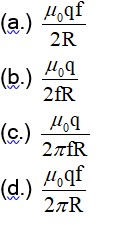
Charge q is uniformly spread on a thin ring of radius R. The ring rotates about its axis with a uniform frequency f Hz. The magnitude of magnetic induction at the centre of the ring is
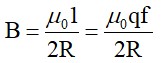
When the ring rotates about its axis with a uniform frequency fHz, the current flowing in the ring is
I=q/T=qf
Magnetic field at the centre of the ring is
 Upvote

In gravity free space, a bead of charge and mass 3mg is threaded on a rough rod of friction coefficient = 0.3. A magnetic field of magnitude 0.2 T exists perpendicular to the rod. The bead is projected along the rod with a speed 4m/s. How much distance (in m) will the bead cover before coming to rest?
In gravity free space, a bead of charge and mass 3mg is threaded on a rough rod of friction coefficient = 0.3. A magnetic field of magnitude 0.2 T exists perpendicular to the rod. The bead is projected along the rod with a speed 4m/s. How much distance (in m) will the bead cover before coming to rest?
An infinite cylindrical current carrying wire carries a current that is uniformly distributed over its cross section. The magnetic field as a function of distance form it’s axis is-
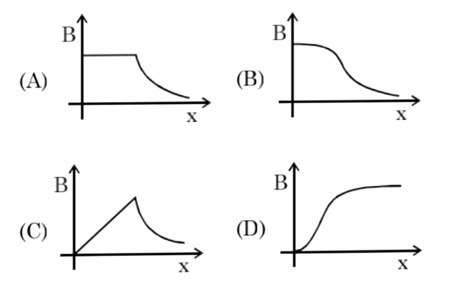
An infinite cylindrical current carrying wire carries a current that is uniformly distributed over its cross section. The magnetic field as a function of distance form it’s axis is-
Apply Ampere’s Law
For inside
For outside
Upvote A cell having N turns is would tightly in the form of a spiral with inner and outer radii ‘a’ and ‘b’ respectively. Find the magnetic field at centre, when a current I passes through coil:
A cell having N turns is would tightly in the form of a spiral with inner and outer radii ‘a’ and ‘b’ respectively. Find the magnetic field at centre, when a current I passes through coil:
Let us consider an elementary ring of radius r and thickness dr in which current is flowing.
So, No. of turns in this elementary ring
Upvote An electron moving with a velocity of 2 m/s along +ve x-axis at a point in a magnetic field experiences a force of 2N along -ve y-axis. If the electron moves with of a velocity of 2 m/s along +ve y-axis at the same point, it experiences a force of 2N along +ve x-axis. Find force that the electron would experience if it were moving with a velocity of 2m/s along z-axis.
An electron moving with a velocity of 2 m/s along +ve x-axis at a point in a magnetic field experiences a force of 2N along -ve y-axis. If the electron moves with of a velocity of 2 m/s along +ve y-axis at the same point, it experiences a force of 2N along +ve x-axis. Find force that the electron would experience if it were moving with a velocity of 2m/s along z-axis.
v? = 2î F? = -2?
v? = 2? F? = -2î
⇒ B? is along -k? Hence v? = 2k? ⇒ F? = 0
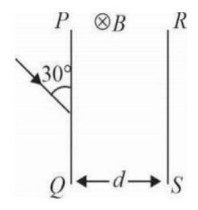
Upvote Magnetic field exists in the region between lines PQ and RS as shown in the figure. A particle having charge to mass ratio of a enters the magnetic field as shown in the figure with a speed v. Lines PQ and RS are parallel to each other. Find the value of d such that the charged particle exits the magnetic field region with velocity perpendicular to line RS.
<!-- [if !supportLineBreakNewLine]-->
<!--[endif]-->
Magnetic field exists in the region between lines PQ and RS as shown in the figure. A particle having charge to mass ratio of a enters the magnetic field as shown in the figure with a speed v. Lines PQ and RS are parallel to each other. Find the value of d such that the charged particle exits the magnetic field region with velocity perpendicular to line RS.
<!-- [if !supportLineBreakNewLine]-->
<!--[endif]-->
d = Rsin 60°
⇒ d = (mv√3)/ (qB 2) = (√3v)/ (2aB)
Upvote A proton of mass m and charge q enters a region of uniform magnetic field of a magnitude B with a velocity v directed perpendicular to the magnetic field. It moves in a circular path and leaves the magnetic field after completing a quarter of a circle. The time spent by the proton inside the magnetic field is proportional to:
A proton of mass m and charge q enters a region of uniform magnetic field of a magnitude B with a velocity v directed perpendicular to the magnetic field. It moves in a circular path and leaves the magnetic field after completing a quarter of a circle. The time spent by the proton inside the magnetic field is proportional to:
The time spent in magnetic field (t) is independent of velocity of charge.
t = (1/4) (2πm/qB)
Upvote AB µ r2 long straight wire with a circular cross-section having radius R, is carrying a steady current I: The current I is uniformly distributed across this cross-section. Then the variation of magnetic field due to current I with distance r(r < R) from its centre will be:
AB µ r2 long straight wire with a circular cross-section having radius R, is carrying a steady current I: The current I is uniformly distributed across this cross-section. Then the variation of magnetic field due to current I with distance r(r < R) from its centre will be:
for current\
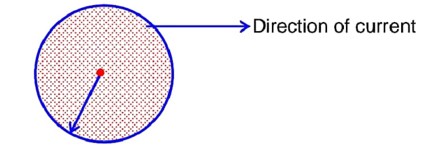
1 unit Area ®
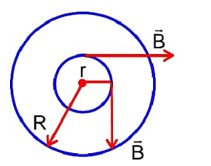
Now, consider Amperian loop of radius small ‘r’ ln Amperian loop magnetic field will be tangential to the amperian loop.
Upvote What is the formula for the force per unit length between two parallel current-carrying conductors?
What is the formula for the force per unit length between two parallel current-carrying conductors?
The exact formula for the magnetic force per unit length between two parallel current-carrying conductors:
For more information, check: Force between parallel conductors
Upvote