
Physics Moving Charges and Magnetism
Get insights from 108 questions on Physics Moving Charges and Magnetism, answered by students, alumni, and experts. You may also ask and answer any question you like about Physics Moving Charges and Magnetism
- 108
Questions
- 0
Discussions
- 0
Active Users
- 0
Followers
Have a question about Physics Moving Charges and Magnetism? Ask our experts
Keep it short & simple. Type complete word. Avoid abusive language.
A charge particle is moving in uniform magnetic field T. If it has an acceleration of , then the value of will be
A charge particle is moving in uniform magnetic field T. If it has an acceleration of , then the value of will be
A deuteron and an alpha particle having equal kinetic energy enter perpendicularly into a magnetic field. Let rd and rd be their respective radii of circular path. The value of <!-- [if gte mso 9]><xml>
A deuteron and an alpha particle having equal kinetic energy enter perpendicularly into a magnetic field. Let rd and rd be their respective radii of circular path. The value of <!-- [if gte mso 9]><xml>
As we know that radius of circular path in magnetic field is given as
Charged particle | Charge | Mass |
Deuteron | e | 2m |
Alpha particle | 2e | 4m |
 Upvote

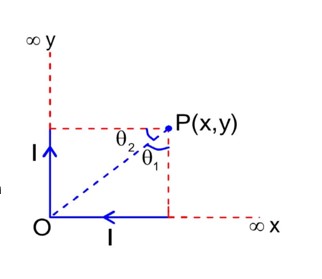
There are two infinitely long straight current carrying conductors and they are held at right angle to each other so that their common ends meet at the origin as shown in the figure given below. The ratio of current in both conductor is 1 : 1. The magnetic field at point P is
There are two infinitely long straight current carrying conductors and they are held at right angle to each other so that their common ends meet at the origin as shown in the figure given below. The ratio of current in both conductor is 1 : 1. The magnetic field at point P is
B due to OX wire
As in the diagram direction of B1 and B2 are in downward direction
So B = B1 + B2
Upvote A current of 1.5 A is flowing through a triangle, of side 9cm each. The magnetic field at the centroid of the triangle is:
(Assume that the current is flowing in the clockwise direction.)
A current of 1.5 A is flowing through a triangle, of side 9cm each. The magnetic field at the centroid of the triangle is:
(Assume that the current is flowing in the clockwise direction.)
Using magnetic field due to straight wire :
So, magnetic field due to three wires
= 3 × 10⁻⁵ T
inside the plane
Upvote There are two infinitely long straight current carrying conductors and they are held at right angle to each other so that their common ends meet at the origin as shown in the figure given below. The ratio of current in both conductor is 1 : 1. The magnetic field at point P is
There are two infinitely long straight current carrying conductors and they are held at right angle to each other so that their common ends meet at the origin as shown in the figure given below. The ratio of current in both conductor is 1 : 1. The magnetic field at point P is
B due to OX wire
As in the diagram direction of B1 and B2 are in downward direction
So B = B1 + B2
Upvote A uniform conducting wire of length is 24a, and resistance R is wound up as a current carrying coil in the shape of an equilateral triangle of side ‘a’ and then in the form of a square of side ‘a’. The coil is connected to a voltage source V0. The ratio of magnetic moment of the coils in case of equilateral triangle to that for square is 1: <!-- [if gte mso 9]><xml>
A uniform conducting wire of length is 24a, and resistance R is wound up as a current carrying coil in the shape of an equilateral triangle of side ‘a’ and then in the form of a square of side ‘a’. The coil is connected to a voltage source V0. The ratio of magnetic moment of the coils in case of equilateral triangle to that for square is 1: <!-- [if gte mso 9]><xml>
If the maximum value of accelerating potential provided by a ratio frequency oscillator is 12 kV. The number of revolution made by proton in a cyclotron to achieve one sixth of the speed of light is_________.
<!-- [if gte mso 9]><xml>
If the maximum value of accelerating potential provided by a ratio frequency oscillator is 12 kV. The number of revolution made by proton in a cyclotron to achieve one sixth of the speed of light is_________.
<!-- [if gte mso 9]><xml>
A long straight wire with a circular cross-section having radius R, is carrying a steady current I: The current I is uniformly distributed across this cross-section. Then the variation of magnetic field due to current I with distance r(r < R) from its centre will be:
A long straight wire with a circular cross-section having radius R, is carrying a steady current I: The current I is uniformly distributed across this cross-section. Then the variation of magnetic field due to current I with distance r(r < R) from its centre will be:
for current
1 unit Area
Now, consider Amperian loop of radius small ‘r’ ln Amperian loop magnetic field will be tangential to the amperian loop.
(Ampere circuital law)
Upvote