
Physics Moving Charges and Magnetism
Get insights from 108 questions on Physics Moving Charges and Magnetism, answered by students, alumni, and experts. You may also ask and answer any question you like about Physics Moving Charges and Magnetism
- 108
Questions
- 0
Discussions
- 0
Active Users
- 0
Followers
Have a question about Physics Moving Charges and Magnetism? Ask our experts
Keep it short & simple. Type complete word. Avoid abusive language.
A positively charged particle of specific charge α, accelerated by a potential difference V moves through a uniform transverse magnetic field B. The field occupies a region of width l. The angle θ through which the charged particle deviates from initial direction of its motion is
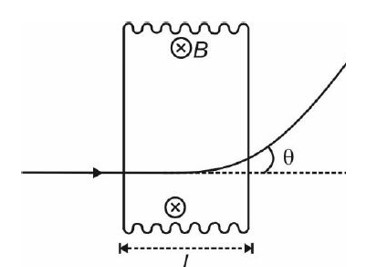
A positively charged particle of specific charge α, accelerated by a potential difference V moves through a uniform transverse magnetic field B. The field occupies a region of width l. The angle θ through which the charged particle deviates from initial direction of its motion is
p²/2m = Vq => p = √2mVq
θ = sin? ¹ (l/R') = l/R = mV/qB = p/qB
 Upvote


A wire carrying a current I along the positive x-axis has length L<!-- [if gte msEquation 12]>L
<!-- [if !supportLineBreakNewLine]-->
<!--[endif]-->
A wire carrying a current I along the positive x-axis has length L<!-- [if gte msEquation 12]>
<!-- [if !supportLineBreakNewLine]-->
<!--[endif]-->
A very long conducting wire is bent in a semi-circular shape from A to B as shown in figure. The magnetic field at point P for steady current configuration is given by:
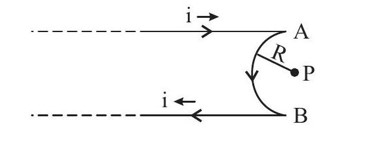
A very long conducting wire is bent in a semi-circular shape from A to B as shown in figure. The magnetic field at point P for steady current configuration is given by:
pointing away from the page
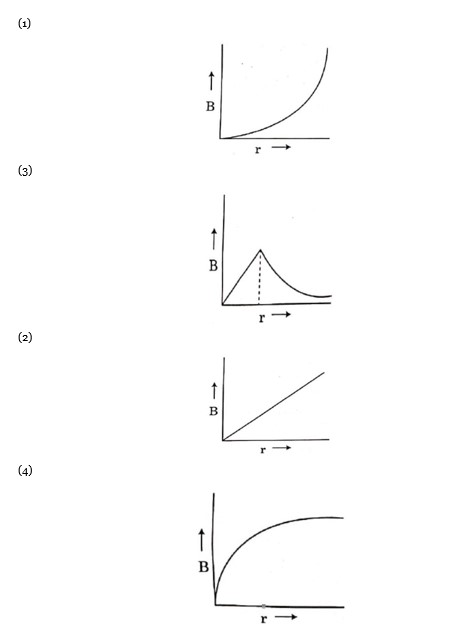
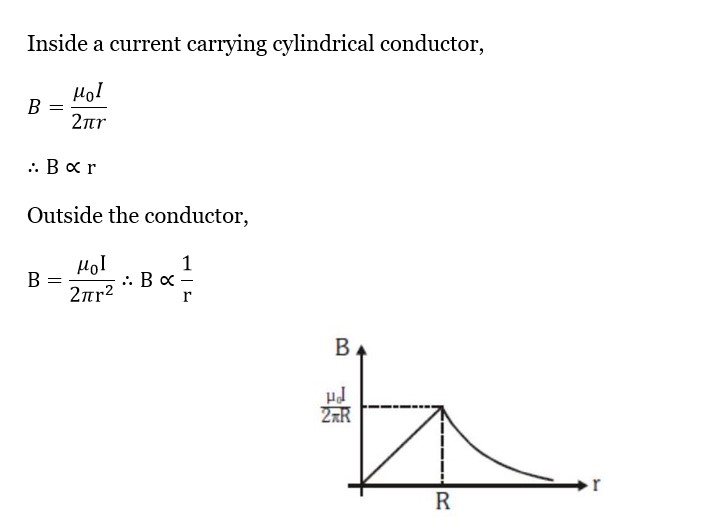
Upvote A thick current carrying cable of radius ' R' carries current ' I ' uniformly distributed across its cross-section. The variation of magnetic-field B(r) due to the cable with the distance 'r' from the axis of the cable is represented by:
<!-- [if !supportLineBreakNewLine]-->
<!--[endif]-->
A thick current carrying cable of radius ' R' carries current ' I ' uniformly distributed across its cross-section. The variation of magnetic-field B(r) due to the cable with the distance 'r' from the axis of the cable is represented by:
<!-- [if !supportLineBreakNewLine]-->
<!--[endif]-->
Match List-I with List-II
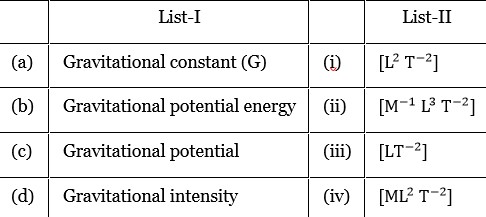
Choose the correct answer from the options given below :
<!-- [if !supportLineBreakNewLine]-->
<!--[endif]-->
Match List-I with List-II
Choose the correct answer from the options given below :
<!-- [if !supportLineBreakNewLine]-->
<!--[endif]-->
Gravitational constant
Gravitational potential energy
Gravitational potential
Gravitational intensity
Upvote An infinitely long straight conductor carries a current of as shown. An electron is moving with a speed of parallel to the conductor. The perpendicular distance between the electron and the conductor is at an instant. Calculate the magnitude of the force experienced by the electron at that instant.

An infinitely long straight conductor carries a current of as shown. An electron is moving with a speed of parallel to the conductor. The perpendicular distance between the electron and the conductor is at an instant. Calculate the magnitude of the force experienced by the electron at that instant.

