

Physics
Get insights from 5.6k questions on Physics, answered by students, alumni, and experts. You may also ask and answer any question you like about Physics
Follow Ask QuestionQuestions
Discussions
Active Users
Followers
New answer posted
a year agoContributor-Level 10
Tension in the string and gravitational force are common forces. These forces are resolved into tangential and radial components.
New answer posted
a year agoContributor-Level 10
For small displacements, sinθ≈θ (in radians), the small-angle approximation simplifies pendulum motion equations and makes it to approximate simple harmonic motion.


New answer posted
a year agoContributor-Level 10
Statement I is true as atoms are electrically neutral because they contain equal number of positive and negative charges.
Statement II is wrong as atom of most of the elements are stable and emit characteristic spectrum. But this statement is not true for every atom.
New answer posted
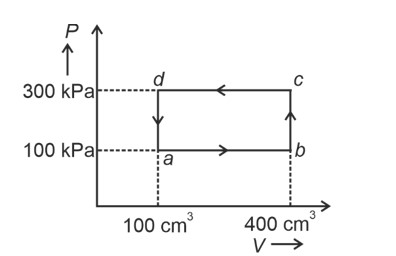
a year agoA thermodynamic system is taken through the cycle abcda. The work done by the gas along the path is:
Contributor-Level 10
Path is an isochoric process.
Work done by gas along path is zero.
New answer posted
a year agoContributor-Level 10
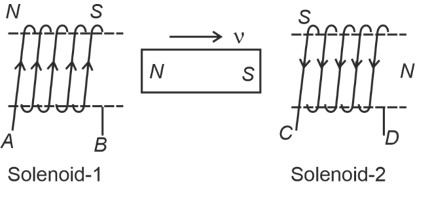
North of magnet is moving away from solenoid 1 so end of solenoid 1 is South and as south of magnet is approaching solenoid 2 so end of solenoid 2 is South.
Taking an Exam? Selecting a College?
Get authentic answers from experts, students and alumni that you won't find anywhere else
Sign Up on ShikshaOn Shiksha, get access to
- 67k Colleges
- 1.2k Exams
- 718k Reviews
- 1850k Answers