

Physics
Get insights from 5.6k questions on Physics, answered by students, alumni, and experts. You may also ask and answer any question you like about Physics
Follow Ask QuestionQuestions
Discussions
Active Users
Followers
New answer posted
a year agoContributor-Level 10
Let 'h' be the height at which velocity becomes equal to magnitude of Acceleration
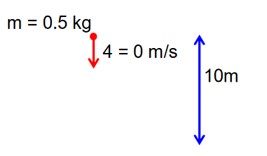
v = g = 10
v = u + at
10 = 0 + 10t
t = 1 sec
= 5m
New answer posted
a year agoContributor-Level 10
Heat given to water by geyser
- (1)
heat provided by combustion of fuel
New answer posted
a year ago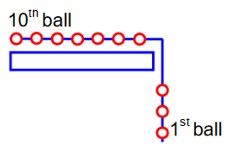
Contributor-Level 10
12 g – T = 12 a- (1)
T – T' = 2a- (2)
T' = 6a- (3)
From (1) & (2)
12g – 12a – T' = 2a- (4)
From (4) & (3)
12g – 12a – T' = 14
New answer posted
a year agoContributor-Level 10
B fighter jet
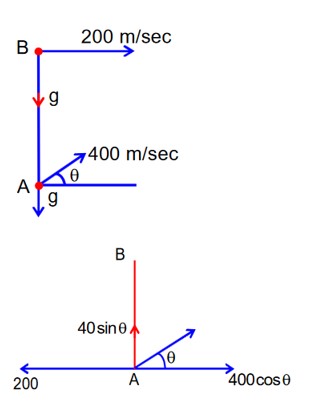
A anti-Air craft gun
Draw velocity diagram of A w.r.t. B
If A hits B
Then Relative velocity perpendicular to the line joining A to B will be zero.
That means 400 cos = 200
New question posted
a year ago
New answer posted
a year agoContributor-Level 10
Now velocity B with respect to A
= 50 – 30
= 20 m/sec
Now
=
= 0
Time taken to collide.
80 = 20t
t = 4 sec
Total time = 4 + 2
= 6 sec
New answer posted
a year agoContributor-Level 10
In amplitude modulation, the amplitude of the career signal is varied in according with the modulating signal.
Taking an Exam? Selecting a College?
Get authentic answers from experts, students and alumni that you won't find anywhere else
Sign Up on ShikshaOn Shiksha, get access to
- 67k Colleges
- 1.2k Exams
- 718k Reviews
- 1850k Answers