

Physics
Get insights from 5.6k questions on Physics, answered by students, alumni, and experts. You may also ask and answer any question you like about Physics
Follow Ask QuestionQuestions
Discussions
Active Users
Followers
New answer posted
a year ago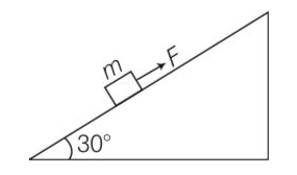
Contributor-Level 10
This is a long answer type question as classified in NCERT Exemplar
(a) work done= increase in PE

= mg (vertical distance travelled)
= mg (s)sin = 50J
(b) work done against friction = fs
=
= 0.1
(c) increase in PE =mgh
=1
(d) according to work energy theorem W= change in KE
= -mgh-fs+FS
= -50-8.66+10 (10)
= 41.34J
(e) force f = FS
= 10 (10)= 100J
New answer posted
a year agoContributor-Level 10
This is a multiple choice answer as classified in NCERT Exemplar
(a, b, c) The length of the telescope tube L= f0+fe= 20+0.02= 20.02m
Also magnification is = 20/0.02= 1000
And image formed is inverted
New answer posted
a year agoContributor-Level 10
This is a multiple choice answer as classified in NCERT Exemplar
(a, b) A magnifying glass is used, as the object to be viewed can be brought closer to the eye than the normal near point. This results in a larger angle to be subtended by the object at the eye and hence, viewed in greater detail. Morever, the formation of a virtual erect and enlarged image, takes place.
New answer posted
a year agoContributor-Level 10
This is a multiple choice answer as classified in NCERT Exemplar
(a, d) Alexandar's dark band lies between the primary and secondary rainbows, forms due to light Scattered into this region interfere destructively.
Since, primary rainbows subtends an angle nearly 41° to 42° at observer's eye, whereas, secondary rainbows subtends an angle nearly 51° to 54° at observer's eye w.r.t. incident light ray. So, the scattered rays with respect to the incident light of the sun lies between approximately 42°and50°.
New answer posted
a year ago
Contributor-Level 10
This is a multiple choice answer as classified in NCERT Exemplar
(d) For µ = 16., the critical angle, µ = 1/ sin C, we have C = 38.7°, when viewed from AD, as long as angle of incidence on AD of the ray emanating from pin is greater than the critical angle, the light suffers from total internal reflection and cannot be seen through AD.
New answer posted
a year agoContributor-Level 10
This is a Short Answer Type Questions as classified in NCERT Exemplar
Sol:
New answer posted
a year agoContributor-Level 10
This is a multiple choice answer as classified in NCERT Exemplar
(a, b, c) When immersed object is seen from close to the edge of the trough the object looks distorted because the apparent depth of the points close to the edge are nearer the surface of the water compared to the points away from the edge.
The angle subtended by the image of the object at the eye is smaller than the actual angle subtended by the object in air and some of the points of the object far away from the edge may not be visible because of total internal reflection.
New answer posted
a year ago
Contributor-Level 10
This is a multiple choice answer as classified in NCERT Exemplar
(a) The negative refractive index metamaterials are those in which incident ray from air (Medium 1) to them refract or bend differently to that of positive refractive index medium.
New answer posted
a year agoContributor-Level 10
This is a multiple choice answer as classified in NCERT Exemplar
(d) The speed of the image of the car would appear to increase as the distance between the cars decreases.
New answer posted
a year ago
Contributor-Level 10
This is a multiple choice answer as classified in NCERT Exemplar
Here, light ray goes from (optically) rarer medium air to optically denser terpentine, then it bends towards the normal i.e., i>r whereas when it goes from to optically denser medium terpentine to rarer medium water. then it bends away the normal i.e., i
Taking an Exam? Selecting a College?
Get authentic answers from experts, students and alumni that you won't find anywhere else
Sign Up on ShikshaOn Shiksha, get access to
- 67k Colleges
- 1.2k Exams
- 718k Reviews
- 1850k Answers