

Physics
Get insights from 5.6k questions on Physics, answered by students, alumni, and experts. You may also ask and answer any question you like about Physics
Follow Ask QuestionQuestions
Discussions
Active Users
Followers
New question posted
a year agoNew answer posted
a year agoContributor-Level 10
This is a long answer type question as classified in NCERT Exemplar
(a) consider a horizontal parcel of air with cross section A and height dh

Let the pressure on the top surface and bottom surface be P and p+dp. If the parcel is in equilibrium , then the net upward force must be balanced by the weight
(P+dP)-PA=-
dP= -
negative sign shows that pressure decreases with height.
(b) let o be the density of air on the surface of earth.
As per question , pressure density
dP= -
In
P=Poe(- )
(c) as P =Po
in
p=1/10 Po
in( ) =-
in1/10 =-
h=- in1/10= - -1=
=
=
= 16 103m
(d) we know that
P , temperature remain
New answer posted
a year agoContributor-Level 10
This is a Long Answer Type Questions as classified in NCERT Exemplar
Explanation- electric field at the axis of the ring is E=KQy/ (R2+z2)3/2 where z is distance .

F=qE=KQqy/ (R2+z2)3/2
When z<
F= = -Kz
So force is directly proportional to – distance that is completely defined that is follows S.H.M
(b)w=
T=2 w=2
T=2
New answer posted
a year agoContributor-Level 10
Explanation- two charge -q at A and B
AB=AO+OB=2d and x= small distance perpendicular to O

When x
F=qq/4 where AP=BP=r but horizontal components gets cancel out each other and vertical components gets add .
If angle APO=O the net force on q along PO is F'= 2Fcos
= =
When x
K= ,F
Force on charge q is proportional to its displacement from the center O and it is directed towards O
Hence we can say that motion of charge would be simple harmonic
Where w= and T=
T= 2 = 2 = [8π3?o md3/q2]1/2
New answer posted
a year ago
Contributor-Level 10
This is a Long Answer Type Questions as classified in NCERT Exemplar
Explanation- as we know F= Qq/r2= 1dyne = 1esu of charge2/1cm2
1 esu of charge = M1/2L3/2T—1
- Q=xC where x is dimensionless quantity
So F= =1 dyne = 10-5N
Taking x= 1/3 9
After solving we get 1/4
New answer posted
a year ago
Contributor-Level 10
This is a Long Answer Type Questions as classified in NCERT Exemplar
Explanation- net electric field at plate γ due to two other plate
From plate 1 ,E1=
From plate 2 ,E2=
Total electric field E= E1 + E2 = to the left , if Q>q
electric field at o due to plate α =
electric field at o due to plate β =
electric field at o due to plate γ =
as the electric field at o is zero therefore
As there is no loss of charge on collision
Q+q=
On solving these
q1= (Q+q/2)= charge on plate β
q2= (q/2)= charge on plate γ
New answer posted
a year ago
Contributor-Level 10
This is a Long Answer Type Questions as classified in NCERT Exemplar
Explanation-
(i) when r
= and we know that V =
= 4
=
E(4 ) = = so it is clear that E is radially outwards.
When r>R
=
E= again field is outwards
(ii) When two protons are there then they must be on opposite sides or we can say along the end of diameter
So q=
.q= 4
If protons 1 and 2 are embedded at distance r from the center of the sphere then force will be
F=eE=- but the force applied by proton F=
By adding these F= -
If F=0 then &nbs
New answer posted
a year agoContributor-Level 10
This is a Long Answer Type Questions as classified in NCERT Exemplar
Explanation- let us consider that universe is of radius R
And we know that hydrogen is made up one electron and proton so net charge is
-(1+y)e+e = -ye
Now the number of hydrogen atom in the universe = N
So total charge is = -ye N
&n
New answer posted
a year ago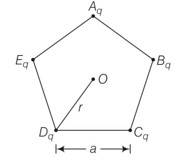
Contributor-Level 10
This is a Long Answer Type Questions as classified in NCERT Exemplar
Explanation- (a)
(i) The electric field at the center of pentagon is zero because the distance from the center is same.
(ii) The field through one charge is Kq/r2
(iii) When one charge is positive and other is negative then net force towards negative charge. So net force is Kq/r2+ Kq/r2= 2Kq/r2
(b) It doesn't depend upon the number of sides increasing the net electric field is zero.
New question posted
a year agoTaking an Exam? Selecting a College?
Get authentic answers from experts, students and alumni that you won't find anywhere else
Sign Up on ShikshaOn Shiksha, get access to
- 67k Colleges
- 1.2k Exams
- 718k Reviews
- 1850k Answers