

Physics
Get insights from 5.6k questions on Physics, answered by students, alumni, and experts. You may also ask and answer any question you like about Physics
Follow Ask QuestionQuestions
Discussions
Active Users
Followers
New answer posted
a year agoContributor-Level 10
This is a multiple choice answer as classified in NCERT Exemplar
(d) As , aluminium will expand more . so it would have larger radius of curvature. So aluminium will expand and will outside region.

New answer posted
a year agoContributor-Level 10
This is a Short Answer Type Questions as classified in NCERT Exemplar
Explanation- Electric flux through a dipole is always zero, because the positive and negative charges cancel each other out
New answer posted
a year agoContributor-Level 10
This is a short answer type question as classified in NCERT Exemplar
The first option kept water warmer because according to newton's law of cooling the rate of loss of heat is directly proportional to the difference of temperature of the body and the surroundings and in the first case temperature difference is less. So rate of loss of heat will be less.
New answer posted
a year agoContributor-Level 10
This is a short answer type question as classified in NCERT Exemplar
Mass of water m =100
Change in temperature
Specific heat of water Sw= 1cal/g C
Latent heat of fusion of water Lfusion= 80cal/g
Heat required to bring water in super cooling from -10 to 0
Q= ms
Let m gram of ice be melted Q= mL
m=Q/L=1000/80= 12.5g
New answer posted
a year agoContributor-Level 10
This is a short answer type question as classified in NCERT Exemplar
Increasing pressure at 00C and 1 atm takes ice into liquid state and decreasing pressure in liquid state at 00C and 1 atm takes to ice state.

When crushed ice is squeezed, some of it melts, filling up the gap between ice flakes upon releasing pressure. This water freezes, binding all ice flakes and making the ball more stable.
New answer posted
a year agoContributor-Level 10
This is a short answer type question as classified in NCERT Exemplar
Let the mass and length of a uniform rod be M and l respectively.
Moment of inertia of the rod about its perpendicular bisector I= ml2/12
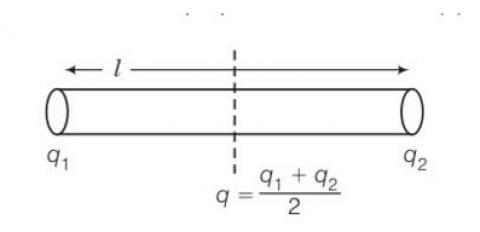
Increase in length of the rod when temperature is increased by T is given by
So new moment of inertia of the rod = =
As change in length is very small therefore neglecting so we get
I'= = l+mI
Increase in moment of inertia =
New answer posted
a year agoContributor-Level 10
This is a short answer type question as classified in NCERT Exemplar
As copper is a good conductor of heat as compared to steel. The steel utensils with copper bottom absorbs heat more quickly than steel and give it to food in utensils. So, food heated uniformly and quickly.

New answer posted
a year agoContributor-Level 10
This is a short answer type question as classified in NCERT Exemplar
According to the formula
F=C=Q
= Q=-40C or 40F
New answer posted
a year agoContributor-Level 10
This is a short answer type question as classified in NCERT Exemplar
Due to difference in conductivity metals having high conductivity compared to wood. On touch with a finger heat from the surroundings flows faster to the finger from metals and so one feels the heat.
Similarly when one touches a cold metal the heat from the finger flows away to the surroundings faster.
New answer posted
a year ago
Contributor-Level 10
This is a short answer type question as classified in NCERT Exemplar
= oC-1
From next observation
From next observation
From next observation = so this value satisfies the equation.
Taking an Exam? Selecting a College?
Get authentic answers from experts, students and alumni that you won't find anywhere else
Sign Up on ShikshaOn Shiksha, get access to
- 67k Colleges
- 1.2k Exams
- 718k Reviews
- 1850k Answers