

Physics
Get insights from 5.6k questions on Physics, answered by students, alumni, and experts. You may also ask and answer any question you like about Physics
Follow Ask QuestionQuestions
Discussions
Active Users
Followers
New answer posted
a year agoContributor-Level 10
This is a short answer type question as classified in NCERT Exemplar
Work done =1/2F l
As spring of both are equally compressed
So Young's modulus Y= as is inversely proportional to young's modulus
And also we know W is inversely proportional to young's modulus
So
Wsteel
New answer posted
a year agoContributor-Level 10
This is a short answer type question as classified in NCERT Exemplar
stress=
Therefore stress is scalar quantity not vector quantity.
New answer posted
a year agoContributor-Level 10
This is a short answer type question as classified in NCERT Exemplar
Young's modulus Y= stress/longitudinal strain
For same longitudinal strain,
Ysteel>Yrubber
so we can say that stresssteel > stressrubber
New answer posted
a year agoContributor-Level 10
This is a Multiple Choice Questions as classified in NCERT Exemplar
Answer-a, c
Explanation- as we know F=
V= orbital speed=
Time period of revolution of planet T = =
T2 ……….1
Hence orbit will be elliptical.
F= =g'm
It is clear from equation 1 that its path is parabola.
New answer posted
a year ago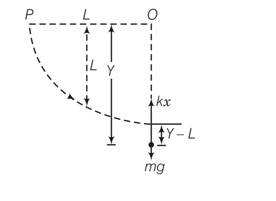
Contributor-Level 10
This is a long answer type question as classified in NCERT Exemplar
Till the stone drops through a length L it will be in free fall. After that the elasticity of the spring will force it to a SHM. Let the stone come to rest instantaneously at y.
The loss in PE of the stone is the PE stored in the stretched string .
Mgy=1/2 k(y-L)2
Mgy =
=
Y=
b)in SHM the maximum velocity is attained when the body passes through the equilibrium position i.e when instantaneous acceleration is zero. That is mg-kx=0
so mg=kx
from the conservation of energy
mg=kx
x=mg/k
v2=2gL+mg2/K
v= (2gL+mg2/K)1/2
c)when stone is at lowest position i.e at instantaneo
New answer posted
a year agoContributor-Level 10
This is a Multiple Choice Questions as classified in NCERT Exemplar
Answer-a, c, d
Explanation- acceleration due to gravity at altitude g'=
At depth d, g'=g (1-d/R)
In both cases value of g decreases
But in case of latitude the value of g increases when we increase
also we conclude from the formula that it is independent upon mass.
New answer posted
a year ago
Contributor-Level 10
This is a Multiple Choice Questions as classified in NCERT Exemplar
Answer-c
Explanation- force on B due to A = FBA=
force on B due to C = FBC=
BC = 2AB
FBC=
So it move towards BA
New answer posted
a year agoContributor-Level 10
This is a long answer type question as classified in NCERT Exemplar
Consider the diagram according, the bending torque on the trunk of radius r of the tree =

When the tree is about to buckle Wd=
If R>>h, then the centre of gravity is at a height l
From 2+ (h/2)2
If d <2+
So d = h2/8R
If wo is the weight /volume
h= ( )1/3r2/3
critical height = h= ( )1/3r2/3
New answer posted
a year agoContributor-Level 10
This is a Multiple Choice Questions as classified in NCERT Exemplar
Answer-d
Explanation- gravitational mass of proton is equivalent to its inertial mass and independent of presence neighbouring heavy objects.
New answer posted
a year agoContributor-Level 10
This is a Multiple Choice Questions as classified in NCERT Exemplar
Answer-d
Explanation- asteroids are also being acted upon by central gravitational forces, hence they are moving in circular orbits like planets and obey Kepler's law.
Taking an Exam? Selecting a College?
Get authentic answers from experts, students and alumni that you won't find anywhere else
Sign Up on ShikshaOn Shiksha, get access to
- 67k Colleges
- 1.2k Exams
- 718k Reviews
- 1850k Answers