

Physics
Get insights from 5.6k questions on Physics, answered by students, alumni, and experts. You may also ask and answer any question you like about Physics
Follow Ask QuestionQuestions
Discussions
Active Users
Followers
New answer posted
a year agoContributor-Level 10
14.10 In a p-n junction diode, the expression for current is given as:
Where, = Reverse saturation current = 5 A
T = Absolute temperature = 300 K
= Boltzmann constant = 8.6 eV/K = 8.6 J/K = 1.376
V = voltage across the diode
e = charge of an electron = 1.6 C
Forward voltage, V = 0.6V
Current, =
= 0.02315 A
For forward voltage, V = 0.7V, we can write
Current, =
= 1.117 A
Hence increase in the current, ΔI = I'-I = 1.117 – 0.02315 = 1.0934 A
Dynamic resistance = =
If the reverse bias voltage is changed from 1 V to 2 V, the current will remain same as will be equal in both cases. Therefore
New answer posted
a year agoContributor-Level 10
14.9 Energy gap of the given intrinsic semiconductor, = 1.2 eV
The temperature dependence of the intrinsic carrier-concentration is written as:
Where,
= Boltzmann constant = 8.62
eV/K
T = Temperature
= constant
Initial temperature,
= 300 K
The intrinsic carrier-concentration at this temperature can be written as
……(1)
Final temperature, = 600 K
The intrinsic carrier-concentration at this temperature can be written as
……(2)
The ratio between conductivity at 600K and at 300 K is equal to the ratio between the respective intrinsic carrier concentration at these temperatures.
Therefore,
=&nbs
New answer posted
a year agoContributor-Level 10
14.8 Number of silicone atoms, = 5 /
Number of arsenic atoms, = 5 /
Number of indium atoms, = 5 /
Number of thermally generated atoms, = 1.5 /
Hence number of electrons, = 5 1.5 = 4.99
Number of holes =
In thermal equilibrium, the concentration of electrons and holes in a semiconductor are related as:
=
Therefore, = = = 4.51
Since the number of electrons are more (4.99 than the number of holes (4.51 , the material is a
New answer posted
a year agoContributor-Level 10
14.7 Energy band gap of the given photodiode, = 2.8 eV
Wavelength, = 6000 nm = 6000 m
The energy of a signal is given by the relation,
=
Where
h = Planck's constant = 6.626 Js
c = sped of light = 3 m/s
= = 3.313 J = eV = 0.207 eV
Therefore the energy of a signal of wavelength 6000 nm is 0.207 eV, which is less than 2.8 eV – the energy band gap of the photodiode. Hence, the photodiode cannot detect the signal.
New answer posted
a year agoContributor-Level 10
14.6 Input frequency = 50 Hz
For a half-wave rectifier, the output frequency is equal to the input frequency.
Hence, the output frequency = 50 Hz
For a full-wave rectifier, the output frequency is twice the input frequency.
Hence the output frequency = 2
New answer posted
a year agoContributor-Level 10
14.5 The correct statement is (c).
When a forward bias is applied to a p-n junction, it lowers the value of potential barrier. In the case of a forward bias, the potential barrier opposes the applied voltage. Hence, the potential barrier across the junction gets reduced.
New answer posted
a year agoContributor-Level 10
14.4 The correct statement is (c).
The diffusion of charge carriers across a junction takes place from the regions of higher concentration to the region of lower concentration. In this case, the p-region has greater concentration of holes than the n-region. Hence, in an unbiased p-n junction, holes diffuse from the p-region to the n-region.
New answer posted
a year agoContributor-Level 10
14.2 The correct statement is (d).
In a p-type semiconductor, the holes are the majority carriers, while the electrons are the minority carriers. A p-type semiconductor is obtained when trivalent atoms, such as aluminium, are doped in silicon atoms.
New answer posted
a year agoContributor-Level 10
14.1 The correct statement is (c ).
In an n-type silicon, the electrons are the majority carrier, while the holes are the minority carriers. An n-type semiconductor is obtained when pentavalent atoms, such as phosphorous, are doped in silicon atoms.
New answer posted
a year ago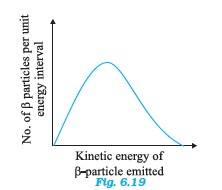
Contributor-Level 10
6.30 The decay process of free neutron at rest is given as:
n
From Einstein's mass-energy relation, we have the energy of electron as? where,
? m = Mass defect = Mass of neutron – ( Mass of proton + mass of electron)
c = speed of light
? m and c are constant. Hence, the given two-body decay is unable to explain the continuous energy distribution in the -decay of a neutron or a nucleus. The presence of neutrino von the LHS of the decay correctly explain the continuous energy distribution.
Taking an Exam? Selecting a College?
Get authentic answers from experts, students and alumni that you won't find anywhere else
Sign Up on ShikshaOn Shiksha, get access to
- 67k Colleges
- 1.2k Exams
- 718k Reviews
- 1850k Answers