

Physics
Get insights from 5.6k questions on Physics, answered by students, alumni, and experts. You may also ask and answer any question you like about Physics
Follow Ask QuestionQuestions
Discussions
Active Users
Followers
New answer posted
a year ago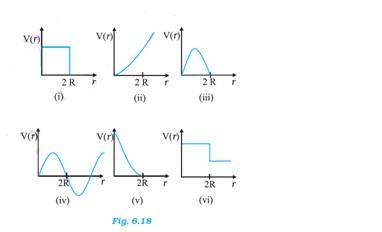
Contributor-Level 10
6.29 The potential energy of two masses in a system is inversely proportional to the distance between them. The potential energy of the system of two balls will decrease as they get closer to each other. When the balls touch each other, the potential energy becomes zero, I.e. at r = 2R. The potential energy curve in (i), (ii), (iii), (iv) and (vi) do not satisfy these conditions. So there is no elastic collision.
New answer posted
a year agoContributor-Level 10
6.28 Mass, m = 200 kg
Speed, v = 36 km/h = 10 m/s
Mass of the boy, M = 20 kg
Initial momentum = (M + m)v = (20 + 200) x 10 kg-m/s = 2200 kg-m/s
If v' is the final velocity of the trolley, then
The final momentum = (M+m) x v' – M x 4= 220v'-80
According to the law of conservation of energy,
Initial momentum = final momentum
2200 = 220v'-80
V' = 10.36 m/s
Time required by the boy to travel 10m = 10/4 = 2.5 s
Distance travel by trolley in 2.5 s = 10.36 x 2.5 m = 25.9 m
New answer posted
a year agoContributor-Level 10
6.27 Mass of the bolt, m = 0.3 kg, Height of the elevator, h = 3 m
Since the bolt did not rebound, the entire potential energy got converted into heat.
The potential energy of the bolt = mgh = 0.3 x 9.8 x 3 J = 8.82 J
The heat produced will remain same even if the lift is stationary, since g = constant
New answer posted
a year ago
Contributor-Level 10
6.26 Mass of the block = 1 kg
Spring constant = 100 N/m
Displacement of the block, x = 10 cm = 0.1 m
At equilibrium, normal reaction, R =
Frictional force, F = =
Net force acting on the block down on the incline = - F
= -
=mg ( )
At equilibrium,
Work done = Potential energy of the stretched string
mg ( ) = (1/2)kx2
1 x 10 x ( ) = (1/2) x 100 x 0.1
10 x (0.602 – = 0.5 x 100 x 0.1
New answer posted
a year ago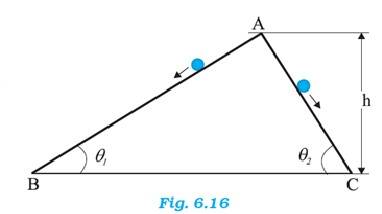
Contributor-Level 10
6.25 From the law of conservation of energy,
the potential energy at the top = Kinetic energy at the bottom
mgh = (1/2)m ….(1)
and
mgh = (1/2)m ….(2)
= , Both the stones will reach with the same speed
For stone 1, the force acting on the stone 1 is given by , = m = mg
= g
For stone 2, = g
As , >
From v = u + at, we get t = v/a
Therefore < Stone 2 will reach faster than stone 1
From the law of conservation of energy
mgh = (1/2) mv2
v = = 14 m/s ( Given h = 10 m)
The time taken by two stones given as
&
New answer posted
a year agoContributor-Level 10
6.24 Mass of the bullet, = 0.012 kg
Initial speed of the bullet, u = 70 m/s
Mass of the wooden block , = 0.4 kg
Initial speed of the wooden block = 0
Let's assume, final speed of the bullet = v
Applying the law of conservation of momentum
Hence v = ( = 2.04 m/s
Let h be the height by which the block rise. Applying law of conservation of energy
Potential energy of the combined bullet + block = Kinetic energy of the combination
(1/2)
h = /2g = 0.212 m
The heat produced = Initial kinetic energy of the bullet – final kinetic energy of the combination
= (1/2) - (1/2)
= (1/2
New answer posted
a year agoContributor-Level 10
6.23 Power used by the family = 8 kW = 8000 W
(a) Solar energy received = 200 W/
Percentage conversion of Solar energy to Electrical energy = 20%
If the area required is A then 0.2
A = 200 . The comparable roof size is 14.14 X 14.14 m
New answer posted
a year agoContributor-Level 10
The principle of mass-energy equivalence, given by Einstein's equation:
It states that mass and energy are interchangeable.
A small amount of mass can be converted into a large amount of energy because the speed of light is very large and appears squared in the equation.
Significance in Nuclear Reactions:
- Helps in calculating the energy release in Nuclear Reactions
- Provides explanation for powering Nuclear Reactors and the Sun
- Explanation of Binding Energy of Nucleous
New answer posted
a year agoBeginner-Level 5
Nuclear Binding Energy is the amount of energy required to completely dismantle a nucleus into its individual protons and neutrons which is equivalent to the amount of energy to form a nucleous from its constituent nucleons (protons and neutrons).
Binding energy is calculated using Einstein's mass-energy equivalence relation:
Where:
= mass defect (in kg or amu)
= speed of light
New answer posted
a year agoContributor-Level 10
Ans.4.21: (a) Velocity , = 10.0 ? m/s Acceleration, = (8.0 ? + 2.0 ?) m s-2 We know = = 8.0 ? + 2.0 ? = (8.0 ? + 2.0 ?)dt Integrating both sides we get (t) = 8.0t ? + 2.0t ? + , Where, velocity vector of the particle at t =0 velocity vector of the particle at time t But = = dt = (8.0t ? + 2.0t ? + )dt Integrating both sides with the condition at t = 0, r =0 and at t =t, r = r t + ½ 8.0 t2 ? + ½ 2.0 t2 ? = t + 4.0 t2 ? + t2 ? Substituting the value of , we get ( 10.0 ?)t + 4.0 t2 ? + t2 ? . This equation can be expressed as x ? + y ? = 4.0 t2 ? + ( 10.0t + t2) ? Since the motion of the particle is confined to the x-y plane, on equating the coefficients of ? and ?, we get x = 4.0 t2 and y = 10.0t + t2 t = (a) When x = 16m, t = 2 s, y = 24m (b) Velocity of the particle (t) = 8.0t ? + 2.0t ? + At t = 2 s, (t) = 8.0 2 ? + 2.0 ? + 10 ? = 16 ? + 14 ? The magnitude of (t) is given by = ( 162 + 142)1/2 = 21.26 m/s |
Taking an Exam? Selecting a College?
Get authentic answers from experts, students and alumni that you won't find anywhere else
Sign Up on ShikshaOn Shiksha, get access to
- 67k Colleges
- 1.2k Exams
- 718k Reviews
- 1850k Answers