
Relations and Functions
Get insights from 232 questions on Relations and Functions, answered by students, alumni, and experts. You may also ask and answer any question you like about Relations and Functions
- 232
Questions
- 0
Discussions
- 0
Active Users
- 1
Followers
Have a question about Relations and Functions? Ask our experts
Keep it short & simple. Type complete word. Avoid abusive language.
Let f : R -> R be defined as f(x) = 2x -1 and g : R - {1} -> R be defined as g(x) = <!-- [if gte mso 9]><xml>
Let f : R -> R be defined as f(x) = 2x -1 and g : R - {1} -> R be defined as g(x) = <!-- [if gte mso 9]><xml>
One – one but not onto
 Upvote

The function f(x) <!-- [if gte mso 9]><xml>
The function f(x) <!-- [if gte mso 9]><xml>
The minimum values of a for which the equation <!-- [if gte mso 9]><xml>
The minimum values of a for which the equation <!-- [if gte mso 9]><xml>
Let sin x = t, t
Minimum value of a for which solution exist = 9
Upvote Let f: R -> R be defined as
<!-- [if gte mso 9]><xml>
Let A = <!-- [if gte mso 9]><xml>
Let f: R -> R be defined as
<!-- [if gte mso 9]><xml>
Let A = <!-- [if gte mso 9]><xml>
let f : R -> R
f’ (x) increasing in x
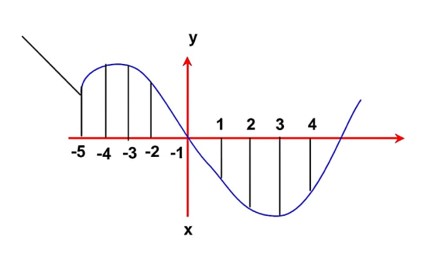
Upvote The minimum value of f(x) = where a, x R and a > 0, is equal to
The minimum value of f(x) = where a, x R and a > 0, is equal to
Let f, g a: N ® N such that f (n + 1) = f (n) +f (1) <!-- [if gte mso 9]><xml>
Let f, g a: N ® N such that f (n + 1) = f (n) +f (1) <!-- [if gte mso 9]><xml>
f : N ->N
f (n + 1) = f (n) + f (1)
Let f (1) = a, a
f (2) = f (1) + f (1) = 2a
f (3) = f (2) + f (1) = 3a
and so on
->f (m) = ma, m, a
->f is one – one, Þ option (2) is true.
Suppose f (g (x) is one-one
then f (g (x1) f (g (x2) for x1
->g (x1)
-
Upvote Let [t] denote the greatest integer <!-- [if gte mso 9]><xml>
Let [t] denote the greatest integer <!-- [if gte mso 9]><xml>
Points of discontinuity
x = 0, 1
Upvote <!-- [if gte mso 9]><xml>
(The inverse trigonometric functions take the principal values)
<!-- [if gte mso 9]><xml>
(The inverse trigonometric functions take the principal values)
Given expression
= 2π - 5 + 6 - 2π - (12 - 4π) = 4π - 11
Upvote Let f : N -> N be a function such that f(m + n) = f(m) + f(n) for every m, n <!-- [if gte mso 9]><xml>
Let f : N -> N be a function such that f(m + n) = f(m) + f(n) for every m, n <!-- [if gte mso 9]><xml>
f (m + n) = f (m) + f (n)
put m = n = 1, f (2) = f (1) + f (1)
again put m = 2, n = 1, f (3) = f (2) + f (1)
and put m = 3, n = 3, f (3 + 3) = f (3) + f (3), 2f (3) = f (6) = 18 Þ f (3) = 9
f (3) = 3f (1)
f (1) = 3, f (2) = 6
f (2).f (3) = 54
Upvote The domain of the function f(x) = <!-- [if gte mso 9]><xml>
The domain of the function f(x) = <!-- [if gte mso 9]><xml>
Domain of sin1 is
and
Domain of the function is .
Upvote