
Relations and Functions
Get insights from 232 questions on Relations and Functions, answered by students, alumni, and experts. You may also ask and answer any question you like about Relations and Functions
- 232
Questions
- 0
Discussions
- 0
Active Users
- 1
Followers
Have a question about Relations and Functions? Ask our experts
Keep it short & simple. Type complete word. Avoid abusive language.
An integer is said to be related to another integer if is a integral multiple of . This relation in is reflexive, symmetric, and transitive.
An integer is said to be related to another integer if is a integral multiple of . This relation in is reflexive, symmetric, and transitive.
This is a True or False Type Question as classified in NCERT Exemplar
Sol:
 Upvote

Every relation which is symmetric and transitive is also reflexive.
Every relation which is symmetric and transitive is also reflexive.
This is a True or False Type Question as classified in NCERT Exemplar
Sol:
 Upvote
Let be the function defined by . Then is invertible.
Let be the function defined by . Then is invertible.
This is a True or False Type Question as classified in NCERT Exemplar
Sol:
Upvote State True or False for the statements in each of the Exercises 6 to 14:
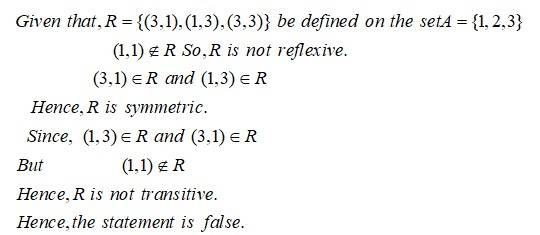
Let be a relation defined on the set . Then is symmetric, transitive but not reflexive.
State True or False for the statements in each of the Exercises 6 to 14:
Let be a relation defined on the set . Then is symmetric, transitive but not reflexive.
This is a True or False Type Question as classified in NCERT Exemplar
Sol:
 Upvote
This is a Fill in the Blanks Type Question as classified in NCERT Exemplar
Sol:
Upvote 
This is a Fill in the Blanks Type Question as classified in NCERT Exemplar
Upvote This is a Fill in the Blanks Type Question as classified in NCERT Exemplar
Sol:
Upvote Let the relation be defined on the set by . Then is given by ________
Let the relation be defined on the set by . Then is given by ________
This is a Fill in the Blanks Type Question as classified in NCERT Exemplar
Sol:
 Upvote
This is a Fill in the Blanks Type Question as classified in NCERT Exemplar
Sol:
 Upvote
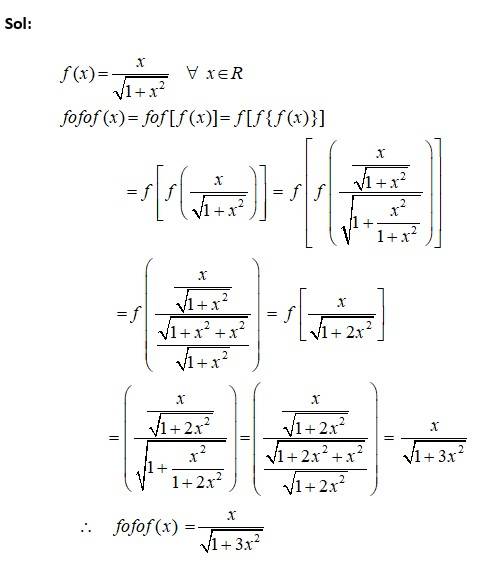
Let be given by . Then is
(A)
(B)
(C) Does not exist
(D) None of these
Let be given by . Then is
(A)
(B)
(C) Does not exist
(D) None of these
This is a Objective Type Question as classified in NCERT Exemplar
Sol:
Upvote