
Relations and Functions
Get insights from 232 questions on Relations and Functions, answered by students, alumni, and experts. You may also ask and answer any question you like about Relations and Functions
- 232
Questions
- 0
Discussions
- 0
Active Users
- 1
Followers
Have a question about Relations and Functions? Ask our experts
Keep it short & simple. Type complete word. Avoid abusive language.
Suppose a class has 7 students. The average marks of these students in the mathematics examination is 62, and their variance is 20. A student fails in the examination if he/she gets less than 50 marks, then in worst case, the number of students can fail is………….
Suppose a class has 7 students. The average marks of these students in the mathematics examination is 62, and their variance is 20. A student fails in the examination if he/she gets less than 50 marks, then in worst case, the number of students can fail is………….
= 140……………… (i)
If any one student get less 50 marks then
but
both condition cannot satisfy together hence no students fails.
 Upvote

The probability that a relation R from <!-- [if gte mso 9]><xml>
The probability that a relation R from <!-- [if gte mso 9]><xml>
Total number of possible relation =
Favourable relations =
Probability =
Upvote There are ten boys B1, B2,…., B10 and five girls G1, G2,…., G5 in a class. Then the number of ways of forming a group consisting of three boys and three girls, if both B1 and B2 together should not be the members of a group, is………….
There are ten boys B1, B2,…., B10 and five girls G1, G2,…., G5 in a class. Then the number of ways of forming a group consisting of three boys and three girls, if both B1 and B2 together should not be the members of a group, is………….
Boys (10) Girls (5)
(3) (3)
B1 & B2 should not be selected together
Total number of ways
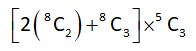 Upvote
Let p and q be two real numbers such that p + q = 3 and p4 + q4 = 369. Then is equal to……….
Let p and q be two real numbers such that p + q = 3 and p4 + q4 = 369. Then is equal to……….
….(i)
and = 369 ….(ii)
or
or
But pq 24 is not possible
Upvote Let a set A = A1 A2 …. Ak, where Ai Aj = for Define the reaction R from A to A by R = Then, R is:
Let a set A = A1 A2 …. Ak, where Ai Aj = for Define the reaction R from A to A by R = Then, R is:
Use aRb = a is related to b, belongs to A iff a belongs to A.
In simple terms, aRb is true if both a & b belongs to the same set.
For reflexive
aRa, a
For symmetric
Let aRb be true
Þ a & b belongs to the same set.
Þ b & a also belongs to the same set
Þ bRa will be true
For transitive
Let
Upvote If f(x) = are continuous on R, then (gof)(2) + (fog)(2) is equal to:
If f(x) = are continuous on R, then (gof)(2) + (fog)(2) is equal to:
f (x) and g (x) are continuous on R a = 4 and b = 1 – 16 = 15
then (gof) (2) + (fog) (2) = g (2) + f (-1) = -11 + 3 = -8
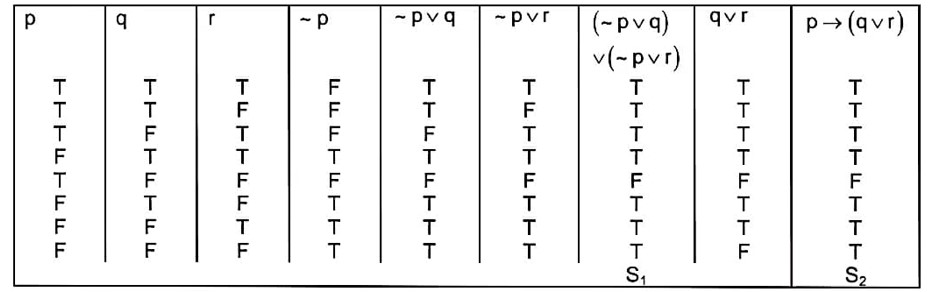
Upvote Let p, q, r be three logical statements. Consider the compound statements
Then, which of the following is NOT true?
Let p, q, r be three logical statements. Consider the compound statements
Then, which of the following is NOT true?
Let f : R → R be defined as
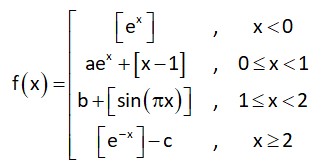
where a, b, c R and [t] denotes greatest integer less than or equal to t. Then, which of the following statements is true?
Let f : R → R be defined as
where a, b, c R and [t] denotes greatest integer less than or equal to t. Then, which of the following statements is true?
For x < 0 0 < ex < 1 Þ [ex] = 0
= a ex – 1 b + [sin px]
For f to be co
Upvote