Waves
Get insights from 109 questions on Waves, answered by students, alumni, and experts. You may also ask and answer any question you like about Waves
- 109
Questions
- 0
Discussions
- 0
Active Users
- 0
Followers
Have a question about Waves? Ask our experts
Keep it short & simple. Type complete word. Avoid abusive language.
A stretched wire vibrates with a frequency of when the tension is and frequency of when the tension is . When the tension is , its frequency of vibration is (in Hz)
A stretched wire vibrates with a frequency of when the tension is and frequency of when the tension is . When the tension is , its frequency of vibration is (in Hz)
Frequency in the stretched wire is
 Upvote

Equation of a standing wave is expressed as y = 2Asinωtcoskx. In this equation, quantity ω/k represents
Equation of a standing wave is expressed as y = 2Asinωtcoskx. In this equation, quantity ω/k represents
Equation of component waves are
y = Asin (ωt – kx) and y = Asin (ωt + kx)
So speed of component wave is ω/k
Upvote A tuning fork A of unknown frequency produces 5 beats/s with a fork of known frequency 340 Hz. When fork A is filed, the beat frequency decreases to 2 beats/s. What is the frequency of fork A?
A tuning fork A of unknown frequency produces 5 beats/s with a fork of known frequency 340 Hz. When fork A is filed, the beat frequency decreases to 2 beats/s. What is the frequency of fork A?
Frequency increases on filing. So, initial frequency of A is 335 Hz.
f = 340 – 5 = 335 Hz
Upvote In an experiment to determine the velocity of sound in air at room temperature using a resonance tube, the first resonance is observed when the air column has a length of 20.0 cm for a tuning form of frequency 400 Hz is used. The velocity of the sound at room temperature is 336 ms-1. The third resonance is observed when the air column has a length of ____________cm.
In an experiment to determine the velocity of sound in air at room temperature using a resonance tube, the first resonance is observed when the air column has a length of 20.0 cm for a tuning form of frequency 400 Hz is used. The velocity of the sound at room temperature is 336 ms-1. The third resonance is observed when the air column has a length of ____________cm.
According to Concept of resonance tube, we can write
Upvote A sine wave is travelling in a medium. The minimum distance between the two particles, always having same speed, is
A sine wave is travelling in a medium. The minimum distance between the two particles, always having same speed, is
Answer (3)
Particles having phase difference of will move with same speed.
Upvote A source of sound S is moving with a velocity of 50 m/s towards a stationary observer. The observer measures the frequency of the source as 1000 Hz. What will be the apparent frequency (in Hz) of the source when it is moving away from the observer after crossing him? (Take speed of sound in air as 350 m/s)
A source of sound S is moving with a velocity of 50 m/s towards a stationary observer. The observer measures the frequency of the source as 1000 Hz. What will be the apparent frequency (in Hz) of the source when it is moving away from the observer after crossing him? (Take speed of sound in air as 350 m/s)
Kindly consider the following figure
Upvote Speed of sound in a resonance tube experiment is given by the expression v = 2f0(l2 – l1) where f? is the frequency of the tuning fork and l1, l2 are length of the air column. Consider f0 = 300 Hz with no error in its value. Lengths of the air column l1 and l2 are measured as 25.0 cm and 80.0 cm respectively. Find the absolute error in the speed of sound (in m/s).
Speed of sound in a resonance tube experiment is given by the expression v = 2f0(l2 – l1) where f? is the frequency of the tuning fork and l1, l2 are length of the air column. Consider f0 = 300 Hz with no error in its value. Lengths of the air column l1 and l2 are measured as 25.0 cm and 80.0 cm respectively. Find the absolute error in the speed of sound (in m/s).
Δν = 2f? (Δl? + Δl? ) = 2 × 300 (0.1 + 0.1) × 10? ² = 1.2 m/s
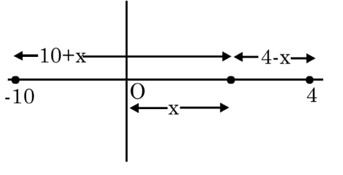
Upvote A sound source is located somewhere along the x-axis. Experiment shows that the same wavefront simultaneously reaches listeners at x = -10m and x = +4.0m. A third listener is positioned along the positive y-axis. What is y-coordinate (in m) if the same wavefront reaches at him at the same instant it does the first two listeners?
A sound source is located somewhere along the x-axis. Experiment shows that the same wavefront simultaneously reaches listeners at x = -10m and x = +4.0m. A third listener is positioned along the positive y-axis. What is y-coordinate (in m) if the same wavefront reaches at him at the same instant it does the first two listeners?