
Waves
Get insights from 109 questions on Waves, answered by students, alumni, and experts. You may also ask and answer any question you like about Waves
- 109
Questions
- 0
Discussions
- 0
Active Users
- 0
Followers
Have a question about Waves? Ask our experts
Keep it short & simple. Type complete word. Avoid abusive language.
Two cars are approaching each other at an equal speed of 7.2 km/hr. When they see each other, both blow horns of 676Hz. The beat frequency heard by each driver will be…………………. Hz.
[Velocity of sound in air is 340 m/s]
Two cars are approaching each other at an equal speed of 7.2 km/hr. When they see each other, both blow horns of 676Hz. The beat frequency heard by each driver will be…………………. Hz.
[Velocity of sound in air is 340 m/s]
[VA = VB = 2m/s]
App freq heard by car B
Similarly,
Beat frequency heard by both = 684 – 676 = 8Hz
 Upvote

Which of the following equations represents a traveling wave?
Which of the following equations represents a traveling wave?
Travelling wave is represented by
Thus, y = A sin (15x – 2t) represents a travelling wave
Upvote A student is performing the experiment of resonance column. The diameter of the column tube is 6cm. THE Frequency of the tuning fork is 504 Hz. Speed of the sound at the given temperature is 336m/s. The zero of the meter scale coincides with tip end of the resonance column tube. The reading of the water level in the column when the first resonance occurs is:
A student is performing the experiment of resonance column. The diameter of the column tube is 6cm. THE Frequency of the tuning fork is 504 Hz. Speed of the sound at the given temperature is 336m/s. The zero of the meter scale coincides with tip end of the resonance column tube. The reading of the water level in the column when the first resonance occurs is:
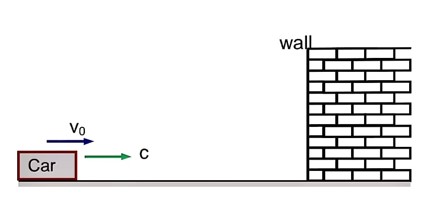
The frequency of a car horn encountered a change from 400Hz to 500Hz, when the car approaches a vertical wall. If the speed of sound is 330 m/s. Then the speed of car is_________km/h.
The frequency of a car horn encountered a change from 400Hz to 500Hz, when the car approaches a vertical wall. If the speed of sound is 330 m/s. Then the speed of car is_________km/h.
Initially wall will act as observer, so with the help of Doppler’s effect, we can write
Now wall will act as source of sound of frequency f’, so With the help of Doppler’s effect, we can write
Upvote Two cars X and Y are approaching each other with velocities is 36 km/h and 72 km/h respectively . The frequency of a whistle sound as emitted by a passenger in car X, heard by the passenger in car Y is 1320 Hz. If the velocity of sound in air is 340 m/s, the actual frequency of the whistle sound produced is……….Hz.
Two cars X and Y are approaching each other with velocities is 36 km/h and 72 km/h respectively . The frequency of a whistle sound as emitted by a passenger in car X, heard by the passenger in car Y is 1320 Hz. If the velocity of sound in air is 340 m/s, the actual frequency of the whistle sound produced is……….Hz.
Two waves are simultaneously passing through a string and their equations are:
Given amplitudes A1 = 12mm and A2 = 5mm, x0 = 3.5 cm and wave number k = 6.28 cm-1. The amplitude of resulting wave will be________mm.
Two waves are simultaneously passing through a string and their equations are:
Given amplitudes A1 = 12mm and A2 = 5mm, x0 = 3.5 cm and wave number k = 6.28 cm-1. The amplitude of resulting wave will be________mm.
Phase difference between the two waves,
Amplitude of resulting wave,
Upvote A stationary observer receives sound from two identical tuning forks, one of which approaches and the other one recedes with the same speed (much les than the speed of sound). The observers hears 2 beats/sec. The oscillation frequency of each tuning fork is <!-- [if gte vml 1]>
<!-- [if !supportLineBreakNewLine]-->
<!--[endif]-->
A stationary observer receives sound from two identical tuning forks, one of which approaches and the other one recedes with the same speed (much les than the speed of sound). The observers hears 2 beats/sec. The oscillation frequency of each tuning fork is <!-- [if gte vml 1]>
<!-- [if !supportLineBreakNewLine]-->
<!--[endif]-->
In the wave equation
the velocity of the wave will be:
In the wave equation
the velocity of the wave will be: