
Waves
Get insights from 109 questions on Waves, answered by students, alumni, and experts. You may also ask and answer any question you like about Waves
- 109
Questions
- 0
Discussions
- 0
Active Users
- 0
Followers
Have a question about Waves? Ask our experts
Keep it short & simple. Type complete word. Avoid abusive language.
Change in temperature of the medium changes
(a) Frequency of sound waves.
(b) Amplitude of sound waves.
(c) Wavelength of sound waves.
(d) Loudness of sound waves.
Change in temperature of the medium changes
(a) Frequency of sound waves.
(b) Amplitude of sound waves.
(c) Wavelength of sound waves.
(d) Loudness of sound waves.
This is a multiple choice answer as classified in NCERT Exemplar
(c) Speed of sound wave in a medium v
Clearly when temperature changes speed also changes
As v= as frequency remains constant and speed changes so wavelength changes
 Upvote

Speed of sound wave in air
(a) Is independent of temperature.
(b) Increases with pressure.
(c) Increases with increase in humidity.
(d) Decreases with increase in humidity.
Speed of sound wave in air
(a) Is independent of temperature.
(b) Increases with pressure.
(c) Increases with increase in humidity.
(d) Decreases with increase in humidity.
This is a multiple choice answer as classified in NCERT Exemplar
(c) Due to presence of moisture density of air decreases.
As we know speed of sound in air v=
So v
v2/v1=
2 (moist air)< 1 (dry air)
So v2>v1
So speed of sound wave increases with increase in humidity
Upvote Sound waves of wavelength λ travelling in a medium with a speed of v m/s enter into another medium where its speed is 2v m/s. Wavelength of sound waves in the second medium is
(a) λ
(b) 2 λ
(c) 2λ
(d) 4λ
Sound waves of wavelength λ travelling in a medium with a speed of v m/s enter into another medium where its speed is 2v m/s. Wavelength of sound waves in the second medium is
(a) λ
(b) 2 λ
(c) 2λ
(d) 4λ
This is a multiple choice answer as classified in NCERT Exemplar
(c) Let frequency of the two will be and it is same in both medium
So v/ = v’/
= v’ /v
= 2v /v=2
Where and ’ and v and v’ are wavelength and speeds of first and second medium respectively
Upvote Water waves produced by a motor boat sailing in water are
(a) Neither longitudinal nor transverse.
(b) Both longitudinal and transverse.
(c) Only longitudinal.
(d) Only transverse.
Water waves produced by a motor boat sailing in water are
(a) Neither longitudinal nor transverse.
(b) Both longitudinal and transverse.
(c) Only longitudinal.
(d) Only transverse.
This is a multiple choice answer as classified in NCERT Exemplar
(b) Water waves produced by a motorboat are both longitudinal and transverse because it produce both lateral and transverse wave In the medium.
Upvote Show that when a string fixed at its two ends vibrates in 1 loop, 2 loops, 3 loops and 4 loops, the frequencies are in the ratio 1:2:3:4.
Show that when a string fixed at its two ends vibrates in 1 loop, 2 loops, 3 loops and 4 loops, the frequencies are in the ratio 1:2:3:4.
This is a short answer type question as classified in NCERT Exemplar
Let there are n number of loops in the string

length corresponding each loop is
So we can write L=
v/ =2L/n
so frequency v=
v
so
= 1:2:3:4
Upvote A tuning fork vibrating with a frequency of 512Hz is kept close to the open end of a tube filled with water (Fig. 15.4). The water level in the tube is gradually lowered. When the water level is 17cm below the open end, maximum intensity of sound is heard. If the room temperature is 20° C, calculate
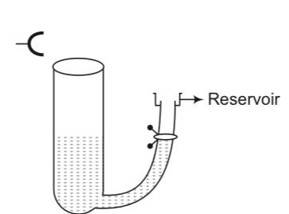
(a) Speed of sound in air at room temperature
(b) Speed of sound in air at 0° C
(c) If the water in the tube is replaced with mercury, will there be any difference in your observations?
A tuning fork vibrating with a frequency of 512Hz is kept close to the open end of a tube filled with water (Fig. 15.4). The water level in the tube is gradually lowered. When the water level is 17cm below the open end, maximum intensity of sound is heard. If the room temperature is 20° C, calculate

(a) Speed of sound in air at room temperature
(b) Speed of sound in air at 0° C
(c) If the water in the tube is replaced with mercury, will there be any difference in your observations?
This is a short answer type question as classified in NCERT Exemplar
consider the frequency of tuning fork= 512Hz

(a) L=
V= = 512
= 348.16m/s
(b) we know that v
=
Vo=
(c) Resonance will be observed at 17cm length of air column only intensity of sound heard may be greater due to more com
Upvote The pattern of standing waves formed on a stretched string at two instants of time are shown in Fig. The velocity of two waves superimposing to form stationary waves is 360 ms–1 and their frequencies are 256 Hz
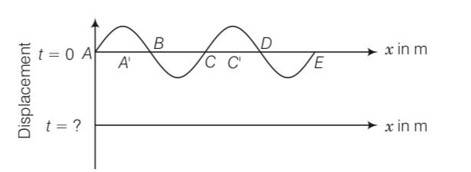
(a) Calculate the time at which the second curve is plotted.
(b) Mark nodes and antinodes on the curve.
(c) Calculate the distance between A′ and C′ .
The pattern of standing waves formed on a stretched string at two instants of time are shown in Fig. The velocity of two waves superimposing to form stationary waves is 360 ms–1 and their frequencies are 256 Hz

(a) Calculate the time at which the second curve is plotted.
(b) Mark nodes and antinodes on the curve.
(c) Calculate the distance between A′ and C′ .
This is a short answer type question as classified in NCERT Exemplar
Given frequency of the wave v=256Hz
T=
(a) time taken to pass through mean position is
t=T/4=1/40 =3.9 9.8 10-4s
(b) nodes are A, B, C, D, E (having zero displacement)
antinode
Upvote The wave pattern on a stretched string is shown in Fig. Interpret what kind of wave this is and find its wavelength
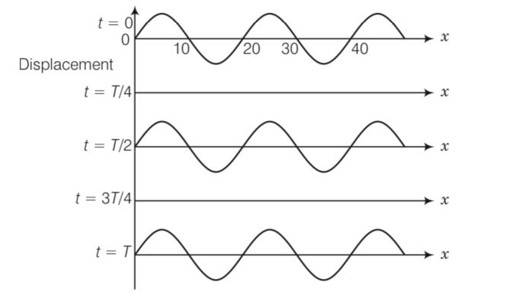
The wave pattern on a stretched string is shown in Fig. Interpret what kind of wave this is and find its wavelength

This is a short answer type question as classified in NCERT Exemplar
We have to observe the displacement and position of different points, then accordingly nature of two waves decided
Points on positions x= 10,20,30,40 never move, always at mean position with respect to time . these are forming nodes
Upvote A train standing at the outer signal of a railway station blows a whistle of frequency 400 Hz still air. The train begins to move with a speed of 10 m/s towards the platform. What is the frequency of the sound for an observer standing on the platform? (sound velocity in air = 330 m/s)
A train standing at the outer signal of a railway station blows a whistle of frequency 400 Hz still air. The train begins to move with a speed of 10 m/s towards the platform. What is the frequency of the sound for an observer standing on the platform? (sound velocity in air = 330 m/s)
This is a short answer type question as classified in NCERT Exemplar
As the source is moving towards the observer hence apparent frequency observed is more than the natural frequency
Frequency of whistle
Speed of train = vt= 10m/s
Velocity of sound in air =v= 330m/s
Apparent frequency when source is m
Upvote A pipe 20 cm long is closed at one end. Which harmonic mode of the pipe is resonantly excited by a source of 1237.5 Hz ?(sound velocity in air = 330 m/s)
A pipe 20 cm long is closed at one end. Which harmonic mode of the pipe is resonantly excited by a source of 1237.5 Hz ?(sound velocity in air = 330 m/s)
This is a short answer type question as classified in NCERT Exemplar
length of pipe

L=20cm =20
=3
Hence 3rd harmonic node of the pipe is resonantly excited by the source of the given frequency.
Upvote