
Alternating Current
Get insights from 94 questions on Alternating Current, answered by students, alumni, and experts. You may also ask and answer any question you like about Alternating Current
- 94
Questions
- 0
Discussions
- 0
Active Users
- 0
Followers
Have a question about Alternating Current? Ask our experts
Keep it short & simple. Type complete word. Avoid abusive language.
Two cells of emf 2E and E with internal resistance r? and r? respectively are connected in series to an external resistor R (see figure). The value of R, at which the potential difference across the terminals of the first cell becomes zero is:
<!-- [if !supportLineBreakNewLine]--><!--[endif]-->
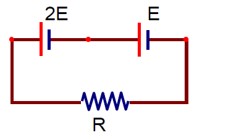
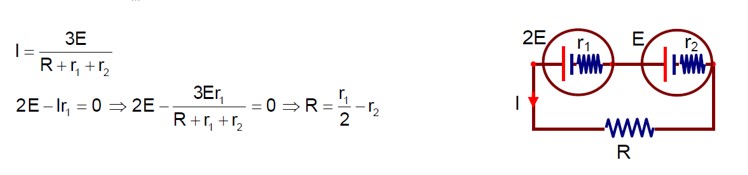
Two cells of emf 2E and E with internal resistance r? and r? respectively are connected in series to an external resistor R (see figure). The value of R, at which the potential difference across the terminals of the first cell becomes zero is:
<!-- [if !supportLineBreakNewLine]--><!--[endif]-->
What happens to the inductive reactance and the current in a purely inductive circuit if the frequency is halved?
What happens to the inductive reactance and the current in a purely inductive circuit if the frequency is halved?
Given the initial relationships:
X? = ωL and i? = V? / (ωL)
If the angular frequency ω is halved, the inductive reactance X? is halved, while the peak current i? is doubled.
 Upvote

An electrical power line, having a total resistance of 2Ω, delivers 1 kW at 220 V. The efficiency of the transmission line is approximately:
<!-- [if !supportLineBreakNewLine]-->
<!--[endif]-->
An electrical power line, having a total resistance of 2Ω, delivers 1 kW at 220 V. The efficiency of the transmission line is approximately:
<!-- [if !supportLineBreakNewLine]-->
<!--[endif]-->
Power delivered = 1000 W
Voltage = 220 V
Transmission 'I' = 1000/220
Power loss = I²R
Efficiency = (1000x100)/ (1000 + I²R)
Upvote In a series LR circuit, power of 400 W is dissipated from a source of 250 V, 50 Hz. The power factor of the circuit is 0.8 . In order to bring the power factor to unity, a capacitor of value C is added in series to the L and R. Taking the value of C as (n/3π) μF, then value of ' n ' is
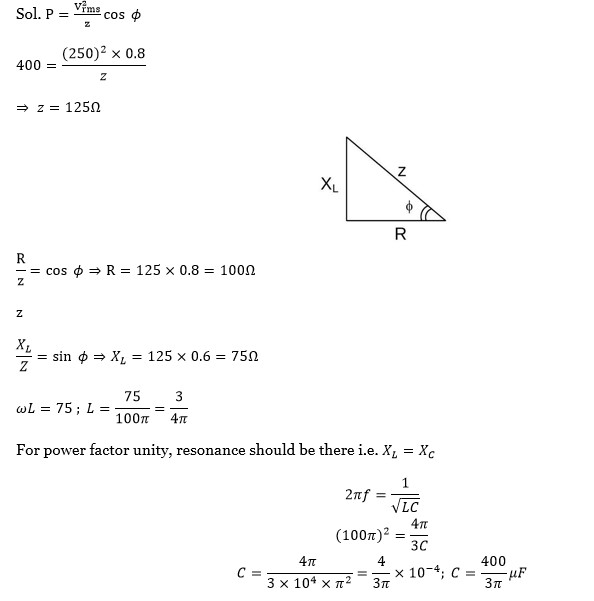
In a series LR circuit, power of 400 W is dissipated from a source of 250 V, 50 Hz. The power factor of the circuit is 0.8 . In order to bring the power factor to unity, a capacitor of value C is added in series to the L and R. Taking the value of C as (n/3π) μF, then value of ' n ' is
A series LCR circuit driven by 300V at a frequency of 50 Hz contains a resistance R = <!-- [if gte mso 9]><xml>
(Take π2 = 10)
A series LCR circuit driven by 300V at a frequency of 50 Hz contains a resistance R = <!-- [if gte mso 9]><xml>
(Take π2 = 10)
What happens when a voltage is applied across an inductor?
What happens when a voltage is applied across an inductor?
The inductor generates induced electromotive force (EMF) and opposes the changes in the current flow. Due to this the current lag the voltage by 90 degrees.
Upvote A circuit element X when connected to an a.c. supply of peak voltage 100V given a peak current of 5A which is in phase with the voltage. A second element Y when connected to the same a.c. supply also gives the same value of peak current which lags behind the voltage by <!-- [if gte mso 9]><xml>
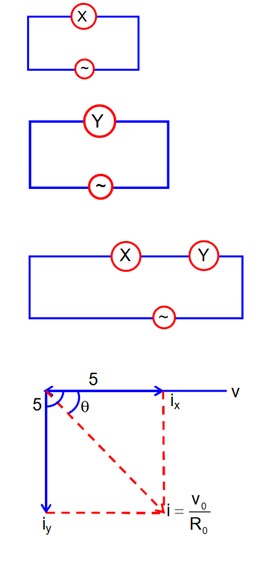
A circuit element X when connected to an a.c. supply of peak voltage 100V given a peak current of 5A which is in phase with the voltage. A second element Y when connected to the same a.c. supply also gives the same value of peak current which lags behind the voltage by <!-- [if gte mso 9]><xml>
v = 100 sin
i =
i = 100 5sin
When x and y both are connected in series :-
v = 100sin
tan = 1 = 45°
R0 =
 Upvote
The effective current I in the given circuit at very high frequencies will be _________A.

The effective current I in the given circuit at very high frequencies will be _________A.
At very high frequencies
Thus equivalent circuit
Upvote