
Alternating Current
Get insights from 94 questions on Alternating Current, answered by students, alumni, and experts. You may also ask and answer any question you like about Alternating Current
- 94
Questions
- 0
Discussions
- 0
Active Users
- 0
Followers
Have a question about Alternating Current? Ask our experts
Keep it short & simple. Type complete word. Avoid abusive language.
As shown in the figure an inductor of inductance 200 mH is connected to an AC source of emf 220 V and frequency 50 Hz. The instantaneous voltage of the source is 0 V when the peak value of current is The value of a is __________.
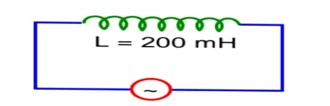
As shown in the figure an inductor of inductance 200 mH is connected to an AC source of emf 220 V and frequency 50 Hz. The instantaneous voltage of the source is 0 V when the peak value of current is The value of a is __________.
Let l = l0 cos wt
Then v = v0 sinwt
at t = 0, v = 0
but l = l0
a = 121 × 2
a = 242
 Upvote

At t < 0, the capacitor is charged and the switch is opened. At t = 0 the switch is closed. The shortest time T at which the charge on the capacitor will be zero is given by:
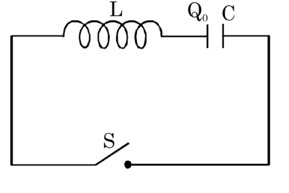
At t < 0, the capacitor is charged and the switch is opened. At t = 0 the switch is closed. The shortest time T at which the charge on the capacitor will be zero is given by:
The time period of LC oscillations,
The time at which charge on the capacitor will be zero is
So t
Upvote A series LCR circuit containing 5.0H inductor, 80μF capacitor and 40Ω resistor is connected to 230 V variable frequency ac source. The angular frequencies of the source at which power transferred to the circuit is half the power at the resonant angular frequency are likely to be:
<!-- [if !supportLineBreakNewLine]-->
<!--[endif]-->
A series LCR circuit containing 5.0H inductor, 80μF capacitor and 40Ω resistor is connected to 230 V variable frequency ac source. The angular frequencies of the source at which power transferred to the circuit is half the power at the resonant angular frequency are likely to be:
<!-- [if !supportLineBreakNewLine]-->
<!--[endif]-->
Q = ω? L/R ⇒ Δω = R/L = 50/4 = 8rad/sec
Δω
ω? = 1/√LC = 1/√ (5×80×10? ) = 50rad/sec
ω? = ω? - Δω/2 = 46rad/sec
ω? = ω? + Δω/2 = 54rad/sec
Upvote A step down transformer connected to an ac mains supply of 220 V is made to operate at 11 V, 44 W lamp. Ignoring power losses in the transformer, what is the current in the primary circuit?
<!-- [if !supportLineBreakNewLine]-->
<!--[endif]-->
A step down transformer connected to an ac mains supply of 220 V is made to operate at 11 V, 44 W lamp. Ignoring power losses in the transformer, what is the current in the primary circuit?
<!-- [if !supportLineBreakNewLine]-->
<!--[endif]-->
220 × i? = 44
⇒ I? = 44/220 = 1/5 = 0.2 A
Upvote An inductor of inductance L, a capacitor of capacitance C and a resistor of resistance ' R '
are connected in series to an ac source of potential difference ' V volts as shown in figure.
Potential difference across L, C and R is 40 V, 10 V and 40 V, respectively. The amplitude of current flowing through LCR series circuit is 10√2 A. The impedance of the circuit is:

An inductor of inductance L, a capacitor of capacitance C and a resistor of resistance ' R '
are connected in series to an ac source of potential difference ' V volts as shown in figure.
Potential difference across L, C and R is 40 V, 10 V and 40 V, respectively. The amplitude of current flowing through LCR series circuit is 10√2 A. The impedance of the circuit is:


A screw gauge gives the following readings when used to measure the diameter of a wire
Main scale reading: 0 mm
Circular scale reading: 52 divisions
Given that 1 mm on main scale corresponds to 100 divisions on the circular scale. The diameter of the wire from the above data is:
A screw gauge gives the following readings when used to measure the diameter of a wire
Main scale reading: 0 mm
Circular scale reading: 52 divisions
Given that 1 mm on main scale corresponds to 100 divisions on the circular scale. The diameter of the wire from the above data is:
Least count = 1 mm / 100 = 0.01 mm
Diameter = main scale reading + circular scale reading
Diameter = 0 + 52 × 0.01 mm
= 0.52 mm = 0.052 cm
Upvote An ac source is connected to a capacitor . Due to decrease in its operating frequency:
An ac source is connected to a capacitor . Due to decrease in its operating frequency:
Speed of light in air is
Speed of light in another denser medium.
(d)
is proportional to but independent of .
(c) Energy of electron
for minimum wavelength, maximum loss of energy
- (b) Incident energy
If electron will emit.
No electron emission
Only caesium will emit elec
Upvote Match List-I with List-II
List - I
List - II
(a) Phase difference between current and voltage in a purely resistive AC circuit
(i) π/2; current leads voltage
(b) Phase difference between current and voltage in a pure inductive AC circuit
(ii) Zero
(c) Phase difference between current and voltage in a pure capacitive AC circuit
(iii) π/2; current lags voltage
(d) Phase difference between current and voltage in an LCR series circuit
(iv) tan?¹((X_L - X_C)/R)
Choose the most appropriate answer from the options given below :
<!-- [if !supportLineBreakNewLine]-->
<!--[endif]-->
Match List-I with List-II
|
List - I |
List - II |
|
(a) Phase difference between current and voltage in a purely resistive AC circuit |
(i) π/2; current leads voltage |
|
(b) Phase difference between current and voltage in a pure inductive AC circuit |
(ii) Zero |
|
(c) Phase difference between current and voltage in a pure capacitive AC circuit |
(iii) π/2; current lags voltage |
|
(d) Phase difference between current and voltage in an LCR series circuit |
(iv) tan?¹((X_L - X_C)/R) |
Choose the most appropriate answer from the options given below :
<!-- [if !supportLineBreakNewLine]-->
<!--[endif]-->
In a purely resistive AC circuit, if V = V? sin (ωt), then the current I is:
I = (V? / X? ) * sin (ωt - π/2)
Upvote