
Atoms
Get insights from 99 questions on Atoms, answered by students, alumni, and experts. You may also ask and answer any question you like about Atoms
- 99
Questions
- 0
Discussions
- 0
Active Users
- 0
Followers
Have a question about Atoms? Ask our experts
Keep it short & simple. Type complete word. Avoid abusive language.
The recoil speed of a hydrogen atom after it emits a photon in going from n = 5 state to n = 1 state will be:
The recoil speed of a hydrogen atom after it emits a photon in going from n = 5 state to n = 1 state will be:
With the help of conservation of linear momentum, we can write
 Upvote

Which of the following transitions of He+ ion will give rise to spectral line which has same wavelength as some spectral line in hydrogen atom?
Which of the following transitions of He+ ion will give rise to spectral line which has same wavelength as some spectral line in hydrogen atom?
If n2 -> n1 in H (Z = 1) gives
Upvote If the wavelength of α -line of Lyman series in hydrogen atom is λ, find the wavelength of β -line of Paschen series.
<!-- [if !supportLineBreakNewLine]-->
<!--[endif]-->
If the wavelength of α -line of Lyman series in hydrogen atom is λ, find the wavelength of β -line of Paschen series.
<!-- [if !supportLineBreakNewLine]-->
<!--[endif]-->
(hc/λ) = 13.6Z² (1/1² - 1/4²) = 13.6Z² (3/4) ; [λ = (4/3)k]
β line of Paschen
(hc/λ') = 13.6Z² (1/9 - 1/25)
λ = k × (9×25/16) ; λ' = (3/4)λ × (9×25/16) = (3³×5²/2? )λ
Upvote In the given, figure, the energy levels of hydrogen atom have been shown along with some transitions marked A, B, C, D and E. The transitions A, B and C respectively represents:
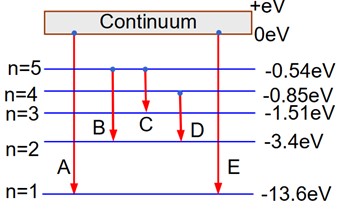
In the given, figure, the energy levels of hydrogen atom have been shown along with some transitions marked A, B, C, D and E. The transitions A, B and C respectively represents:
A : Series limit of Lyman series
B : Third line of Balmer series
C : Second line of Paschen series
Upvote Let and be the energy of an electron in the first and second excited states of hydrogen atom, respectively. According the Bohr's model of an atom, the ratio is :
<!-- [if !supportLineBreakNewLine]-->
<!--[endif]-->
Let and be the energy of an electron in the first and second excited states of hydrogen atom, respectively. According the Bohr's model of an atom, the ratio is :
<!-- [if !supportLineBreakNewLine]-->
<!--[endif]-->
First excited state
Second excited state
Upvote In hydrogen spectrum, the shortest wavelength in the Balmer series is . The shortest wavelength in the Bracket series is :
<!-- [if !supportLineBreakNewLine]-->
<!--[endif]-->
In hydrogen spectrum, the shortest wavelength in the Balmer series is . The shortest wavelength in the Bracket series is :
<!-- [if !supportLineBreakNewLine]-->
<!--[endif]-->
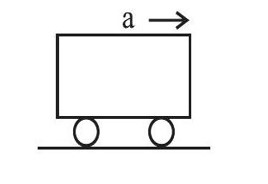
In the frame of car

Upvote A particle of mass m moves in a circular orbit in a central potential field U(r) = U₀r⁴. If Bohr's quantization conditions are applied, radii of possible orbitals rₙ vary with nᵃ, where α is---------.
A particle of mass m moves in a circular orbit in a central potential field U(r) = U₀r⁴. If Bohr's quantization conditions are applied, radii of possible orbitals rₙ vary with nᵃ, where α is---------.
From the given relations:
mv²/r = |dU/dr| = 4|U? |r³ . (1)
mvr = nh / 2π . (2)
By combining equations (1) and (2), we can derive the radius r:
r = ( (nh)² / (4π√* (U? )*) )¹/³ ⇒ r ∝ n²/³
Upvote The atomic hydrogen emits a line spectrum consisting of various series. Which series of hydrogen atomic spectra is lying in the visible region?
The atomic hydrogen emits a line spectrum consisting of various series. Which series of hydrogen atomic spectra is lying in the visible region?
The Balmer series lies in the visible region of the electromagnetic spectrum.
Upvote If an electron is moving in the nth orbit of the hydrogen atom, then its velocity (vn) for the nth orbit is given as :
<!-- [if !supportLineBreakNewLine]-->
<!--[endif]-->
If an electron is moving in the nth orbit of the hydrogen atom, then its velocity (vn) for the nth orbit is given as :
<!-- [if !supportLineBreakNewLine]-->
<!--[endif]-->
Velocity of an electron in the nth orbit:
v ∝ 1/n
Upvote