
Atoms
Get insights from 99 questions on Atoms, answered by students, alumni, and experts. You may also ask and answer any question you like about Atoms
- 99
Questions
- 0
Discussions
- 0
Active Users
- 0
Followers
Have a question about Atoms? Ask our experts
Keep it short & simple. Type complete word. Avoid abusive language.
Given below are two statements:
Statement I : In hydrogen atom, the frequency of radiation emitted when an electron jumps from lower energy orbit (E1) to higher energy orbit (E2), is given as hf = E1 = E2
Statement II : The jumping of electron from higher energy orbit (E2) to lower energy orbit (E1) is associated with frequency of radiation given as f = (E2 – E1) / h
This condition is Bohr’s frequency condition.
In the light of the above statements, choose the correct answer from the options given below:
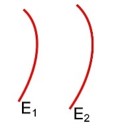
For statement 1
hf = E1 - E2
Since, E2 > E1
So, it should be
hf = E2 – E1
Therefore statement 1 is wrong
For statement 2
For the jumping of electron from higher energy orbit
(E2) to lower energy orbit (E1)
hf = E2 – E1
&
 Upvote

The simple Bohr model is not applicable to He4atom because
(a) He4 is an inert gas
(b) He4 has neutrons in the nucleus
(c) He4 has one more electron
(d) Electrons are not subject to central forces
The simple Bohr model is not applicable to He4atom because
(a) He4 is an inert gas
(b) He4 has neutrons in the nucleus
(c) He4 has one more electron
(d) Electrons are not subject to central forces
This is a Multiple Choice Questions as classified in NCERT Exemplar
Answer- (c, d)
Explanation- The simple Bohr model is not applicable to He4 atom because He4 has one more electron and electrons are not subject to central forces.
Upvote Let En= be the energy of the nth level of H atom. If all the H-atoms are in the ground state and radiation of frequency falls on it
(a) It will not be absorbed at all
(b) Some of atoms will move to first excited state
(c) All atoms will be excited to the n= 2 state
(d) No atoms will make a transition to then n=3 state
Let En= be the energy of the nth level of H atom. If all the H-atoms are in the ground state and radiation of frequency falls on it
(a) It will not be absorbed at all
(b) Some of atoms will move to first excited state
(c) All atoms will be excited to the n= 2 state
(d) No atoms will make a transition to then n=3 state
This is a Multiple Choice Questions as classified in NCERT Exemplar
Answer- (b, d)
Explanation- when a radiation of energy fall on it some atoms would be excited but not all would be excite also no atom will go to 3 level some go to 2 level also but not all excite to 2 level. So by considering these f
Upvote The Balmer series for the H-atom can be observed
(a) If we measure the frequencies of light emitted when an excited atom falls to the ground state
(b) If we measure the frequencies of light emitted due to transitions between excited states and the first excited state
(c) In any transition in a H-atom .
(d) As a sequence of frequencies with the higher frequencies getting closely
The Balmer series for the H-atom can be observed
(a) If we measure the frequencies of light emitted when an excited atom falls to the ground state
(b) If we measure the frequencies of light emitted due to transitions between excited states and the first excited state
(c) In any transition in a H-atom .
(d) As a sequence of frequencies with the higher frequencies getting closely
This is a Multiple Choice Questions as classified in NCERT Exemplar
Answer- (b, d)
Explantion- Balmer series for the H-atom can be observed if we measure the frequencies of light emitted due to transitions between higher excited states and the first excited state and as a sequence of frequencies with
Upvote The Bohr model for the spectra of a H-atom
(a) Will not be applicable to hydrogen in the molecular form
(b) Will not be applicable as it is for a He-atom
(c) Is valid only at room temperature
(d) Predicts continuous as well as discrete spectral lines
The Bohr model for the spectra of a H-atom
(a) Will not be applicable to hydrogen in the molecular form
(b) Will not be applicable as it is for a He-atom
(c) Is valid only at room temperature
(d) Predicts continuous as well as discrete spectral lines
This is a Multiple Choice Questions as classified in NCERT Exemplar
Answer- (a, b)
Explantion- The Bohr model for the spectra of a H-atom will not be applicable to hydrogen in the Molecular form. And also, it will not be applicable as it is for a He-atom.
Upvote Consider aiming a beam of free electrons towards free protons. When-they scatter, an electron and a proton cannot combine to produce a H-atom.
(a) Because of energy conservation
(b) Without simultaneously releasing energy in the form of radiation
(c) Because of momentum conservation
(d) Because of angular momentum conservation
Consider aiming a beam of free electrons towards free protons. When-they scatter, an electron and a proton cannot combine to produce a H-atom.
(a) Because of energy conservation
(b) Without simultaneously releasing energy in the form of radiation
(c) Because of momentum conservation
(d) Because of angular momentum conservation
This is a Multiple Choice Questions as classified in NCERT Exemplar
Answer- (a, b)
Explantion- When beam of free electrons is aiming towards free protons. Then, they scatter but an electron and a proton cannot combine to produce a H-atom because of energy conservation and without simultaneously releas
Upvote An ionised H-molecule consists of an electron and two protons. The protons are separated by a small distance of the order of angstrom. In the ground state,
(a) The electron would not move in circular orbits
(b) The energy would be (2)4times that of a H-atom
(c) The electrons, orbit would go around the protons
(d) The molecule will soon decay in a proton and a H-atom
An ionised H-molecule consists of an electron and two protons. The protons are separated by a small distance of the order of angstrom. In the ground state,
(a) The electron would not move in circular orbits
(b) The energy would be (2)4times that of a H-atom
(c) The electrons, orbit would go around the protons
(d) The molecule will soon decay in a proton and a H-atom
This is a Multiple Choice Questions as classified in NCERT Exemplar
Answer- (a, c)
Explantion- The protons are separated by a small distance of the order of angstrom. In the ground state the electron would not move in circular orbits the electrons, orbit would go around the protons.
Upvote A set of atoms in an excited state decays
(a) In general to any of the states with lower energy
(b) Into a lower state only when excited by an external electric field
(c) All together simultaneously into a lower state
(d) To emit photons only when they collide.
A set of atoms in an excited state decays
(a) In general to any of the states with lower energy
(b) Into a lower state only when excited by an external electric field
(c) All together simultaneously into a lower state
(d) To emit photons only when they collide.
This is a Multiple Choice Questions as classified in NCERT Exemplar
Answer- (a)
Explanation-A set of atoms in an excited state decays in general to any of the states with lower energy.
Upvote Two H atoms in the ground state collide inelastically. The maximum amount by which their combined kinetic energy is reduced is
(a) 10.20 eV
(b) 20.40eV
(c) 13.6 eV
Two H atoms in the ground state collide inelastically. The maximum amount by which their combined kinetic energy is reduced is
(a) 10.20 eV
(b) 20.40eV
(c) 13.6 eV
This is a Multiple Choice Questions as classified in NCERT Exemplar
Answer- (a)
Explanation -Total energy in ground state collide elastically Is 213.6eV= 27.2eV
When a electron excite from ground state to first excited state then
Energy is =-13.6/22= 3.4eV+13.6 (ground state energy) eV = 17.0 eV
So net e
Upvote