

Chemistry in Everyday Life
Get insights from 130 questions on Chemistry in Everyday Life, answered by students, alumni, and experts. You may also ask and answer any question you like about Chemistry in Everyday Life
Follow Ask QuestionQuestions
Discussions
Active Users
Followers
New answer posted
a year agoContributor-Level 10
16.10
The use of chemicals for therapeutic effect is called chemotherapy.
For example: the use of chemicals in the diagnosis, prevention, and treatment of diseases like cancer etc.
New answer posted
a year agoContributor-Level 10
16.10
A medicine has the tendency to bind to more than one receptor site. Thus, a medicine may be toxic for some receptor sites. Further, in most cases, medicines cause harmful effects when taken in higher doses than recommended. As a result, medicines may be poisonous in such cases. Hence, medicines should not be taken without consulting doctors.
New answer posted
a year agoContributor-Level 10
16.9
The macromolecules that are chosen as drug targets are carbohydrates, lipids, proteins, and nucleic acids.
New answer posted
a year agoContributor-Level 10
16.8
In medicinal chemistry, drug targets refer to the specific key molecules involved in certain metabolic pathways that result in specific diseases. Carbohydrates, proteins, lipids, and nucleic acids are examples of drug targets.
Drugs are chemical agents designed to inhibit these target molecules by binding with the active sites of the key molecules.
New answer posted
a year agoContributor-Level 10
16.6
The basis on which drugs are classified in different ways is : - of drugs and the reasons for classification are as follows:
(i) On the basis of pharmacological effect:
This classification provides doctors the whole range of drugs available for the treatment of a particular type of problem. Hence, such a classification is very useful to doctors.
(ii) On the basis of drug action:
This classification is based on the action of a drug on a particular biochemical process.
(iii) On the basis of chemical structure:
This classification provides the range of drugs sharing common structural features and often having similar pharmaco
New answer posted
a year ago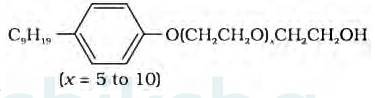
Contributor-Level 10

The functional group present in the molecule is:
1. Ether
2. Primary Alcoholic group
Alcohol group can recognize by the presence of –OH group present in the given organic compound and on the other hand, the ether group can be identified by the presence of R-O-R bonds where R represents the alkyl group present in the compound.
New answer posted
a year agoContributor-Level 10
16.4
Soaps are metallic salts of higher fatty acids such as palmitic acid, stearic acid, oleic acid etc. The process of saponification involves the hydrolysis of an oil or fat with an alkali (sodium hydroxide or potassium hydroxide). Oils and fats are glyceryl esters of fatty acids and may be regarded as mixed glycerides. Sodium soaps are prepared by heating the fats by sodium hydroxide.
(i) (C15H31COO)3C3H5 – Glyceryl palmitate
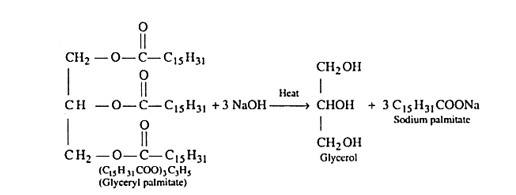
(ii) (C17H32COO)3C3H5 – Glyceryl oleate

New answer posted
a year agoContributor-Level 10
16.3
Diabetes mellitus is the third leading cause of death in the world. It is a medical condition in which the glucose is not consumed in the body due to inefficiency in the secretion of insulin [hormone which converts glucose to glycogen and store in liver]. Diabetes is the precursor for many other diseases like obesity, heart attacks, stroke etc.
Therefore Diabetic people are advised to consume low-calorie diet [fewer carbohydrates & more proteinaceous and fiber rich]. The refined sugar like sucrose adds calorie to the diet but complex sugar and starches do not add to the calorie intake of a person and at the same time impart a
New answer posted
a year agoContributor-Level 10
16.2
Basically drugs can be classified in a number of ways. For example classification on basis of their chemical structure, classification on the basis of their action etc.
In the above statement, the classification is based on the pharmacological effect of drugs on the human body.
Antacids refer to those class of drugs which relieve the acidity by either reacting with the excess acid in the stomach [eg – magnesium hydroxide] or by preventing the secretion of an excess of acids by the stomach cells [eg – ranitidine].
New answer posted
a year agoContributor-Level 10
16.1
Sleeping pills belong to tranquilizers class of drugs. Sleeping pills induce artificial sleep in people suffering from insomnia by depressing the activities of the central nervous system [brain and spinal cord].
When such drugs are taken for a prolonged time, such drugs can become addictive and the person can become addicted to such drugs and the aftereffects of such drugs are drowsiness, hallucinations, slow heart rate etc. and in extreme cases, the person can enter a state of coma and death can also take place.
Therefore it is highly recommended that sleeping pills should be administered to people suffering from insomnia but
Taking an Exam? Selecting a College?
Get authentic answers from experts, students and alumni that you won't find anywhere else
Sign Up on ShikshaOn Shiksha, get access to
- 67k Colleges
- 1.2k Exams
- 716k Reviews
- 1850k Answers