Get insights from 130 questions on Chemistry in Everyday Life, answered by students, alumni, and experts. You may also ask and answer any question you like about Chemistry in Everyday Life
130
Questions
0
Discussions
0
Active Users
0
Followers
Have a question about Chemistry in Everyday Life? Ask our experts
Ask Your Question
Keep it short & simple. Type complete word. Avoid abusive language.
This is a multiple choice answer as classified in NCERT Exemplar
(b) Artificial sweeteners are non-caloric substitutes for sugar. They are often intensely more sweet than sugar but do not enhance nutritional value of food. Vitamins and minerals are essential nutrients because they perform hundreds o
This is a multiple choice answer as classified in NCERT Exemplar
(c) Inhibitors are chemical substances which tend to reduce the activity of a particular enzyme. Generally, a weak bond such as H-bonding, van there Waals interaction, etc. is formed between the enzyme and the inhibitor.
This is a multiple choice answer as classified in NCERT Exemplar
(c) Drugs usually interact with biomolecules such as carbohydrates, lipids, proteins and nucleic acids. These are called drug targets. Vitamins are not a target molecule for drug function in body.
This is a multiple choice answer as classified in NCERT Exemplar
(c) Glycerol is added to shaving soap to prevent rapid drying while to enhance the leathering property of soap, a gum called rosin is added to them. It forms sodium rosinate which lathers well.
This is a multiple choice answer as classified in NCERT Exemplar
(b) Shaving soaps contain glycerol to prevent rapid drying. A gum called rosin is added in these soaps which forms sodium rosinate which enhances lathering property of soap.
This is a multiple choice answer as classified in NCERT Exemplar
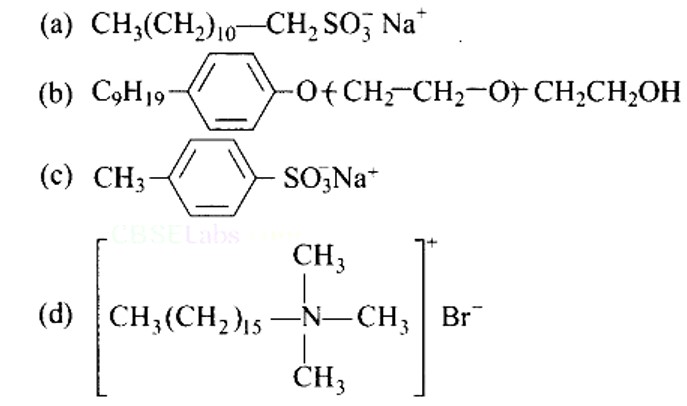
(d) All soaps are made by boiling fats or oils with suitable hydroxide. Variations are made by adding different raw materials. Sodium laurylsulphate and sodium dodecylbenzenesulphonate are anionic detergents.

 Upvote