
Chemistry in Everyday Life
Get insights from 130 questions on Chemistry in Everyday Life, answered by students, alumni, and experts. You may also ask and answer any question you like about Chemistry in Everyday Life
- 130
Questions
- 0
Discussions
- 0
Active Users
- 0
Followers
Have a question about Chemistry in Everyday Life? Ask our experts
Keep it short & simple. Type complete word. Avoid abusive language.
DDT, organophosphates and dieldrin are pesticides.
 Upvote

Which of the following compounds is an example of hypnotic drug?
Which of the following compounds is an example of hypnotic drug?
Drug used in the treatment of sleeping problems
Upvote The pair of herbicides is sodium chlorate and sodium arsinite
Upvote The mechanism of action of "Terfenadine" (Seldane) is :
The mechanism of action of "Terfenadine" (Seldane) is :
Sol. , cell reaction is reversed
i.e. anode
cathode
Upvote Match List I with List II
List I
List II
(Anion)
(gas evolved on reaction with dil H2SO4)
A.
CO32-
I.
Colourless gas which turns lead acetate paper black
B.
S2-
II.
Colourless gas which turns acidified potassium dichromate solution green
C.
SO32-
III.
Brown fumes which turns acidified Kl solution containing starch blue.
D.
NO2-
IV.
Colourless gas evolved with brisk effervescence, which turns lime water milky
Choose the correct answer from the option given below:
Match List I with List II
|
List I |
List II |
||
|
(Anion) |
(gas evolved on reaction with dil H2SO4) |
||
|
A. |
CO32- |
I. |
Colourless gas which turns lead acetate paper black |
|
B. |
S2- |
II. |
Colourless gas which turns acidified potassium dichromate solution green |
|
C. |
SO32- |
III. |
Brown fumes which turns acidified Kl solution containing starch blue.
|
|
D. |
NO2- |
IV. |
Colourless gas evolved with brisk effervescence, which turns lime water milky |
Choose the correct answer from the option given below:
A.
CO2 is colourless gas with brisk effervescence and turns lime water milky
B. &nb
Upvote Match List I with List II
List I List II
A. Antipyretic I. Reduces pain
B. Analgesic II. Reduces stress
C. Tranquilizer III. Reduces fever
D. Antacid IV. Reduces acidity (stomach)
Choose the correct answer from the options given below:
Match List I with List II
List I List II
A. Antipyretic I. Reduces pain
B. Analgesic II. Reduces stress
C. Tranquilizer III. Reduces fever
D. Antacid IV. Reduces acidity (stomach)
Choose the correct answer from the options given below:
A. Antipyretic reduces fever.
B. Analgesic reduces pain.
C. Tranquilizer reduces stress.
D. Antacid reduces acidity of stomach.
Upvote This is a short answer type question as classified in NCERT Exemplar
Medicines are used in diagnosis, prevention and treatment of diseases.
Upvote This is a short answer type question as classified in NCERT Exemplar
The average molecular mass of drugs is of the order of 100-500 u.
Upvote Which of the following statements are correct?
(a) Cationic detergents have germicidal properties.
(b) Bacteria can degrade the detergents containing highly branched chains.
(c) Some synthetic detergents can give foam even in ice cold water.
(d) Synthetic detergents are not soaps.
<!-- [if !supportLineBreakNewLine]-->
<!--[endif]-->
Which of the following statements are correct?
(a) Cationic detergents have germicidal properties.
(b) Bacteria can degrade the detergents containing highly branched chains.
(c) Some synthetic detergents can give foam even in ice cold water.
(d) Synthetic detergents are not soaps.
<!-- [if !supportLineBreakNewLine]-->
<!--[endif]-->
This is a multiple choice answer as classified in NCERT Exemplar
(a, c, d)
(a) Cationic detergents are quaternary ammonium salts of amines with acetates, chlorides or bromides as anions. These detergents have germicidal properties.
(b) Bacteria cannot degrade the detergents containing highly branche
Upvote Which of the following are anionic detergents?
(a) Sodium salts of sulphonated long chain alcohol.
(b) Ester of stearic acid and polyethylene glycol.
(c) Quaternary ammonium salt of amine with acetate ion.
(d) Sodium salts of sulphonated long chain hydrocarbons.
<!-- [if !supportLineBreakNewLine]-->
<!--[endif]-->
Which of the following are anionic detergents?
(a) Sodium salts of sulphonated long chain alcohol.
(b) Ester of stearic acid and polyethylene glycol.
(c) Quaternary ammonium salt of amine with acetate ion.
(d) Sodium salts of sulphonated long chain hydrocarbons.
<!-- [if !supportLineBreakNewLine]-->
<!--[endif]-->
This is a multiple choice answer as classified in NCERT Exemplar
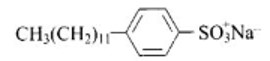
(a, d) Sodium salts of sulphonated long chain alcohol and sodium salts of sulphonated long chain hydrocarbons are anionic detergents e.g., Sodium laurylsulphate CH3 (CH2)10CH2OSO3– Na+ and sodium dodecylbenzene sulphonate.
 Upvote