

Chemistry
Get insights from 6.9k questions on Chemistry, answered by students, alumni, and experts. You may also ask and answer any question you like about Chemistry
Follow Ask QuestionQuestions
Discussions
Active Users
Followers
New answer posted
a year ago
Contributor-Level 9
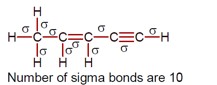
Number of sigma bonds are 10.
[Structure showing 10 sigma bonds in the molecule]
New answer posted
a year ago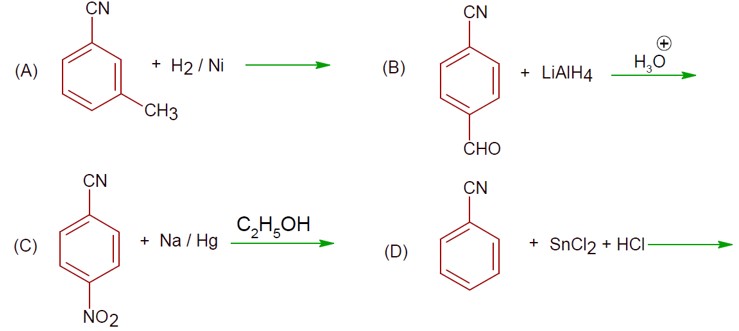
Contributor-Level 9
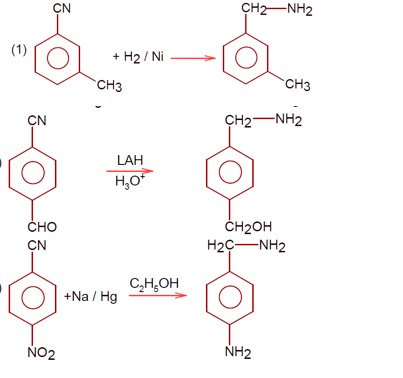
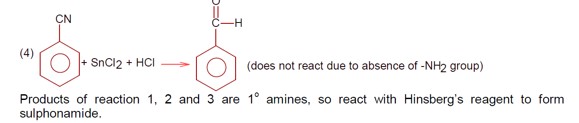
[Reactions showing reduction of various functional groups]
(1) Nitrile reduced to primary amine with H? /Ni.
(2) Nitrile and aldehyde reduced to primary amine and alcohol with LAH.
(3) Nitro group reduced to primary amine with Na/Hg, C? H? OH.
(4) Nitrile reduced to aldehyde with SnCl? /HCl.
Products of reaction 1, 2 and 3 are 1° amines, so react with Hinsberg's reagent to form sulphonamide. Product of (4) is an aldehyde, which does not react.
New answer posted
a year agoContributor-Level 9
Cl?C=CCl? is not used for dry cleaning of clothes due to safety purpose.
New answer posted
a year agoContributor-Level 10
H? O (l) → H? O (g)
ΔH° = ΔU° + ΔngRT
ΔH° - ΔU° = ΔngRT
= 1 * 8.31 * 373
= 3099.63 J/mol
= 30.9963 * 10² J/mol
≈ 31 * 10² J/mol
New answer posted
a year agoContributor-Level 10
Let volume of solution = x ml
So mass of solution = 1.2x
And mass of water = x gm
Mass of solute = 0.2x
Molality = (W_solute * 1000) / (M_solute * W_solvent) = (0.2x * 1000) / (40 * x) = 5 m
New answer posted
a year ago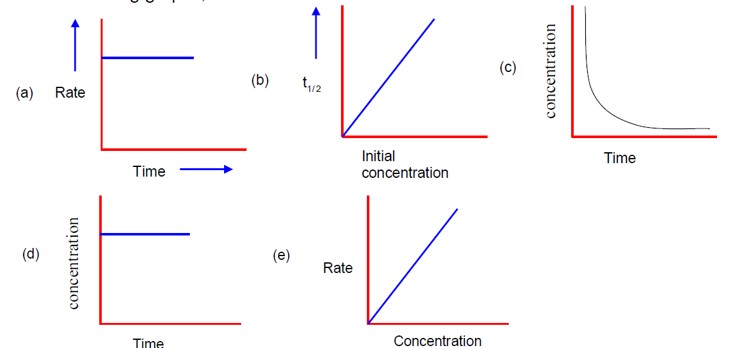
Contributor-Level 9
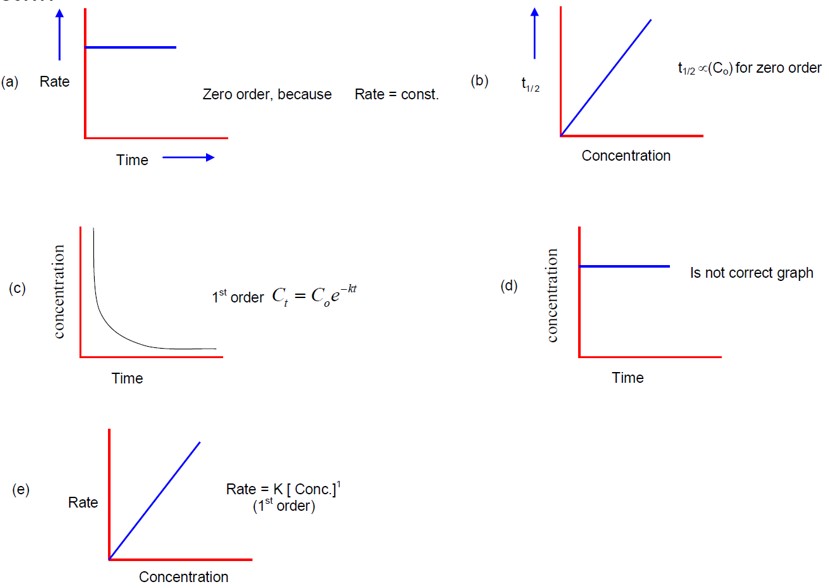
(a) Rate vs Time for zero order is a horizontal line (Rate = const.)
(b) t?/? vs Concentration for zero order is a straight line through the origin (t?/? ∝ [C?])
(c) Concentration vs Time for first order is an exponential decay (C? = C?e?)
(d) Concentration vs Time for a reaction is a decreasing curve, not a horizontal line.
(e) Rate vs Concentration for first order is a straight line through the origin (Rate = k[Conc.]¹)
New answer posted
a year agoContributor-Level 10
B.O. of CO = 3
B.O. of NO? = 3
Both are isoelectronic
So difference = 0
∴ x = 0
New answer posted
a year agoContributor-Level 10
PCl? (g)? PCl? (g) + Cl? (g); Kc = 1.844
t=0: 3, 0, 0
equilibrium: 3-x, x
Kc = x² / (3-x) = 1.844
x² + 1.844x - 5.532 = 0
x = (-1.844 + √ (1.844² - 4 (1) (-5.532)/2 = (-1.844 + √25.528)/2 ≈ 1.604
At equilibrium number of moles of PCl? = (3 - 1.604) = 1.396 mol
= 1396 * 10? ³ mol
New answer posted
a year agoContributor-Level 10
(x/m) = k (p)¹/? (1)
64 (x/m) = k (2p)¹/? (2)
From equation (1) and (2)
64 = 2¹/?
2? = 2¹/?
1/n = 6
n = 1/6
⇒ n = 0.167
= 16.7 * 10? ²
Taking an Exam? Selecting a College?
Get authentic answers from experts, students and alumni that you won't find anywhere else
Sign Up on ShikshaOn Shiksha, get access to
- 67k Colleges
- 1.2k Exams
- 716k Reviews
- 1850k Answers