

Chemistry
Get insights from 6.9k questions on Chemistry, answered by students, alumni, and experts. You may also ask and answer any question you like about Chemistry
Follow Ask QuestionQuestions
Discussions
Active Users
Followers
New answer posted
a year agoContributor-Level 10
Ba (OH)? ? Ba? ² + 2 (OH)?
Initial: 0.005M, 0, 0
Final: 0, 0.005, 0.010
[OH? ] = 0.01 M = 10? ² M
Kw = [H? ] [OH? ]
[H? ] or [H? O? ] = Kw/ [OH? ] = 10? ¹? /10? ² = 10? ¹² M
∴ [H? O? ] = 1 * 10? ¹² M
New answer posted
a year ago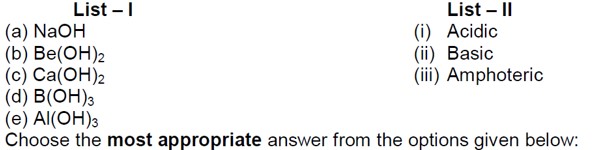
Contributor-Level 10
NaOH - Base
Be (OH)? - Amphoteric
Ca (OH)? - Base
B (OH)? - Acidic
Al (OH)? - Amphoteric
New answer posted
a year agoNumber of electrons present in 4f orbital of Ho³? ion is __________.
(Given atomic number of Ho = 67)
Contributor-Level 10
? Ho = [Xe] 4f¹¹ 6s²
∴ Ho? ³ = [Xe] 4f¹? 6s?
Number of electrons in 4f- subshell = 10
New answer posted
a year agoContributor-Level 9
When positive charge increases, ionic radii decreases in isoelectronic ions
Al?³ < Mg? < Na? < K?
New answer posted
a year agoContributor-Level 10
Δx . Δp = h/4π
Δx . mΔv = h/4π
Δv = 5 * 10? * 0.02/100 = 1000 m/s
∴ Δx = h/ (4πmΔv) = 6.63*10? ³? / (4*3.14*9.1*10? ³¹*1000)
= 5.8 * 10? m
= 58 * 10? m.
New answer posted
a year agoContributor-Level 10
CH? + I? CH? I + HI
It is reversible due to reducing nature of HI but it can be irreversible by addition of oxidizing agents like, HNO? , HIO? , HgO, etc. which will oxidize HI into I?
New answer posted
a year agoContributor-Level 10
P? = 300 kPa = 3 * 10? Pa = 3 bar
T? = 300 K
P? = 1.2 * 10? Pa = 12 * 10? Pa = 12 bar
T? =?
P? /T? = P? /T?
3/300 = 12/T?
T? = (12 * 300)/3 K = 1200 K
∴ T in °C = 1200 - 273 = 927°C
Taking an Exam? Selecting a College?
Get authentic answers from experts, students and alumni that you won't find anywhere else
Sign Up on ShikshaOn Shiksha, get access to
- 67k Colleges
- 1.2k Exams
- 716k Reviews
- 1850k Answers