

Chemistry
Get insights from 6.9k questions on Chemistry, answered by students, alumni, and experts. You may also ask and answer any question you like about Chemistry
Follow Ask QuestionQuestions
Discussions
Active Users
Followers
New answer posted
a year agoContributor-Level 10
This is a multiple choice answer as classified in NCERT Exemplar
Dihaloalkanes with two halogen atoms linked to the same carbon atom are known as gem-dihalides. Alkylidene halides are another name for them. The chemical ethylene dichloride is a vicinal dihalide, meaning that chlorine atoms are linked to neighbouring carbon atoms. There is only one chlorine atom in benzoyl chloride. According to the molecule's nomenclature, ethylidene chloride is a gem-dihalide. The IUPAC terminology for methylene chloride is dichloromethane. Two chlorine atoms are joined to a single carbon atom in this compound.
Correct Answer: Option (i) and (iii)
New answer posted
a year agoContributor-Level 10
This is a multiple choice answer as classified in NCERT Exemplar
Isomers are ethylene chloride ClCH2-CH2Cl and ethylidene dichloride CH3-CHCl2. Because the carbon atoms are not surrounded by distinct groups, neither molecule is optically active. When haloalkanes are treated with alcoholic KOH, they undergo an elimination process in which a hydrogen atom from the -carbon atom and a halogen atom from the -carbon atom are eliminated. To form the ethyne molecule, each of these chemicals lose hydrogen and chlorine atoms. When exposed to aqueous NaOH, the molecules undergo nucleophilic substitution, with the –Cl groups being replaced by -OH
New answer posted
a year agoContributor-Level 10
This is a multiple choice answer as classified in NCERT Exemplar
Option (i) and (iv) have a halogen atom linked to an sp3 hybridised carbon that is single-bonded to other groups. The other possibilities are sp2 hybridised because they are linked to carbon atoms, which are coupled to other groups in double bonds. Option I and (iv) are both correct.
Correct Answer: Option (i) and (iv)
New answer posted
a year agoContributor-Level 10
This is a multiple choice answer as classified in NCERT Exemplar
The reaction is of the type SN1 nucleophilic substitution. This sort of reaction is governed by second order kinetics, in which the rate of reaction is determined only by the concentration of the reactant. A reaction's molecularity is defined as the number of molecules involved in the rate-determining phase. Because of second order kinetics, the moleculeity of this reaction is one. (i) and (iii) are the right answers .
Correct Answer: Option (A) and (C)
New answer posted
a year ago
Contributor-Level 10
This is a multiple choice answer as classified in NCERT Exemplar
Because it is a tertiary alkyl halide, the described reaction is a nucleophilic substitution that follows the SN1 mechanism. It's a two-step process. The first step is the gradual breaking of a polarised C-Br bond, which results in the formation of a carbocation and a bromide ion. To complete the substitution, the stable intermediate carbocation is attacked by the nucleophile OH−. (i) and (iv) are the right statements.
Correct Answer: option (A) and (iv)
New answer posted
a year agoContributor-Level 10
This is a multiple choice answer as classified in NCERT Exemplar
Because the carbon atom is transiently linked to five atoms, the intermediate (iii) is less stable than reactant (ii), which is coupled to four groups.
New answer posted
a year agoContributor-Level 10
This is a multiple choice answer as classified in NCERT Exemplar
An SN2 reaction, also known as a nucleophilic substitution, is the reaction in question. The entering nucleophile causes the groups surrounding the carbon atom to migrate in the opposite direction of the nucleophile, causing the configuration of alkyl halides to invert. As a result, (b) and (d) will be in the opposite order. This reaction is also SN2 since there is just one phase in which OH- is added and Cl- is removed at the same time. (i) and (ii) are the right answers.
Correct Answer: Option (A) and (B)
New answer posted
a year ago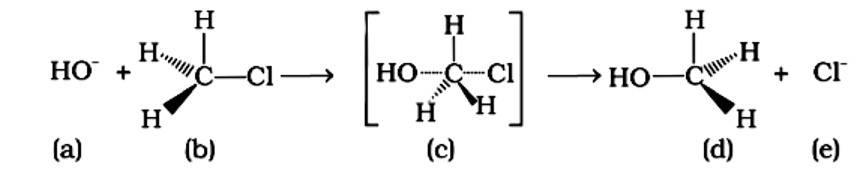
Contributor-Level 10
This is a multiple choice answer as classified in NCERT Exemplar
An SN2 nucleophilic substitution reaction occurs when CH3Cl interacts with the hydroxide ion to produce CH3OH. Both OH - and Cl - are nucleophiles with an excess of electrons in this reaction. Because the binding of OH - and the leaving of Cl - occurs simultaneously in the transition state (c), the carbon atom is linked to just three hydrogens. As a result, the carbon atom becomes sp2 hybridised. Aand (C) are the right statements.
Correct Answer: Option (A) and (C)
New answer posted
a year agoContributor-Level 10
This is a multiple choice answer as classified in NCERT Exemplar
The Correct Answer is Option (iv).
If the halogen atom in all of the supplied alkyl halides is the same kind, the boiling point of a compound rises as the number of alkyl groups added increases. As the quantity and size of molecules and electrons grow, so do their attractions. As a result, the greater the boiling point, the larger the molecular weight of the alkyl halide. The boiling points of the following compounds are listed in ascending order: 1-Bromoethane 1-Bromopropane 1-Bromobutane Bromobenzene The right answer is (iv).
New answer posted
a year agoContributor-Level 10
This is a multiple choice answer as classified in NCERT Exemplar
The Correct Answer is Option (i).
The intermolecular force of attraction will grow as the surface area increases. As a result, the boiling point rises as well. The boiling point of a comparable alkyl halide rises with increasing molecular mass. Iodine has the greatest atomic mass. As a result, 1-iodobutane has the greatest boiling point.
Taking an Exam? Selecting a College?
Get authentic answers from experts, students and alumni that you won't find anywhere else
Sign Up on ShikshaOn Shiksha, get access to
- 67k Colleges
- 1.2k Exams
- 717k Reviews
- 1850k Answers