

Chemistry
Get insights from 6.9k questions on Chemistry, answered by students, alumni, and experts. You may also ask and answer any question you like about Chemistry
Follow Ask QuestionQuestions
Discussions
Active Users
Followers
New answer posted
a year agoContributor-Level 10
Analysis shows that nickel oxide has the formula Ni0.98 O1.00. What fractions of nickel exist as Ni2+ and Ni3+ ions?
1.40 It is given that nickel oxide has the formula as Ni0.98 O1.00.
As per the formula, there are 98 Ni ions for 100 oxide ions.
Out of 98 Ni ions, let x ions be in +2 oxidation state
98−x ions will be in +3 oxidation state.
Oxide ion has −2 charge.
To maintain electrical neutrality, total positive charge on cations = total negative charge on anions.
2x+3(98−x)+100(−2)=0
x=94
Fraction of Ni2+ ions = 94/98 = 0.96
Fraction of Ni2+ ions = 98-94/98 = 0.04
Hence, the fractions of nickel that exists as Ni2+ and Ni3+ are 0.
New answer posted
a year agoContributor-Level 10
Analysis shows that nickel oxide has the formula Ni0.98 O1.00. What fractions of nickel exist as Ni2+ and Ni3+ ions?
1.41 It is given that nickel oxide has the formula as Ni0.98 O1.00.
As per the formula, there are 98 Ni ions for 100 oxide ions.
Out of 98 Ni ions, let x ions be in +2 oxidation state
98? x ions will be in +3 oxidation state.
Oxide ion has ?2 charge.
To maintain electrical neutrality, total positive charge on cations = total negative charge on anions.
2x+3 (98? x)+100 (?2)=0
x=94
Fraction of Ni2+ ions = 94/98 = 0.96
Fraction of Ni2+ ions = 98-94/98 = 0.04
Hence, the fractions of nickel that exists as Ni2+ and Ni3+ are 0.96 a
New question posted
a year agoNew answer posted
a year agoContributor-Level 10
1.38 We apply pythagoras theorem AC2= AB2+ BC2
(2R)2= (R+r)2 +(R+r)2 = 2(R+r)2
4R2 = 2(R+r)2
(2R)2= (R+r)2
√2(R)2= √(R+r)2 = √2r = R+r
r = √2 R – R
r = (√2-1) R
r = (1.4114-1)R
r= 0.414 R
New answer posted
a year agoContributor-Level 10
1.37 Calculation of edge length of unit cell(a)
Atomic mass of the element (M)= 93g mol−1
Number of particles in bcc type unit cell (Z) = 2
Mass of the unit cell = Z * MNA = 2 * (93 g mol−1) (6.022*1023mol−1)
=30.89*10−23g
Density of unit cell (d) =8.55 g cm−3
Volume of unit cell (a3)=Mass of unit cell
Density of unit cell=(30.89*10−23g)(8.55 g cm−3)
=36.16*10−24cm3
Edge length of unit cell (a) = (36.13*10−24cm3)13
=3.31 * 10−8cm
Step II: Calculation of radius of unit cell (r)
For bcc structure, r=√3a4
=√3*(3.31*10−8cm)4
=1.43*10−8cm
New answer posted
a year agoContributor-Level 10
(a) Eutrophication: When the growth of algae increases in the surface of water, dissolved oxygen in water is reduced. This phenomenon is known as eutrophication. (Due to this growth of fish gets inhibited).
(b) Pneumoconiosis: It is a disease which irritates lungs. It causes scarring or fibrosis of the lung.
(c) Photochemical smog: Photochemical smog is formed as a result of the photochemical decomposition of nitrogen dioxide and chemical reactions involving hydrocarbons. It takes place during dry warm season in the presence of sunlight. It is oxidising in nature.
(d) C
New answer posted
a year agoContributor-Level 10
1.36 It is given that the atoms of Q are present at the corners of the cube.
Therefore, number of atoms of Q in one unit cell = 8 x 1/8 = 1
It is also given that the atoms of P are present at the body-centre.
Therefore, number of atoms of P in one unit cell = 1
This means that the ratio of the number of P atoms to the number of Q atoms, P:Q = 1:1
Hence, the formula of the compound is PQ.
The coordination number of both P and Q is 8.
New answer posted
a year agoContributor-Level 10
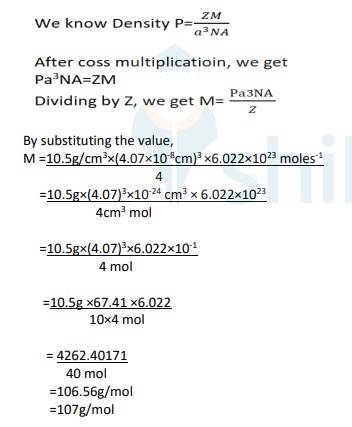
1.35 P= density
A= edge length of the cell
NA= Avogadro Number
Z= no. of atoms in F.C.C unit cell
M= mass of the metal
Edge length of the cell = d = 4.07*10-8 cm
Density = P =10.5g/cm3
No. of unit cell of face centered cubic (F.C.C) lattice is 4, Z=4
Avogadro Number (NA) = 6.022*1023
Mass of silver = M=?
New answer posted
a year agoContributor-Level 10
A Toxic substance that is used to kill insects is called an insecticide. For example: DDT, BHC.
Taking an Exam? Selecting a College?
Get authentic answers from experts, students and alumni that you won't find anywhere else
Sign Up on ShikshaOn Shiksha, get access to
- 67k Colleges
- 1.2k Exams
- 718k Reviews
- 1850k Answers