

Chemistry
Get insights from 6.9k questions on Chemistry, answered by students, alumni, and experts. You may also ask and answer any question you like about Chemistry
Follow Ask QuestionQuestions
Discussions
Active Users
Followers
New answer posted
a year agoContributor-Level 10
Branching of carbon atom chain decreases the boiling point of alkane.
New question posted
a year ago
New answer posted
a year agoContributor-Level 10
3.42. (a) Elements of the same group have similar valence shell electronic configuration and, therefore, exhibit similar chemical properties. However, the elements of the same period have an incrementally increasing number of electrons from left to right, and, therefore, have different valences.
New answer posted
a year agoContributor-Level 10
Schottky defect: Schottky defect is basically a vacancy defect shown by ionic solids. In this defect, an equal number of cations and anions are missing to maintain electrical neutrality. It decreases the density of a substance. Significant number of Schottky defects is present in ionic solids. For example, in NaCl, there are approximately 106 Schottky pairs per cm3 at room temperature. Ionic substances containing similar-sized cations and anions show this type of defect. For example: NaCl, KCl, CsCl, AgBr, etc.
Frenkel defect: Ionic solids containing large differences in the sizes of ions show this type of defect. When the smaller ion (
New answer posted
a year agoContributor-Level 10
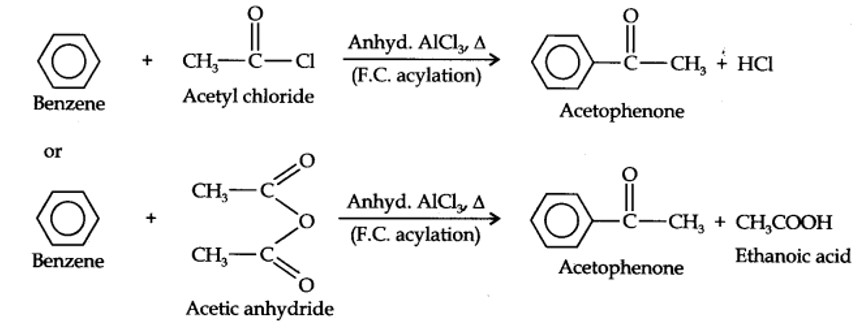
(i) The two substituents in the benzene ring are present at p-positions. Therefore, the sequence of reactions should be such that first an o, p-directing group, i.e., Br atom should be introduced in the benzene ring and this should be followed by nitration. Thus,


New question posted
a year agoNew answer posted
a year ago
Contributor-Level 10

planar. It does contain six n-electrons but the system is not fully conjugated since all the six n-electrons do not form a single cyclic electron cloud which surrounds all the atoms of the ring. Therefore, it is not an aromatic compound.

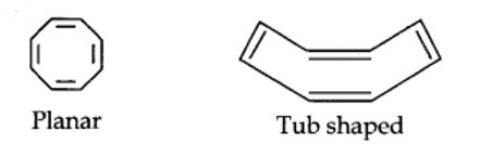
Cyclo-octatetraene is not planar but is tub shaped. It is, therefore, a non-planar system
New answer posted
a year agoContributor-Level 10
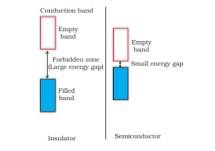
1.47 The energy gap between the valence band and conduction band in an insulator is very large while in a conductor, the energy gap is very small or there is overlapping between valence band and conduction band.
(ii) In a conductor, the valence band is practically filled or there is overlapping between valence band and conduction band while in semiconductor, there is always a small energy gap between them.
New question posted
a year agoTaking an Exam? Selecting a College?
Get authentic answers from experts, students and alumni that you won't find anywhere else
Sign Up on ShikshaOn Shiksha, get access to
- 67k Colleges
- 1.2k Exams
- 718k Reviews
- 1850k Answers