

Class 11th
Get insights from 8k questions on Class 11th, answered by students, alumni, and experts. You may also ask and answer any question you like about Class 11th
Follow Ask QuestionQuestions
Discussions
Active Users
Followers
New answer posted
a year agoContributor-Level 10
This is a Short Answer type Questions as classified in NCERT Exemplar
Explantion - given mass of the body = 2kg
Velocity of the body = 2t? +t2?
Velocity of body at t=2s
V= 2 ? +22? = 4? +4?
Momentum of body =mv = 2 (4? +4? )= 8? +8? kgm/s
Acceleration a= dv/dt
= d/dt (2t? +t2? )= 2? +2t?
At t=2s, a= (2i+2 (2)j)= 2? +4?
Force acting on the body F=ma
=2 (2? +4? )
= 4? +8? N
New answer posted
a year agoContributor-Level 10
This is a Short Answer type Questions as classified in NCERT Exemplar
Explanation- when a person driving car suddenly applies brakes the lower comes to rest but the upper part of the body will remain in motion. so if the driver not wearing seat belt will falls forward and his head hit against the steering wheel.
New answer posted
a year ago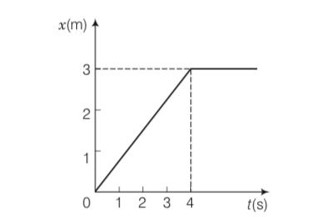
Contributor-Level 10
This is a Short Answer type Questions as classified in NCERT Exemplar
Explanation- mass of body =2kg
From the above graph the body at x=0 when t=0 so body at rest.
So impulse is also zero.
From t=0s to t=4s graph becomes straight line which shows body is at uniform velocity
Beyond 4s graph is parallel to time axis, body is at rest
So tan =3/4
Impulse at t=4s= change in momentum= mv-mu
=m (v-u)
= 2 (0-3/4)= -3/2kgm/s
New answer posted
a year agoContributor-Level 10
This is a Short Answer type Questions as classified in NCERT Exemplar
Explanation – w'=R=m (g-a)
Mass of person =50kg
Descending acceleration= 9m/s2
Acceleration due to gravity g= 10m/s2
Apparent weight of person R= m (g-a)
= 50 (10-9)=50N
Reading in weighing scale = 50/10 =5kg
New answer posted
a year agoContributor-Level 10
This is a Short Answer type Questions as classified in NCERT Exemplar
explanation-total mass of bicycle and stone =m1=50+0.5= 50.5kg
Velocity of bicycle u1= 5m/s mass of stone m2= 0.5kg
Velocity of stone u2= 15m/s mass of girl and bicycle m= 50kg
Also the speed of bicycle change when stone is thrown
According to conservation of linear momentum
m1u1=m2u2+mv
50.5 (5)= 0.5 (15)+50 (v)
V= 4.9m/s
Change in speed 5-4.9= 0.1m/s
New answer posted
a year agoContributor-Level 10
This is a Multiple Choice Questions type Questions as classified in NCERT Exemplar
Answer- a, c
Explanation – mass m= 10kg
F1 =6N, F2= 8N

Resultant force F=
a=f/m= 10/10= 1m/s2
let 1 be the angle between R and F1
tan 1=8/6=4/3
1= tan 1 (4/3) w.r.t F1=6N
let 2 be the angle between F and F2
tan 1=8/6=4/3
2= tan 2 (4/3) w.r.t F2=8N
New answer posted
a year agoContributor-Level 10
This is a Multiple Choice Questions type Questions as classified in NCERT Exemplar
Answer- c, d
Explanation – m1=m2 = 50g= 1/20kg
Initial velocity u1=u2= 5m/s
Final velocity v1=v2= -5m/s
Time duration = 10-3s
Change in linear 1momentum = m (v-u)= 1/20 (-5-5)=-0.5N-s
Force = impulse /time=0.5/10-3= 500N
So impulse and force are opposite in directions.
New answer posted
a year ago
Contributor-Level 10
This is a Multiple Choice Questions type Questions as classified in NCERT Exemplar
Answer- b, c
Explanation- when A starts moving up
Mgsin

mgsin + =
When A moves downward f= mgsin so clearly
New answer posted
a year ago
Contributor-Level 10
This is a Multiple Choice Questions type Questions as classified in NCERT Exemplar
Answer- b, d
Explanation – as we know f =

For system m1+m2 to move up
So m2g- (m1gsin )>0
So m2g- (m1gsin )>0
So m2>m1 (sin )
But if bodies moves downward
m1gsin 2g
m1gsin> m2g
m2
New answer posted
a year ago
Contributor-Level 10
This is a Multiple Choice Questions type Questions as classified in NCERT Exemplar
Answer- a, b, d, e
Explanation- suppose A and B are moving together acommon=
Pseudo force = mA (acommon)= =

Force will be maximum when pseudo force and frictional force are equal to one another
=
= 0.2
Fmax= 0.3mg+f1
= 0.3mg+0.1 (3/2)mg= 0.45mg
(a) for F=0.25mg
(b) for F=0.5mg>Fmax body A will slip with respect to B
(c) for F=0.5mg>Fmax bodies will slip
Taking an Exam? Selecting a College?
Get authentic answers from experts, students and alumni that you won't find anywhere else
Sign Up on ShikshaOn Shiksha, get access to
- 67k Colleges
- 1.2k Exams
- 718k Reviews
- 1850k Answers