

Class 11th
Get insights from 8k questions on Class 11th, answered by students, alumni, and experts. You may also ask and answer any question you like about Class 11th
Follow Ask QuestionQuestions
Discussions
Active Users
Followers
New answer posted
a year agoContributor-Level 10
This is a Multiple Choice Questions as classified in NCERT Exemplar
Answer- b
Explanation – we know that impulse J= f. = , where F is force . is time duration and is change in momentum. As is a vector quantity, hence impulse is also a vector quantity. Sometimes area can also be treated as vector.
New answer posted
a year agoContributor-Level 10
This is a Multiple Choice Questions as classified in NCERT Exemplar
Answer- c
Explanation - we know that =150 and R= 50m
Range, R=
50 =
So u2= 980

So u = m/s
So u= 14 = 31.304m/s
= 450, R=
R= = =
New answer posted
a year agoContributor-Level 10
This is a Multiple Choice Questions as classified in NCERT Exemplar
Answer- b
Explanation – ler r makes an angle with positive x axis component if r along x-axis.
So rx= |r|cos
(rx)maximum= |r| (cos )maximum
= |r|cos = r
=00
R is along positive x-axis.
New answer posted
a year agoContributor-Level 10
This is a Multiple Choice Questions as classified in NCERT Exemplar
Answer- b

Explanation – u= a? + b? as u in the first quadrant, hence both components a and b will be positive. For v= p? + q? , as it is positive x direction and located downward hence x component p will be positive and y component q will be negative.
New answer posted
a year agoContributor-Level 10
This is a Multiple Choice Questions as classified in NCERT Exemplar
Answer- d
Explanation- a scalar quantity is independent of direction hence has the same value for observers with different orientations of the axes.
New answer posted
a year agoContributor-Level 10
This is a Multiple Choice Questions as classified in NCERT Exemplar
Answer- b
Explanation-A = i+j
B = i-j
A.B=|A|B|cos
(? +? ). (? -? ) = cos
Where is the angle between A and B
Cos = =
= 90o
New answer posted
a year ago
Contributor-Level 10
This is a Short Answer Type Question as classified in NCERT Exemplar
Explanation- given |A|=2 and |B|=4
a)|A |=AB cos = 0
so 2 cos =0
so so it matches with ii
B) |A B|= ABcos =8
2 cos =8
So = 0 so it matches with option i
c) |A B|= ABcos =4
so =60 so it matches with option iv
d) |A B|= ABcos =-8
so =180 so it matches with option iii
New answer posted
a year ago
Contributor-Level 10
This is a Short Answer Type Question as classified in NCERT Exemplar
Explanation- given |A|=2 and |B|=4
a)|A |=AB sin = 0
so 2 sin =0
so so it matches with iv
B) |A B|= ABsin =8
2 sin =8
So = 90 so it matches with option iii
c) |A B|= ABsin =4
so =30 so it matches with option i
d) |A B|= ABsin =4
so =45 so it matches with option ii
New answer posted
a year ago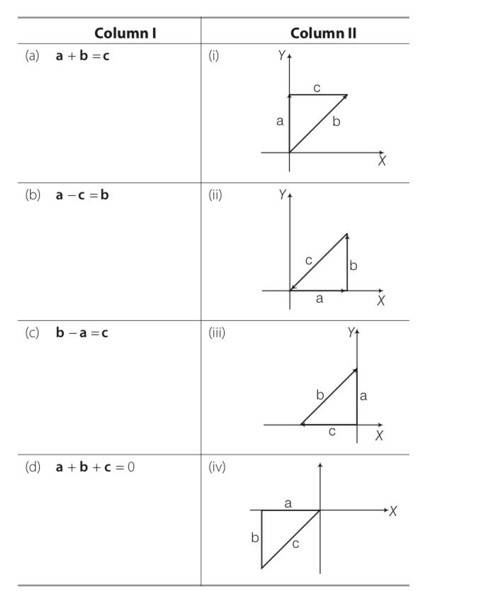
Contributor-Level 10
Explanation – here A and B vectors are joint by head and tail. So C= A+B
(a) from fig iv it is clear that c=a+b

(a) from fig iii it is clear that c+b=a so a-c=b
(b) from fig I it is clear that b=a+c so b-a =c
(c) from ii it is clear that -c= a+b so a+b+c=0
New answer posted
a year agoContributor-Level 10
This is a Short Answer Type Question as classified in NCERT Exemplar
Explanation – a) radius of earth =6400km= 6.4
Time period = 1 day = 24 = 86400s
Centripetal acceleration a= w2r= R(2 )2=4 2R/T
= = 0.034m/s2
b) time = 1yr=365 days= 365=3.15
centripetal acceleration = Rw2=
2
Taking an Exam? Selecting a College?
Get authentic answers from experts, students and alumni that you won't find anywhere else
Sign Up on ShikshaOn Shiksha, get access to
- 67k Colleges
- 1.2k Exams
- 718k Reviews
- 1850k Answers