

Class 11th
Get insights from 8k questions on Class 11th, answered by students, alumni, and experts. You may also ask and answer any question you like about Class 11th
Follow Ask QuestionQuestions
Discussions
Active Users
Followers
New answer posted
a year agoContributor-Level 10
This is a Long Answer Type Questions as classified in NCERT Exemplar
The volume of HCl solution is 250 mL and its molarity is 0.76M.
The number of moles of HCl as follows,
Moles of HCl Molarity Volume (in L)
= 0.76M 0.250 L
= 0.19 mol
The molar mass of CaCO3 is 100 g / gQl and the mass of CaCO3 is given as 1000 g
The number of moles of CaCO3 is calculated as
Moles of CaCO3 = M a s / M o l a r m a s
= 1000 g / 100 g / m o l = 10 mol
According to the given reaction, 1 mole of CaCO3 requires 2 moles of HCl. So, the required number of moles of HCl for 10
New answer posted
a year agoContributor-Level 10
This is a Short Answer Type Questions as classified in NCERT Exemplar
Ans: We know that
λ= c/υ Given,
υ = 4.620 * 1014 Hz
Thus, λ= c/υ = (3.0 * 108 m/s)/ (4.620*1014 Hz) = 649.4nm
This frequency falls under visible range
New answer posted
a year ago
Contributor-Level 10
This is a Short Answer Type Questions as classified in NCERT Exemplar
Ans: The wavelength is defined as the distance between two consecutive crests or troughs of a wave, and it is denoted by l .
l = 4*2.16 pm = 8.64 pm
New answer posted
a year agoContributor-Level 10
This is a Short Answer Type Questions as classified in NCERT Exemplar
Ans: We have
λ = h/mv
Thus, the equation signifies that in order to have the same wavelength the electron should have higher velocity as the mass of the proton is higher than that of the electron
New answer posted
a year agoContributor-Level 10
This is a Long Answer Type Questions as classified in NCERT Exemplar
P1=1 atm
P2= 1/2=0.5 atm
T1=273.15 K
V2=?
V1=?
32 g dioxygen occupies = 22.4 L volume at STP
∴ 1.6 g dioxygen will occupy = 22.4L x 1.6g / 32g = 1.12 L
V1=1.12 L
From Boyle's law (as temperature is constant)
p1V1=p2V2
V2=p1V1p2
= 1 atm x 1.12 l/0.6 atm g = 2.24 L
(ii) Number of molecules of dioxygen.
New answer posted
a year agoContributor-Level 10
This is a Short Answer Type Questions as classified in NCERT Exemplar
Ans: The line spectrum associated with any element possesses lines corresponding to specific wavelengths and these lines are obtained as a result of electronic transitions between the energy levels. Hence, the electrons in these levels have fixed energy i.e., quantized values.
New answer posted
a year agoContributor-Level 10
This is a Short Answer Type Questions as classified in NCERT Exemplar
Ans: As per de Broglie, every object in motion has a wave character i.e. every object/matter have dual nature both particle and wave nature. But the wavelengths associated with ordinary objects are so short (because of their large masses) that their wave properties cannot be detected.
Given, m (mass) = 100g, v=100km/hr
We have
λ = h/mv= 238.5 * 10-34 m
As the wavelength associated with the cricket ball is so small that it can't be detected.
New answer posted
a year agoContributor-Level 10
This is a Short Answer Type Questions as classified in NCERT Exemplar
Ans: We have V = 109677 [1/ni 2 - 1/nf 2 ] cm-1
Given, ni = 2, nf=4
V =109677 [1/4 - 1/16] = 20564.44 cm-1
New answer posted
a year agoContributor-Level 10
This is a Short Answer Type Questions as classified in NCERT Exemplar
Ans: As per the Hund's rule the half filled and fully filled orbital leads to the extra stability due to the symmetry thus fully filled 3d and half filled 4s is preferred.
New answer posted
a year agoContributor-Level 10
This is a Short Answer Type Questions as classified in NCERT Exemplar
Ans:
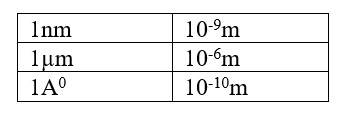
We know that energy is inversely proportional to the wavelength

Thus, the increasing order of energy is B
Taking an Exam? Selecting a College?
Get authentic answers from experts, students and alumni that you won't find anywhere else
Sign Up on ShikshaOn Shiksha, get access to
- 67k Colleges
- 1.2k Exams
- 718k Reviews
- 1850k Answers